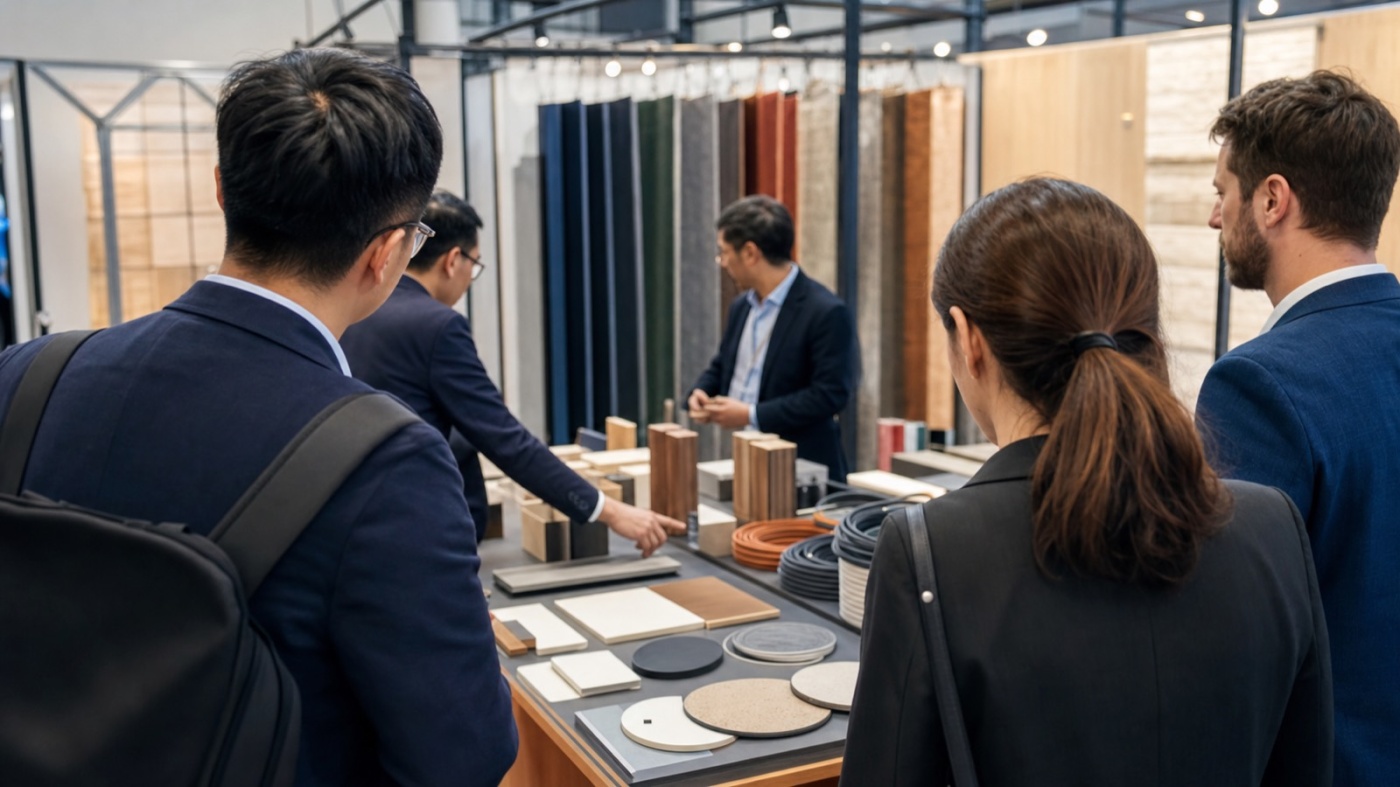
Every two years the Düsseldorf exhibition centre becomes the meeting point of the wire and cable industry. wire runs in parallel with Tube, the international tube and pipe trade fair, and gathers exhibitors from dozens of countries. On a stage this international, language planning helps decide how many technical conversations a show week produces.
A show week of wire and cable for a global audience
wire occupies a large connected block of halls, with Tube in the halls ahead of it. Recent editions added World of Cables as a dedicated area for finished cable products. Messe Düsseldorf publishes the exact allocation for each edition, and the years up to 2032 are listed in our trade fair calendar.
Walking these halls you meet machine builders, material producers, cable works, trading houses and testing service providers. Many exhibitors arrive within national and joint pavilions, and the visitor field is mixed accordingly: purchasing, plant management, engineering, sales agents and entire delegations. Decisions on capital equipment mature across several conversations and among several people. Your stand exists to make those conversations easy to join for everyone involved.
Signage that reads in seconds
The aisle is busy, loud and fast. In that setting the top layer of signage carries the weight, and it works best almost without language: product category, material and application as a large figure, a clear pictogram or an unmistakable exhibit. Company name large, message beneath it short.
English takes the lead on the stand, German sits alongside it, and further languages appear precisely where your target markets are. Keep text volumes deliberately lean, because translations often need more room than the original and the same surface has to carry them all. Choose typefaces that render Cyrillic, Arabic and Chinese characters cleanly, and stay generous with type sizes and contrast. At a fair where many visitors read in their second or third language, legibility works like an invitation.
Units and standards: the quiet translation work
A data sheet in millimetres reads differently in North America than in Europe. Give diameters in metric and imperial, add the wire gauge that is common in your target market, and state tensile values in both systems. The same applies to standards: naming the internationally common equivalent alongside the European standard saves your counterpart a research step and signals preparation.
On the stand this has elegant solutions. A conversion table designed as a graphic element, exhibit labels carrying both values, a tablet where the unit switches at a tap. Details like these look minor and often decide whether a conversation turns technical or stays polite.
Documents visitors actually take home
Paper travels poorly across continents. QR codes at the exhibit that lead to a data sheet in the right language work far better, with a language selector on the landing page and a language code in the file name. The literature stock on the stand stays lean while the information stays complete.
Lead capture rewards care. With explicit consent, record the preferred language and the time zone alongside the contact details. Your follow up then arrives in the visitor's language and at an hour when they are at their desk. Those two fields cost three seconds in conversation and lift response rates noticeably after the show.
Hospitality tuned to delegations
International visitors often arrive as a group. Plan for parties of three to eight people who decide together: a generous table, enough seating, a screened area for longer negotiations. At wire, a room like that returns more than another display case.
Catering needs only a few considerations for a large effect. Tea, water and coffee stand ready, soft drinks are a given, and vegetarian and halal friendly options round out any food on offer. Name badges carry first and family names in Latin script, the stand team offers business cards with both hands, and an interpreter is on hand for important meetings. Our project references from industrial clients show how zones like these come together in space.
A simple language plan for the team helps as well: who speaks which language, who covers which region, who stands by the aisle on day one. A small flag on the name badge makes that visible to visitors and opens conversations faster than any greeting line.
What your stand language leaves behind
After a full show week visitors remember a handful of things: an exhibit they were allowed to touch, a figure they understood at once, and a conversation in which they felt welcome. A multilingual presence at wire therefore means less about translating everything and more about making the essentials readable for everyone.
If you are planning your appearance in Düsseldorf, an early look at signage, units, documents and meeting zones pays off. We are glad to develop this part with you before the first design draft exists: a short enquiry is all it takes.