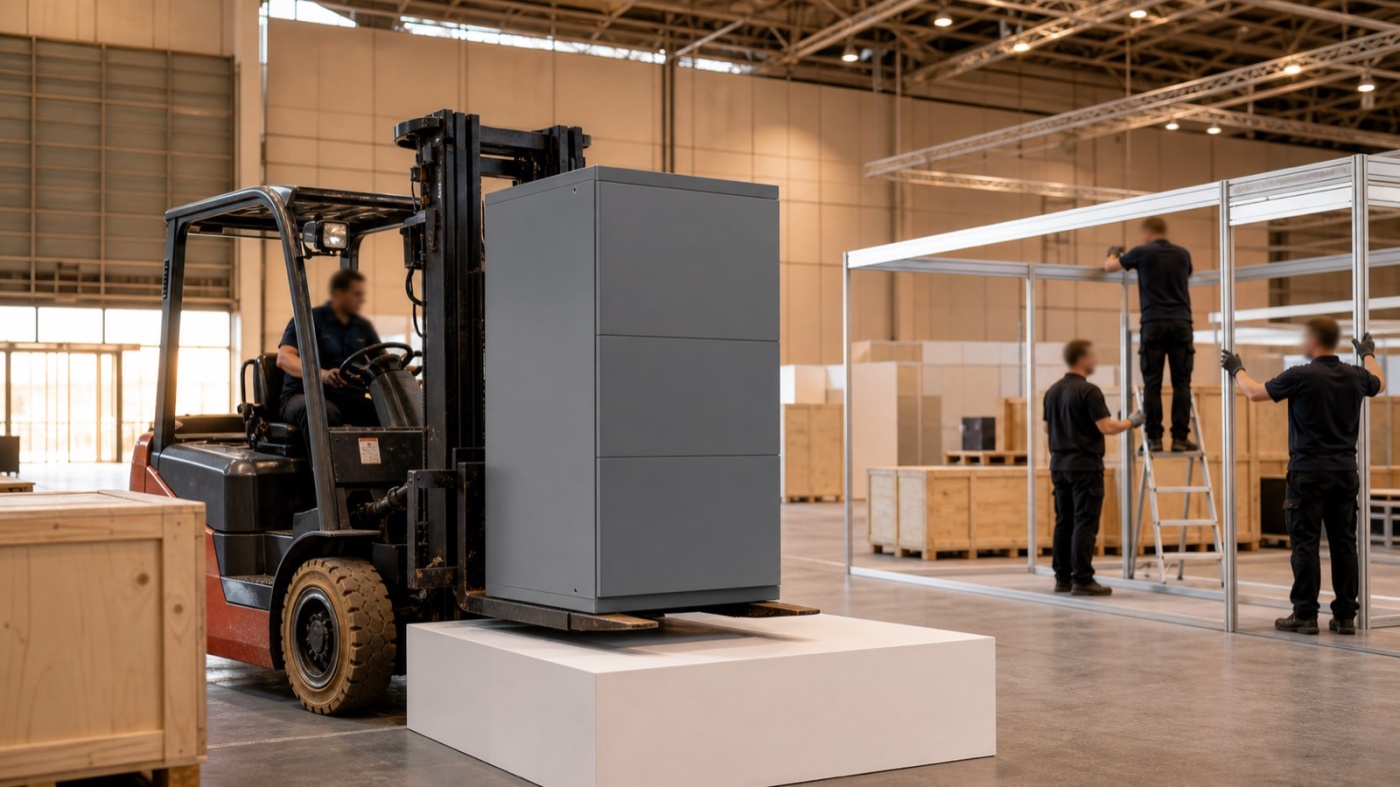
Four trade fairs under one roof, every June, with battery storage systems, inverters, charging stations and complete energy systems as exhibits: The smarter E Europe is one of those events where build-up becomes a project of its own. Plan deliveries, time slots and lifting equipment early, and you buy yourself exactly the calm that pays off on the final day before opening.
Four fairs on one site set the pace
Under the umbrella of The smarter E Europe run Intersolar Europe for the solar industry, ees Europe for batteries and storage systems, Power2Drive Europe for charging infrastructure and e-mobility, and EM-Power Europe for energy management and integrated energy solutions. All four occupy the Messe München grounds together in June, halls and outdoor areas alike.
This bundling creates a build-up density that belongs in your planning from day one. In the same week, stand builders, freight forwarders and technical service providers arrive for four fairs at once, in many cases with very heavy exhibits. Every hour spent waiting in the loading yard is an hour missing at the stand later. Binding build-up times, hall allocations and access rules are published in the traffic guide and exhibitor documents for each edition.
Access and time slots: the route through the traffic management system
Messe München controls deliveries through a traffic management system with online time slot booking. Longer vehicles require a booking during the periods listed in the traffic guide, together with a check-in before entering the site and a limited dwell time on the grounds. Available bays in the loading yard are reported to the driver as soon as the window opens.
Three things follow for your schedule. First, the time slot booking belongs in the same calendar as stand construction, with a buffer for travel and handling. Second, it pays to combine several small deliveries into one consolidated load, because every additional vehicle ties up a separate window. Third, the loading order in the truck should mirror the build-up order at the stand: floor and substructure first, graphics and dressing last.
A stand builder with an in-house fleet holds a practical advantage here, because loading, drivers and the assembly team follow one and the same schedule. Our page on renting an exhibition stand shows how logistics and assembly fit into the modules.
Heavy exhibits deserve a plan of their own
Few industries put so much weight on the floor. Battery cabinets, large inverters, transformer stations and charging pillars quickly reach dimensions where the point load of the hall floor becomes a planning parameter. Permitted values per hall are stated in the technical regulations of Messe München.
Several steps follow, all of them well before build-up:
- Settle load distribution. Heavy exhibits receive load spreading plates or a reinforced substructure. Their position in the layout then follows structural logic as much as visual appeal.
- Order lifting equipment. Forklift and crane services on the exhibition grounds run through the appointed fair forwarder. Book these services with a fixed time rather than improvising on site.
- Arrange empties handling. Transport frames, pallets and crates move into a managed empties store for the duration of the show. That order belongs in the schedule too.
- Register connections. Heavy current for converters and charging points, plus data connectivity: these orders go directly to the organiser and carry their own deadlines.
The build-up sequence at the stand
A build-up thought through from the ground upwards saves the most stress.
The floor comes first, for charging infrastructure often as a platform with protected cable routing. Substructure and load bearing elements follow, then the heavy exhibits move in while the area is still freely accessible. Only afterwards do wall panels, system frames and ceiling elements close the stand. Rigging and truss work runs through the organiser and needs an early appointment, because rigging teams work hall by hall.
Fabric graphics, printed panels, lighting and media technology come last, followed by electrical inspection, fine cleaning and a functional test of the exhibits. A modular system build shows its strength in this rhythm: tool free frames shorten pure assembly time noticeably and create buffer for the technology.
Outdoor areas bring their own rules
Part of the exhibitors present outdoors, for example storage containers, charging parks or vehicles. There the starting point changes: the surface is asphalt rather than hall floor, ballast replaces anchoring, and wind loads enter the structural calculation. Outdoor structures therefore usually call for proof of stability and early coordination with the exhibition company.
Weather is part of logistics as well. Sensitive electronics travel better in weatherproof cases, graphics go up in dry conditions, and a roofed meeting zone works in June against sunshine and showers alike.
Because this industry stands for circularity and resource efficiency in its own right, a reusable stand architecture pays in twice here: credible in content, lean in logistics. More on that on our page about sustainable exhibition stands.
A calm final build-up day as the planning goal
The best measure of sound stand logistics is the evening before the opening: stand finished, exhibits running, team relaxed at the briefing. Few steps lead there, but they hold consistently: time slots booked early, a loading order that mirrors the build-up logic, lifting equipment ordered in advance, and a system stand that assembles quickly.
If you are preparing your appearance in Munich, we are happy to walk through the whole sequence with you, from delivery to handover. A short enquiry is the easiest way in.