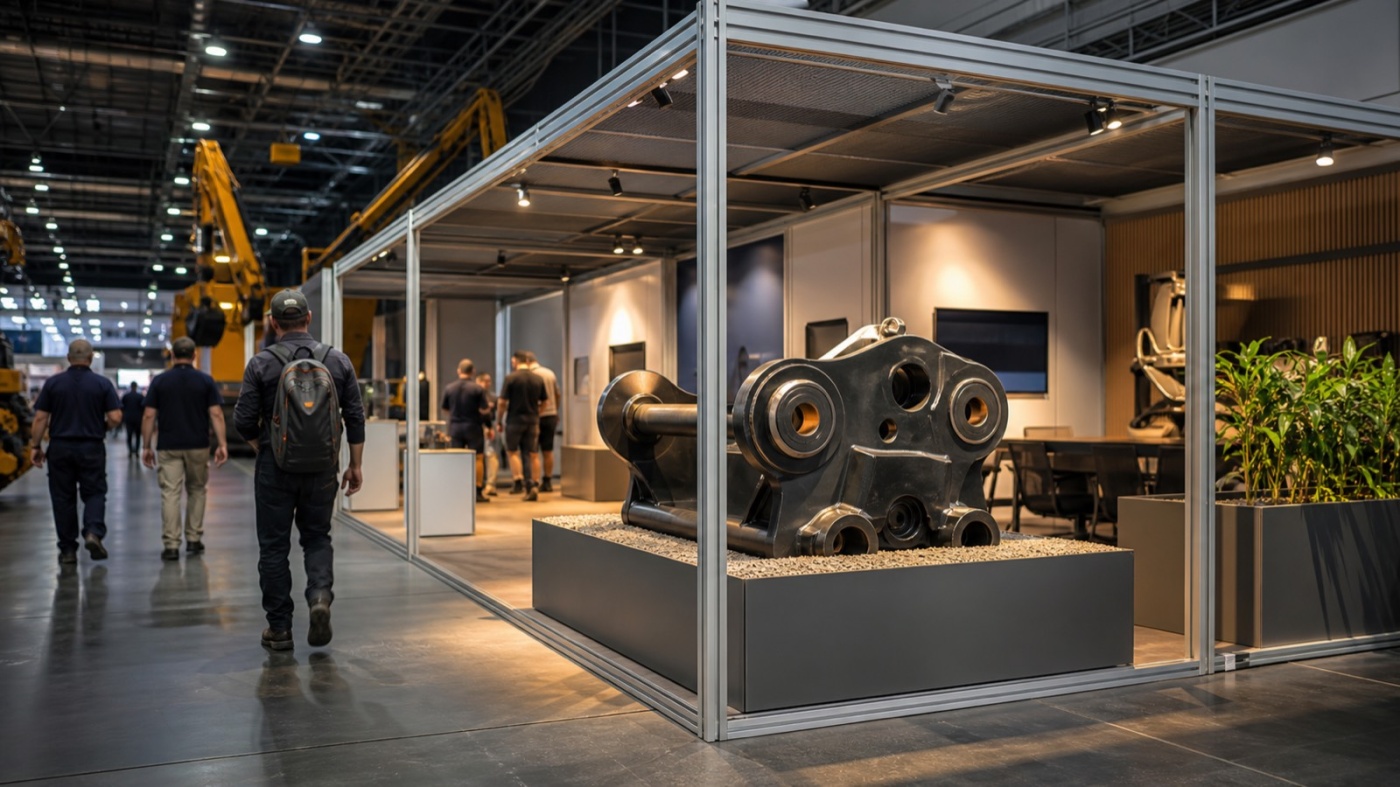
Every three years the Munich exhibition grounds turn into the largest showcase the construction machinery industry has anywhere. For manufacturers and suppliers, bauma is the peak of a year that keeps going long after the halls close. Planning that appearance as a kit from day one pays off well into autumn.
Seven days in Munich, three years apart
bauma ranks among the largest trade fairs in the world. For the 2025 edition, Messe München reported around 3,600 exhibitors from 57 countries, some 600,000 visitors from more than 200 countries and roughly 614,000 square metres of occupied space across the halls and the open-air site. The next edition is due in April 2028, followed by 2031.
A three-year cycle shapes planning far more than an annual show does. It grants a generous runway, and it raises the stakes at the same time: whatever stands in Munich represents your brand for the next three years.
The grounds split the industry in two. Outside, excavators, cranes, wheel loaders and haul trucks appear at full size and often ready to move. Inside, suppliers show hydraulics, drivetrains, attachments, sensors, software, building material technology and mining equipment. For a hall stand that means your neighbours arrive as cutaway models, test rigs and exhibits with serious weight.
Why bauma tests every stand system
Seven show days are a long stretch. Visitors arrive in work clothes, carry dust in from the open-air site and walk kilometres a day. Surfaces, edges and flooring see more traffic in that single week than at two consecutive three-day fairs.
Aluminium frames with exchangeable infills handle that load well. A scuffed fabric panel or a marked board comes out on its own while the structure stays intact, which is exactly what qualifies a system stand for further use in the same year.
Open-air plots follow their own logic: ground conditions, anchoring, wind loads and weather protection belong in the plan early. The technical regulations issued by Messe München for the relevant edition remain the binding reference. Hall exhibitors clarify floor loads and delivery routes for heavy exhibits with the same lead time.
The kit starts on the drawing board
A kit is designed long before the first panel is milled. The key is a consistent grid: every wall element, counter and shelf follows the same module width, so the same parts form a generous stand in Munich and a compact layout for smaller dates.
Three groups have proven useful in practice. The core travels to every appearance: reception counter, lockable storage, brand wall, lighting, one meeting spot. The second group scales the footprint to bauma format with extra wall runs, a larger lounge, exhibit plinths and a media wall. The third group is graphics, and graphics change most often.
That is why it pays to separate artwork early. Permanent brand surfaces (logo, colour world, claim) stay valid for years. Campaign visuals and product imagery come fresh for each date. Fabric prints travel folded in a case and change without tools, while printed board work usually stays in storage.
Technology deserves the same discipline. Monitors, LED tiles and luminaires designed into the grid migrate with the stand. A numbered parts list plus a case plan makes sure the same components land on the floor in the same order in September.
After bauma: open days, dealer events, regional shows
Once the Munich week ends, the year continues. Construction suppliers appear at regional trade shows, dealer and partner days, in-house exhibitions at their own plant, demonstration days on site and recruiting fairs in their region. Every one of these needs a footprint, and every one benefits from a familiar brand picture.
The bauma stand becomes a smaller configuration: the core travels, the extension stays in storage. A handful of square metres carries reception, brand wall and a place to talk, and a much smaller crew handles the build.
The arithmetic changes as well. Instead of the cost of one appearance you look at the cost per use across the year. A system stand that goes up four times spreads its investment over four dates. Our overview of exhibition stand cost shows which items add up.
The environmental side follows the same logic. Reused structures save material and transport runs can be bundled. We describe what stands behind that under sustainable exhibition stands.
An appearance that goes up again in autumn
The choice in favour of a kit belongs to the concept phase, in the year before the fair. Teams that already know their follow-up dates settle the grid, the case logistics and the artwork split in one go. A look at our trade fair calendar helps to sort the year early.
What you end up with is an appearance that shows its full size in Munich in April and returns in a lean version months later. If you would like to build your bauma presence that way, we are happy to talk about grid dimensions, core modules and storage logistics.