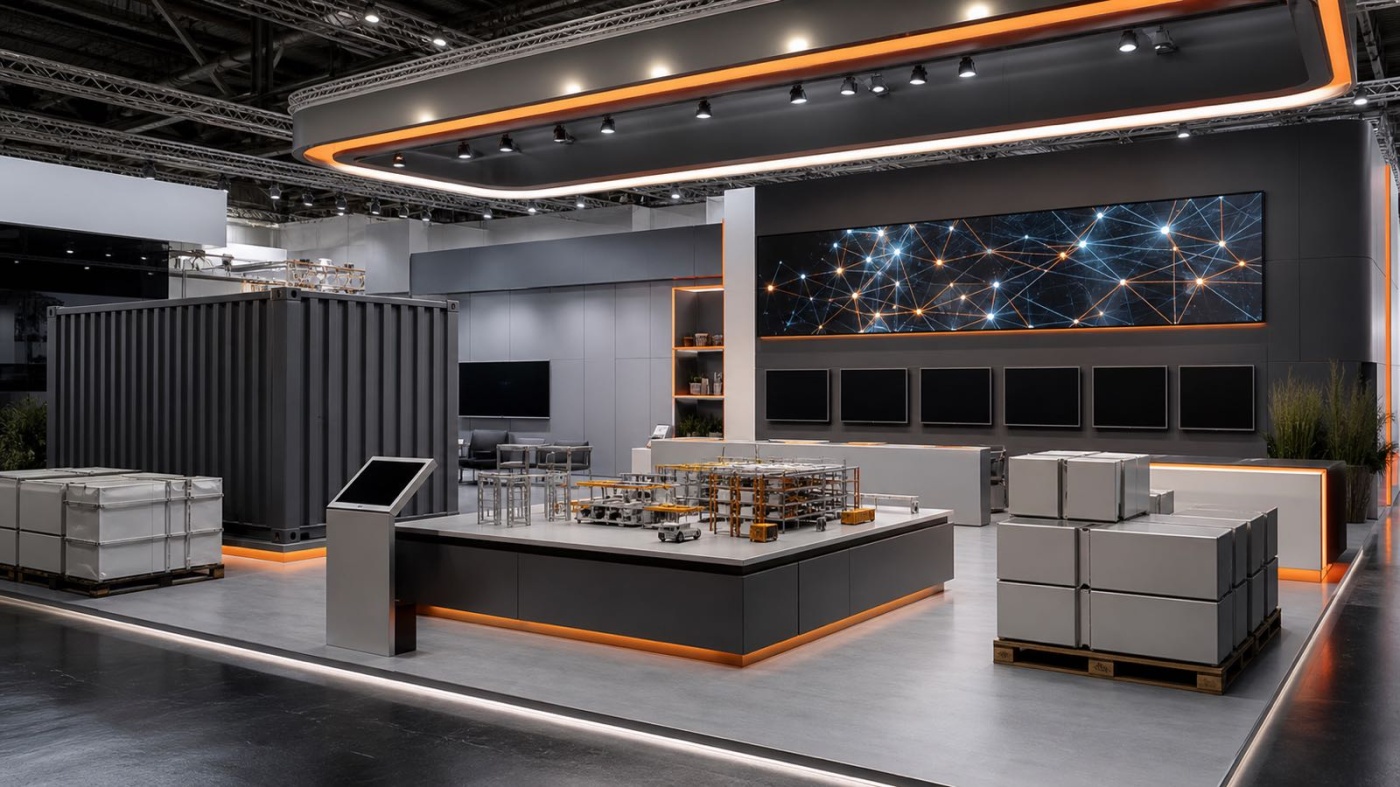
transport logistic in Munich is one of the most important international trade fairs for logistics, mobility and supply chain management. It brings freight forwarders, shippers, vehicle and system manufacturers, telematics providers and the road, rail, water and air transport modes together in one place. If you exhibit here, you rarely present just a brochure and a screen. More often you show large and heavy exhibits, technical systems and advisory services that call for detailed conversation. That fact shapes the planning of your appearance from the very start.
A well thought out exhibition stand at transport logistic combines two tasks. It has to display logistically demanding exhibits safely and with impact, and at the same time create room for confidential expert conversations. This guide sorts through the points that matter most for stand planning in Munich. It describes the exhibition grounds with an eye on delivery and the outdoor area, the requirements for heavy exhibits, the meeting zones, and the technical and scheduling framework. It does not replace the organiser's official specifications. Instead, it helps you ask the right questions at the right time.
transport logistic: a trade fair for the entire logistics chain
transport logistic takes place at the Munich exhibition grounds and runs on a two year cycle. According to the organiser, the coming edition is planned for 26 to 29 April 2027. The date that Messe Munich publishes through its official channels is the binding one, so check it before you fix any part of your plan.
In terms of content, the fair covers the whole logistics value chain. Topics include the movement of goods by road, rail, water and air, along with telematics, IT systems, intralogistics and supply chain management. The air cargo Europe segment, which represents air freight, occupies halls A1 and A2 according to official information. In total the fair spreads across roughly 150,000 square metres in twelve halls plus outdoor areas. You will find details, hall layouts and current figures on the official transport logistic website.
The Munich exhibition grounds at a glance
For exhibitors with heavy material, delivery is a central planning topic. The Trade Fair Center Messe Munich sits directly on the A94 motorway, and the Munich-Riem exit leads straight to the grounds. That makes the approach easier for trucks and articulated lorries that bring vehicles, structures or containers to the stand. For visitors, the grounds are served by the U2 underground line with the Messestadt West and Messestadt Ost stations, about 20 minutes from the main station. Munich Airport lies roughly 42 kilometres to the north, which matters for trade visitors arriving from abroad.
One feature that sets transport logistic apart from many other fairs is the importance of the outdoor area. The open spaces let you show exhibits that are too large or too heavy for a hall, such as commercial vehicles, swap bodies or containers. For rail transport, dedicated track areas are available outdoors where rail vehicles and rolling stock can be presented. If you plan exhibits of this kind, clarify early which spaces are available and how access to them is organised.
For your own stand logistics, it pays to look closely at how build up and dismantling work. Delivering vehicles, crane capacity for heavy parts, time slots for access and the routes inside the hall all help determine how smoothly the build runs. Messe Munich sets out the exact rules for delivery, the outdoor area and build up times in its documents for exhibitors. Request these early and work them into your plan.
Stand requirements for logistics and mobility
Heavy and large format exhibits place particular demands on the stand. A tractor unit, a trailer or a heavy machine concentrates its weight on a small footprint. Whether an exhibit may stand at a given position depends on the permitted floor load, which can vary from one hall and location to another. Messe Munich states the relevant values in its technical regulations. Never place a heavy object without checking them.
Beyond the structural side, access to the stand counts. Vehicles have to be driven or towed to their position without blocking neighbouring stands or the aisles of the hall. Open areas within the stand should be sized so that visitors can walk around an exhibit and take in the technical details. If you want to show a vehicle or a system in operation, further questions arise, for example about securing moving parts, about operating fluids and about safety clearances. Here too the organiser's rules apply, and you should clarify them in advance.
Advisory and meeting zones
transport logistic is a strongly international fair with a professional audience from many countries. Conversations about contracts, networks and cooperation need room and quiet. A stand that relies solely on open presentation space often falls short here. What works well are separate or semi open meeting areas where you can talk undisturbed, together with a reception zone that guides visitors clearly.
On larger stands, deliberate zoning proves its worth. An open zone at the front draws passing visitors and showcases the central exhibits. Behind it or above it, for example on a second level, sit enclosed meeting rooms and a catering area for longer conversations. Good visitor guidance keeps the routes from the exhibit to the meeting table short and logical. In this way, the technical impact of the exhibits and the calm of the conversations do not get in each other's way.
Technical regulations and deadlines
Every trade fair has its own technical regulations, and Messe Munich is no exception. For an individually planned stand, stand construction approval is usually required. To obtain it you submit dimensioned stand plans with a floor plan and elevations, often at a set scale. For special constructions such as second levels, large structures or suspended elements, proof of structural stability may be requested. Which documents are needed exactly is defined by the technical regulations of Messe Munich.
For fire protection, the usual rule is that the materials used must be at least flame retardant, often in class B1. You should also observe rules on visual screens towards neighbouring stands, on escape routes and on building height zones. The lead time matters: approvals and certificates take processing time, and late submissions easily lead to bottlenecks. So submit your documents in good time, and do not treat the points named here as fixed universal values. Always compare them against the current regulations and the Messe Munich service team.
An exhibition stand builder for transport logistic
A full service exhibition stand builder accompanies an appearance like this from the first idea to dismantling. That covers consulting and concept, design and three dimensional visualisation, production in an in house workshop, logistics and assembly, and storage of the stand after the fair. For a logistics heavy fair such as transport logistic, an in house transport chain is especially helpful, because delivery, time slots and build up can be closely coordinated. You can read more about the process and its scope on the exhibition construction services page.
An honest note fits here. die trendSETZEREI GmbH is based in Offenbach am Main and works throughout Germany, which includes Munich. With its own fleet, its own workshop and one fixed contact per project, the routes stay short and responsibility stays clear. For an appearance at transport logistic, that means planning, build and transport come from one team, rather than needing coordination across several independent trades.
Choosing stand size and stand shape
The right stand shape depends on the space you have booked and on the position in the hall. A row stand is open only to the aisle side and suits more compact appearances. A corner stand sits on two open sides and offers more visibility. A peninsula stand opens on three sides and feels generous. An island stand is accessible from all sides and gives heavy or large exhibits the most room, which is often the best solution for vehicles and machines. Each shape carries its own trade offs:
- Row stand: compact, budget friendly, but limited visibility from one side only.
- Corner stand: two open sides for better reach without a large footprint.
- Peninsula stand: three open sides and a spacious feel for mid sized appearances.
- Island stand: open on all sides and the most room for large or heavy exhibits.
Whatever the shape, zoning decides the effect. Separate clearly between exhibition space, reception, consulting and back of house areas such as storage and technical services. You will find a short overview of the options and their pros and cons on the page about exhibition stand types. This lets you gauge early which shape fits your planned presentation and your budget.
Conclusion
An appearance at transport logistic in Munich takes more than an attractive stand. It combines the safe presentation of large and heavy exhibits with quiet zones for international expert conversations and with the organiser's technical requirements. If you factor in delivery, the outdoor area, floor load, approval and deadlines early, you avoid the typical bottlenecks shortly before build up. Messe Munich publishes the binding dates, hall plans and regulations through its official channels.
If you are planning an exhibition stand for transport logistic, die trendSETZEREI GmbH supports you from concept to on site assembly in Munich. Feel free to get in touch, by phone on +49 69 201 65 001 or by email at info@dietrendsetzerei.de. You will find further ways to reach us on the contact page.