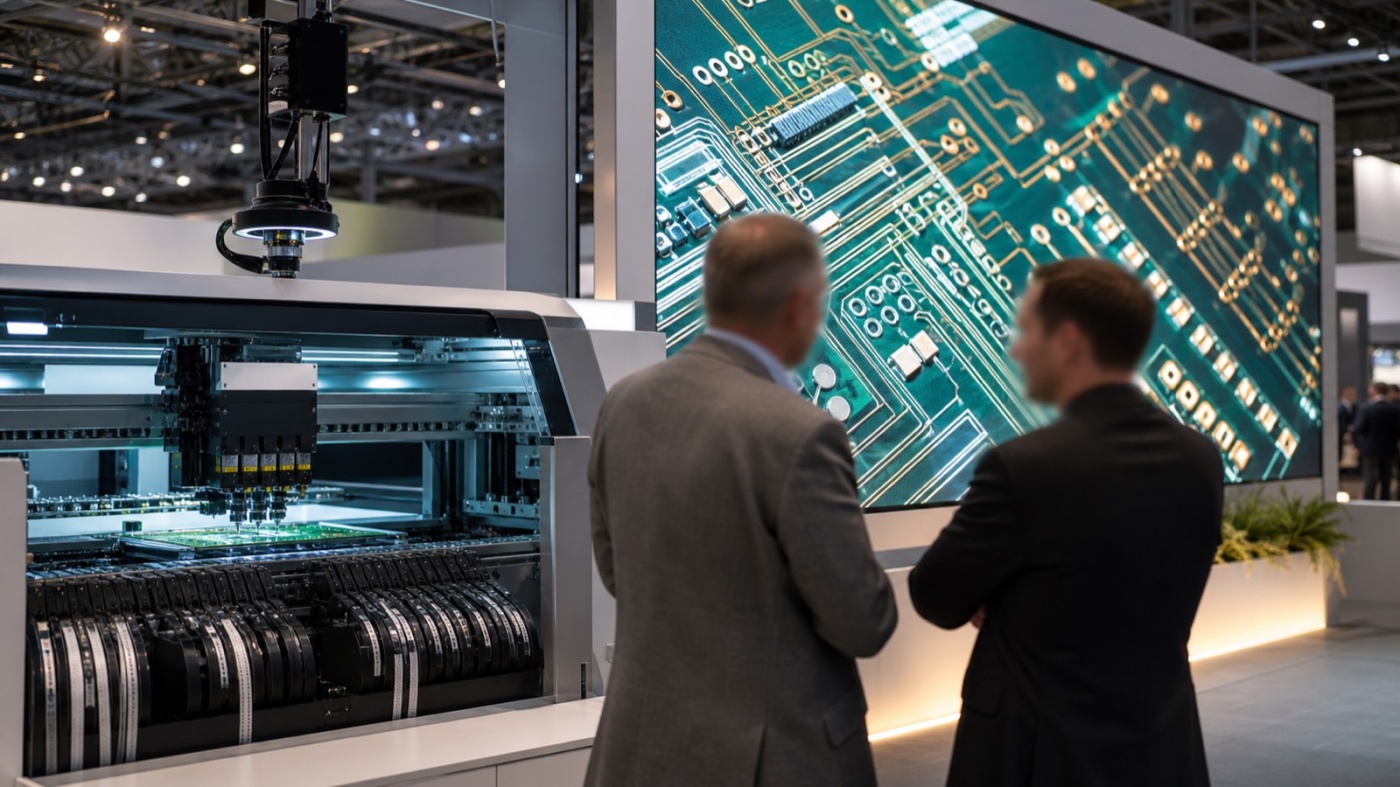
Electronics manufacturing happens at a scale that is hard to read from two metres away: components in tenths of a millimetre, solder deposits in the micrometre range, placement heads moving faster than the eye can follow. When the industry returns to Munich in November 2027, media technology on the stand therefore carries real weight. It shows what otherwise stays hidden inside the machine housing.
An audience that reads processes
productronica is the world's leading trade fair for electronics manufacturing and takes place every two years in odd-numbered years at the Munich exhibition grounds, always in November. For the 2025 edition, more than 1,600 exhibitors from over 50 countries filled ten halls, while SEMICON Europa ran in parallel in the ICM and halls B1, C1 and C2.
The layout follows the manufacturing chain. The SMT cluster occupies halls A1 to A4 with placement technology, soldering and joining, test and measurement and quality assurance. Hall B2 combines semiconductor production with future topics such as battery production and additive processes, hall B3 belongs to PCB manufacturing and EMS, and hall B4 covers cables, coils and hybrid components. Choosing your space also means choosing your neighbourhood and your technical context.
The audience matches that structure. Production managers, process engineers, quality assurance teams and technical buyers ask about cycle time, yield, changeover effort and repeat accuracy. A brand film rarely convinces these guests. A visible process convinces them quickly.
A camera instead of a display case
The strongest media solution at this fair is also the simplest: a running machine plus a camera that shows what happens inside. A macro camera fixed to the machine frame transmits the placement sequence or the solder image live to a monitor right beside it, with a steady frame and a short signal path.
Three details decide how well this lands. First the framing: agree it in advance with your application engineers, so the camera holds exactly the spot where your advantage becomes visible. Second the lighting: process lighting for a camera behaves differently from stand lighting for people and deserves its own plan. Third the slow motion: a split image of live signal and slowed recording shows in seconds what a data sheet needs a page to describe.
A fallback layer helps as well. During changeovers, maintenance or quiet moments, a recorded sequence of the same machine keeps running, so the space always has something to show.
Choosing display size: distance, pixel pitch, brightness
The right display technology follows the viewing distance. At the aisle, where visitors look from six to ten metres, an LED wall with a wider pixel pitch plays to its strengths: high brightness against the hall lighting, generous surface, flexible formats. At the demo, where specialists read details from a metre away, a high resolution monitor with an anti-glare surface belongs.
A clear division of tasks works well: portrait displays at the aisle edge carry one message and one image, the large surface inside the stand carries the process, and small monitors at the exhibits deliver measured values and explanations. That sequence guides visitors from attention to depth.
The structure thinks along. Displays and LED tiles integrate into modular aluminium frames, so cables run inside the profile and service access stays available from behind. Weight, mounting points and heat dissipation belong in the plan early, together with the question of rigging or floor-mounted support. What is permitted on your space follows the technical guidelines of Messe Muenchen, and larger structures and rigged elements call for additional verification.
Sound in a loud hall
In the production halls at productronica, machines are working and the ambient level is high. Conventional public address quickly turns into a contest with the neighbours. Three quieter routes serve better: near-field speakers directly at the demo counter, directional speakers that cover a tightly limited zone, and headphones for in-depth sequences.
One rule applies regardless: every video carries subtitles. The message then reaches visitors who watch while walking past, and it works bilingually at the same time. Loops of 60 to 90 seconds with a clear structure allow anyone to join at any point rather than wait for the start.
Content that carries the whole event
Media technology goes up quickly; strong content needs lead time. Animations from engineering, section views, simulations and process recordings take weeks and pass through approvals. If you show customer data or real process data, secure the release in advance and work with anonymised data sets.
For daily operation, a few simple rules have proven themselves. Content sits locally on media players, so playback runs independently of the hall network. A media control system starts every device in the morning with one button. Spare cables, a spare player and a second HDMI route wait in the stand storage. Interactive elements stay deliberately lean: a touch configurator that reaches a result in three steps, a QR code linking to the data sheet, and contact capture through a badge scan that your guest explicitly agrees to.
From the screen to the conversation
Media technology at productronica has one clear job: it shortens the time until the first technical question. Once a visitor sees on screen how your process works, the conversation starts at eye level. That is why floor plan, display technology and content deserve to be designed together. Our overview of exhibition stand services shows which trades come together in such a project, and completed work appears in our project references. For one of the coming editions, a short conversation about your enquiry is the easiest way to start.