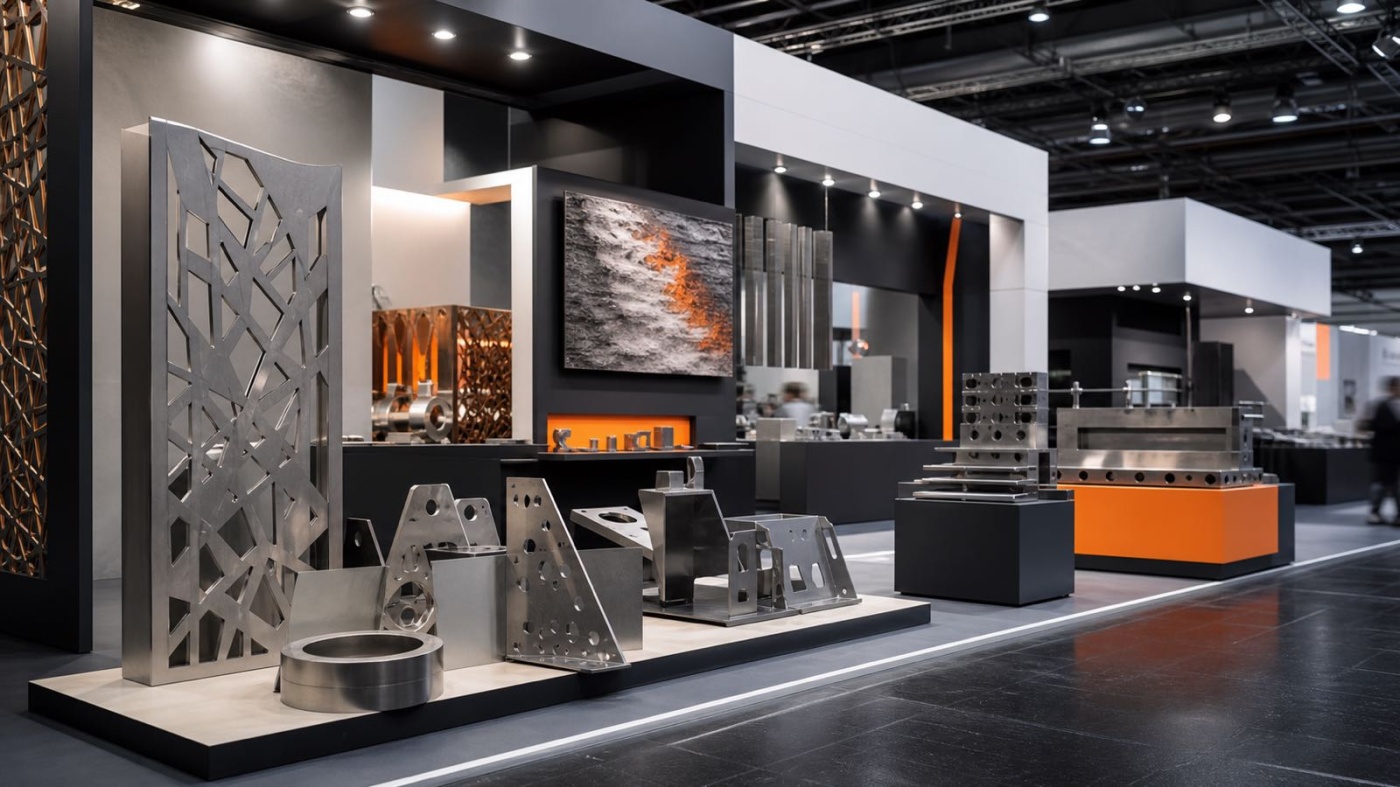
Blechexpo is one of the leading international trade fairs for sheet metal working. In Stuttgart it brings together the entire process chain, from raw material to finished component, complemented by the parallel Schweisstec show for joining technology. Companies that exhibit here usually present machines, systems and tools in live operation. That places very specific demands on the stand, demands that differ clearly from a classic consumer or service fair.
This guide sets out what matters for an exhibition stand at Blechexpo: from the location and logistics of the Stuttgart fairgrounds to the structural requirements for heavy machinery, and on to the technical regulations and deadlines. It is written for exhibiting companies that want to plan their appearance early and on a solid footing. Please always check specific dates, values and deadlines against the official information from the organiser and Messe Stuttgart, because those are binding and can change from one event to the next.
Blechexpo: the trade fair for sheet metal working
Blechexpo is an international trade fair for sheet metal working and takes place every two years at the Stuttgart fairgrounds. The organiser is P. E. Schall GmbH & Co. KG. Running at the same time is Schweisstec, a trade fair for joining technology, so both worlds come together in one place. The most recent edition was held in autumn 2025. The organiser plans the next Blechexpo for 26 to 29 October 2027. The binding date is published by the organiser and Messe Stuttgart on their official pages.
In terms of content, the fair covers the entire process chain of cold-forming sheet metal working, together with the related thermal and mechanical cutting, joining and connecting technology. Typical subject areas include:
- Sheet metal working and forming
- Cutting technology (shearing, punching, laser processing)
- Joining and welding technology (also via the parallel Schweisstec)
- Surface technology as well as handling, automation and material flow
The audience consists of trade visitors from industry and skilled trades, for example from mechanical engineering, automotive supply and metalworking. For exhibitors, Blechexpo is one of the central platforms for showing machines and processes in direct comparison and in practical operation.
The Stuttgart fairgrounds at a glance
The fairgrounds are located at Messepiazza 1 in 70629 Stuttgart, right next to the A8 motorway. For exhibitors, delivery is the decisive factor. Blechexpo occupies several halls (in the area of hall 1 and halls 3 to 10), which are accessed via a west and an east entrance. Heavy machines and systems reach the stands through the hall gates and the associated delivery yards. Because exhibits weighing several tonnes are often moved here, access, sequence and time slots should be agreed with the organiser at an early stage.
Set-up and dismantling times are governed by the organiser through fixed time slots. Especially with large systems, it makes sense to schedule your own delivery within these windows so that cranes, forklifts and pallet trucks can be deployed without waiting times. Dismantling also follows a set schedule, within which the exhibits must be removed from the hall again. If you know these windows and align your logistics with them, you avoid congestion in the delivery yards and additional costs.
For trade visitors and stand personnel, the site is well connected to public transport. The suburban railway stops at the Flughafen/Messe station and links the fairgrounds with Stuttgart central station and the regional network. Added to this are long-distance connections via Deutsche Bahn and several parking areas for those arriving by car. This connection is helpful when planning shifts, stand staffing and overnight stays.
Stand requirements for sheet metal working
Machine exhibits are heavy, and that is exactly what shapes stand planning. The technical regulations of Messe Stuttgart specify a permissible floor load for the hall floors, which can vary from hall to hall and lies in the order of around 5 kN/m2 (about 500 kg/m2). Heavy individual machines can exceed these values at certain points. In such cases, load distribution, suitable substructures and early coordination with the fair are required. The current technical regulations of Messe Stuttgart in their respective valid version are always authoritative.
Besides the floor load, the way exhibits are brought in needs to be clarified: does the exhibit fit through the hall gates, is a crane or a heavy-duty forklift needed, and in what order do machine and stand construction enter the hall. Then there are the utility connections. For live operation, many machines need heavy current, compressed air and sometimes water or extraction. You order these connections from the organiser and plan their positions into the stand layout early on. Finally, safety plays a major role, because a working stand combines movement, electricity and rotating parts.
Demo and presentation areas
The appeal of Blechexpo lies in the demonstration. Visitors want to see machines at work, not just read data sheets. Good stand planning provides clearly defined demonstration areas for this. Around running machines there should be safety distances and, where necessary, barriers or protective devices, so that visitors can watch safely. Visitor guidance directs the flow so that a demonstration is clearly visible without people crowding into the working area.
You should also consider the side effects of operation. Forming and cutting processes generate noise, chips or dust. A well thought out layout, an extraction system and noise-reducing measures help here, so that your own stand and its neighbours are not unduly affected. A quieter zone for conversations, set slightly apart from the demonstration area, ensures that consultation and live operation do not interfere with one another.
Technical regulations and deadlines
The technical regulations of Messe Stuttgart apply to stand construction. Among other things, they set out when stand construction approval is required. For taller stands, special constructions and superstructures, the fair usually requires dimensioned stand plans (floor plan and elevations) and, for structurally relevant constructions, structural proof. Materials used must be suitable in terms of fire protection; at least fire classification B1 (flame retardant) is standard. Depending on the requirements, sight screens towards closed neighbouring stands are prescribed.
These checks need lead time. Stand plans and proofs must be submitted on time before the start of set-up, and construction may only begin after approval. Messe Stuttgart sets the specific deadlines, heights and limit values for each event, which is why the current technical regulations and the exhibitor documents for the respective Blechexpo are authoritative. Checking these requirements early prevents a stand design that is otherwise finished from having to be changed shortly before the fair.
Exhibition stand builder for Blechexpo
An exhibition stand for Blechexpo combines classic stand construction with demanding logistics. trendSETZEREI GmbH is based in Offenbach am Main and works nationwide, including at the Stuttgart location. The route from the Rhine-Main region to Stuttgart is covered by our own vehicle fleet, so delivery and transport are part of the service and do not have to be bought in externally. We are not based in Stuttgart, but we bring materials, the assembly team and logistics to the fair.
The scope of services ranges from the concept and 3D visualisation, through production in our own workshop, to assembly, dismantling and storage. Especially with machine stands, it helps when stand construction and logistics come from one team and a dedicated contact person handles coordination with the organiser. You will find an overview of the individual building blocks on the exhibition services page.
Stand size and stand format for your Blechexpo stand
The stand format depends on its position in the hall. A row stand is open only to the aisle side, while a corner stand sits at the junction of two aisles and is open on two sides. A head stand at the end of a row of stands opens on three sides, whereas an island stand stands freely in the space and is accessible from all four sides. For demonstrations with heavy machines, corner, head and island stands offer more space and better sight lines, because visitors can see the machine from several directions.
More important than the pure square metre count is the zoning. The demonstration area, the consultation zone and the storage or technical area should be clearly separated, so that live operation, conversation and logistics can work side by side. Which stand format suits your exhibits and goals can be worked through with the help of the stand types overview.
Conclusion
A successful appearance at Blechexpo does not come from the stand alone, but from the combination of stand design, machine logistics and timely coordination with Messe Stuttgart. If you clarify floor load, bringing exhibits in, utility connections and the technical deadlines early, you keep your head free at the fair for what really counts: the machines in operation and the conversation with your visitors.
If you are planning your appearance for the next Blechexpo in Stuttgart, trendSETZEREI GmbH supports you from the first sketch to dismantling. You can reach us by phone on +49 69 201 65 001 and by email at info@dietrendsetzerei.de. You will find further ways to get in touch on the contact page.