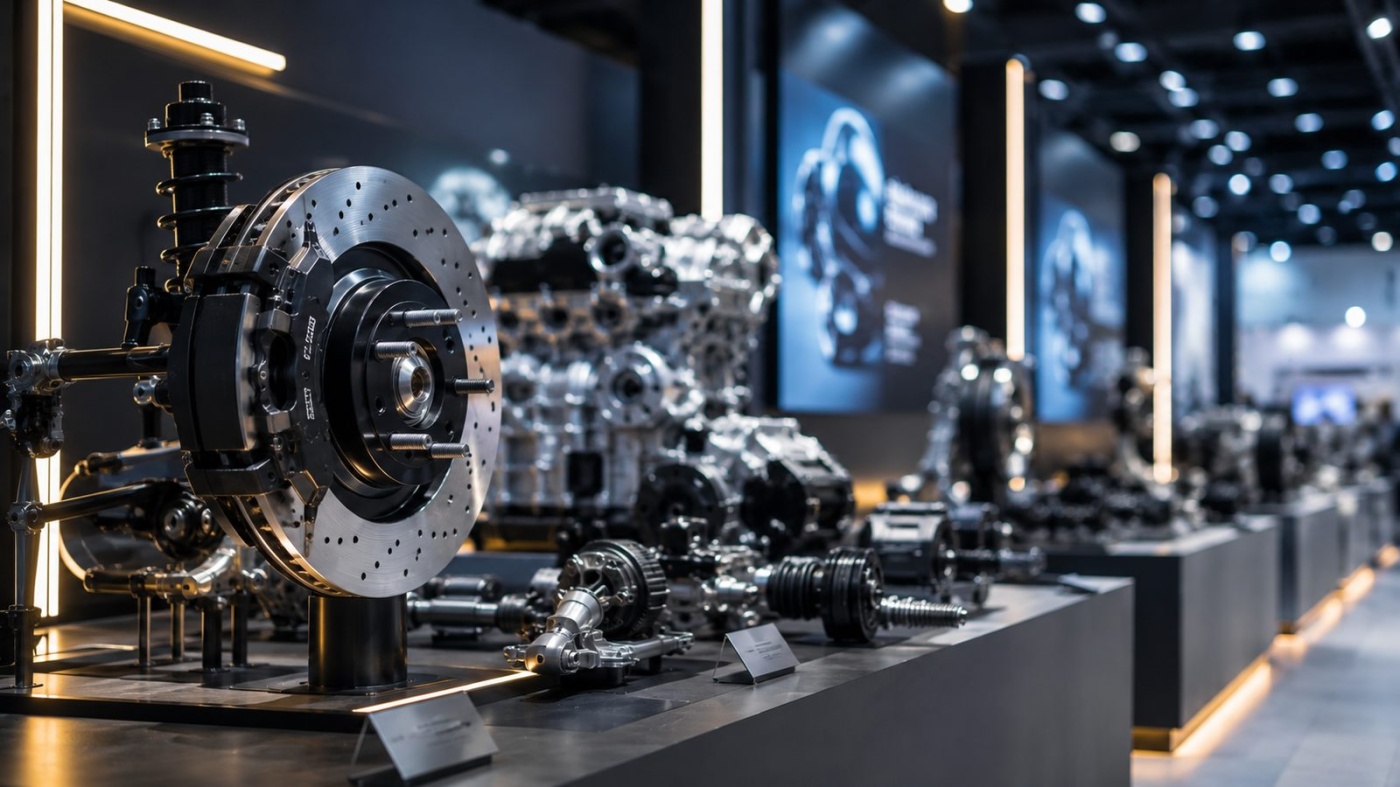
The HANNOVER MESSE is regarded as the world's leading trade fair for industry. Automation, energy technology, digitalisation and hydrogen come together here every year, and with them a professional audience that wants to see technology not just on display but actually in operation. Anyone exhibiting in Hannover plans their appearance differently from a purely presentational fair. The focus is on running machinery, on load-bearing stand surfaces and on a build that carries heavy technology safely.
This guide is aimed at industrial exhibitors preparing an exhibition stand for the HANNOVER MESSE. The next edition is scheduled for 05 to 08 April 2027, although the dates and opening hours may still shift before registration and should therefore be confirmed officially before planning. We explain what matters in stand construction, which technical questions need to be settled early and why a full-service partner with its own workshop and vehicle fleet makes the journey to Hannover easier.
The character of the HANNOVER MESSE
The HANNOVER MESSE brings several leading themes of industrial value creation together in its halls. Automation and robotics sit alongside drive technology, energy solutions, the digital factory and the fast-growing field of hydrogen and fuel cells. The audience consists mainly of engineers, technical buyers and decision-makers looking for concrete use cases. An exhibition stand here must be technically legible at a glance and convey the exhibitor's expertise credibly.
Unlike consumer or lifestyle fairs, Hannover rewards technical substance. Visitors want to watch machines run, follow data streams and go into depth in direct conversation. The stand is therefore less of a shop window and more of a working environment. This orientation shapes every planning decision, from the load-bearing capacity of the floor through the power supply to the number and position of meeting spaces.
The Hannover exhibition grounds
The Hannover exhibition grounds rank among the largest in the world. They are characterised by very large halls with high ceiling loads and by extensive open-air areas where voluminous exhibits also find space. For industrial exhibitors this is an advantage, because large machines, vehicles or complete plants can be staged realistically here. At the same time, these dimensions demand careful preparation.
A central issue in Hannover is heavy machinery. Anyone showing exhibits weighing several tonnes must know the permitted floor load of the respective hall and align the stand build with it structurally. High structures, rigging or special constructions usually require structural proof. Where heavy equipment is involved, crane capacity, manoeuvring routes and the load-bearing capacity under point loads must be coordinated with the organiser early on.
Delivery is no minor matter on grounds of this size either. Access time slots, routes to the hall, available forklifts and the sequence in which heavy parts are brought into the stand all belong in the build schedule. When the open-air grounds are used, weather, subsoil and anchoring come into play as well. A well-considered delivery plan saves time in Hannover and prevents costly waiting periods on the build day.
Stand requirements for industry and machinery
An exhibition stand for the HANNOVER MESSE has to withstand technical loads that play no role at many other fairs. Heavy exhibits need a load-bearing substructure, often with load-distributing plates or a reinforced platform. Running machines generate vibration, heat and noise, which must be considered when positioning meeting zones and media technology. The power supply has to be dimensioned accordingly, including reserves for start-up currents and additional consumers.
Alongside the structure, operational safety counts. Moving parts, compressed air or hydraulics call for protective devices and clearly defined visitor areas. Cable routing, media connections and supply lines belong neatly integrated so that the stand looks professional and avoids trip hazards. An experienced stand builder plans these technical details from the outset rather than improvising them on the build day.
Live demonstrations and conversation zones
In Hannover, success is often decided at the live demonstration. A plant that works before the visitors' eyes builds more trust than any brochure. The stand should therefore have a clearly visible demo area around which an audience can gather without disrupting operation. Sight lines, exhibit height and the audience's viewing direction are shaped deliberately for this.
Conversation and meeting zones are equally important. Technical sales talks in Hannover are often long and detailed, which is why quiet, partly screened areas with seating and a screen make sense. On larger stands, a double-decker booth is worth considering, combining the demo area below with protected meeting rooms above. This keeps the floor space efficient and lets the exhibitor present and negotiate in parallel.
Technical guidelines of Deutsche Messe
For every stand build in Hannover, the technical guidelines of Deutsche Messe are binding. Among other things, they govern building heights, restricted-build zones, sight screens to neighbouring stands, escape routes and fire-protection requirements. Stand-building materials usually have to be at least flame-retardant, and additional conditions may apply to ceilings and overhead structures. The specific values and deadlines are stated in the guidelines valid at the time and must be checked again before each fair, since they can change from event to event.
Structures requiring approval deserve particular attention. Dimensioned stand plans must be submitted on time before the build begins, and construction may only start after clearance. Special constructions, tall structures or rigging often require structural proof. For industrial exhibitors with heavy machinery, additional technical certificates come into play. Coordinating these steps early with an experienced stand builder avoids delays and ensures the stand is signed off on the opening day. The information provided by Deutsche Messe always takes precedence.
Stand builder for the HANNOVER MESSE
trendSETZEREI GmbH is based in Offenbach am Main and works throughout Germany. Even though Frankfurt and the Rhine-Main region are our core area, we deliver trade fair appearances at other German locations. For the HANNOVER MESSE this means an honest assessment: Hannover is not our home fairground but an away assignment that we manage with careful logistics and advance planning.
A key advantage here is our own vehicle fleet. We transport material, system components and equipment to Hannover ourselves, which makes coordination and punctuality easier. This is complemented by our own workshop with CNC production and a paint shop, so that a large part of the stand build is created in-house. As an Aluvision system partner, we rely on modular, reusable construction that transports and assembles well for away assignments. A dedicated contact accompanies the project from the first sketch to dismantling.
Stand size and stand form
The right stand size in Hannover follows from the exhibits and the goals of the appearance. Anyone showing large machines needs space for the equipment itself, for safety clearances and for the audience around it. Stands sized too tightly quickly look overloaded and diminish the effect of expensive exhibits. When choosing the stand form, the position in the hall and the number of open sides need to be considered.
The common stand forms differ above all in how open they are to the aisle:
- Row stand: open only to the aisle side, economical in space, suited to compact appearances.
- Corner stand: open on two sides, offering more visibility and access.
- Head stand: open on three sides, with a strong presence at the end of a row.
- Island stand: open on all sides, maximum impact, ideal for large machines and live demos.
For industrial exhibitors with heavy exhibits, the island stand is often the strongest choice, because the equipment stays accessible from all sides and the demo area can be staged centrally. Which form fits in a given case depends on the budget, the available hall position and the exhibit itself. Our page on exhibition stand types offers an overview of the options.
Conclusion
A convincing exhibition stand for the HANNOVER MESSE combines technical substance with clear staging. Large halls and open-air grounds offer room for heavy machinery but demand careful structural work, well-considered delivery and planning in line with the technical guidelines of Deutsche Messe. Combining live demonstrations with quiet conversation zones makes the most of the fair's technical character. Check the dates and requirements in good time, because the next edition on 05 to 08 April 2027 can be prepared calmly with sufficient lead time.
As a full-service stand builder from Offenbach, we accompany your appearance from concept to dismantling, with our own workshop and vehicle fleet operating throughout Germany. You will find an overview of our exhibition construction services on our website. Talk to us on 069 201 65 001 or by email at info@dietrendsetzerei.de, or reach us directly through our contact form. We advise you honestly and without obligation on your exhibition stand in Hannover.