The 2027 exhibition year gets decided in autumn 2026. Booking early secures position and price. Choosing early spreads your budget across the events that genuinely reach your audience. Both start from the same set of questions.
Audience first, list of fairs second
Before the first date lands in the calendar, write down the answer to three questions: who do you want to meet in 2027, in which role, and in which region. A sales director in mechanical engineering, a buyer in food retail and a planning office in construction walk through entirely different halls.
Turn that answer into selection criteria. Phrase them concretely enough that a candidate can meet them or miss them: share of trade visitors from your sector, share with purchasing authority, share from abroad, proximity to your existing customers, and a fit with the launches in your own pipeline.
Your objective forms the second filter. A large leading fair suits brand building and new contacts, while a smaller specialist show often works better for deep conversations with existing customers. If you expect both, two distinct appearances usually beat one compromise.
Audited figures make the comparison easier
For the German market there is a reliable source. The FKM, the German society for the voluntary control of fair and exhibition statistics, has around 200 events audited every year by independent auditors against uniform rules. Published figures cover exhibitors, floor space and visitors, together with visitor structure data such as origin, professional position and role in procurement decisions. The FKM is managed by AUMA, the German trade fair industry association, and the data is available free of charge.
For your selection, structure counts for more than the headline total. A simple calculation makes that tangible: a fair with 12,000 visitors, 70 percent of them from your target sector and half of those involved in purchasing decisions, puts roughly 4,200 relevant contacts into circulation. An event with 60,000 visitors drawn from a broad public can land below that. Scale every candidate down to your own audience before you compare.
Where audited figures are absent, ask the organiser for the visitor survey, the post-show report and the previous exhibitor list. Willingness to share those is a good signal in itself.
Check cycles and dates early
Many leading fairs run on a two or three year cycle; ACHEMA in Frankfurt, for instance, takes place every three years. The offering therefore differs from year to year, and 2027 puts a different set of events on the table than 2026. Check early which of your candidates actually run, and whether two important dates sit close together.
Three dates per fair matter for your own planning: the registration deadline, the point at which stand space is allocated, and the start of build-up. Between confirmation and build-up, six to twelve months is realistic for concept, approval, production and logistics. Our trade fair calendar gives you an overview of the coming dates.
The sequence across the year deserves a look too. Two fairs three weeks apart tie up the same team twice and call for either two sets of stand equipment or very tight logistics. A modular build makes such back-to-back rounds far easier to plan, because the same inventory adapts to different floor plans.
Competitive field and hall position
The exhibitor list from the last edition tells you a great deal. If your competitors are there, your audience is very likely there as well. If most exhibitors come from adjacent segments, look more closely at who actually walks the halls.
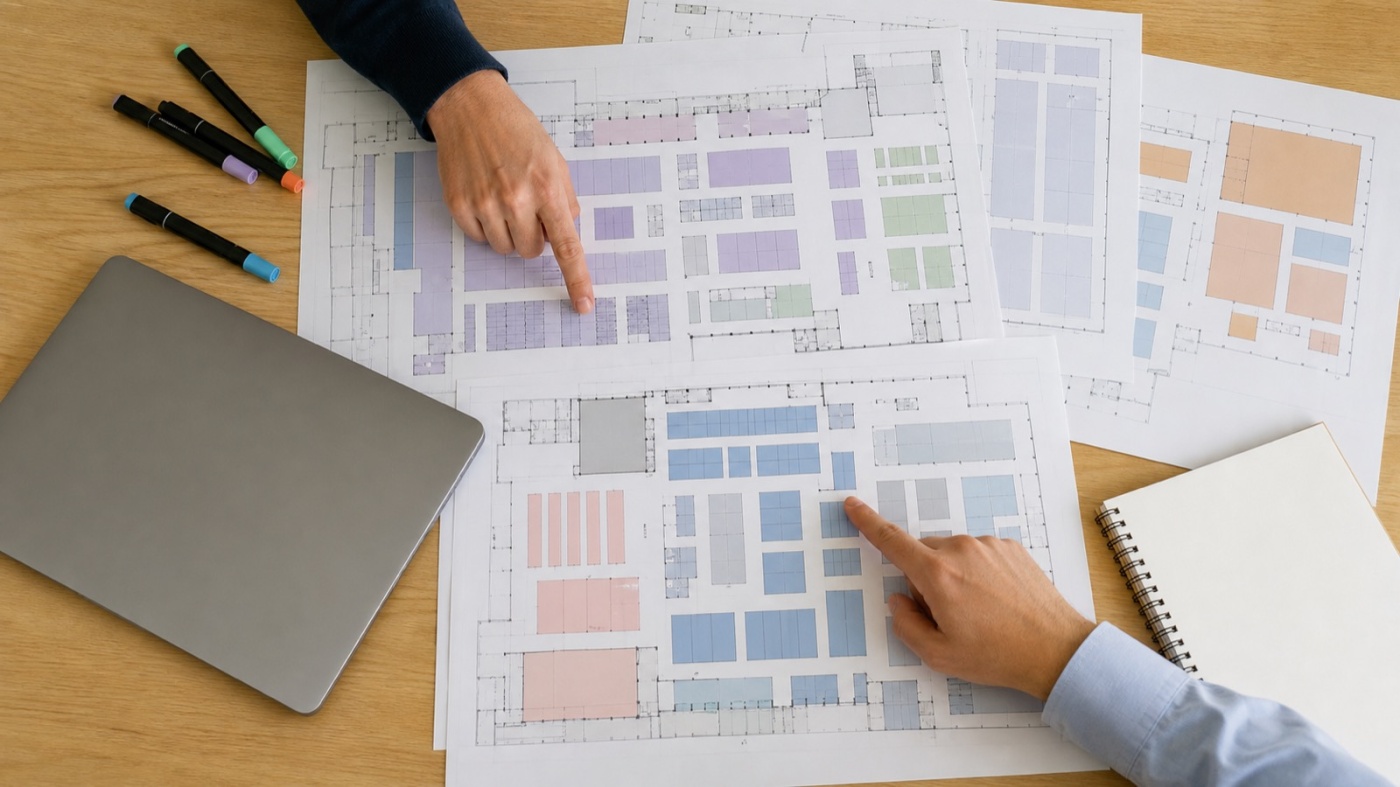
Position matters just as much. Hall plans from previous years show where your segment sits, where special areas and presentation stages are placed, and which aisles visitors take anyway. A smaller stand on a strong aisle often outperforms a large one in a quiet corner. That question gets settled at registration, so it belongs in the selection stage, well ahead of stand design.
The cheapest way to judge all of this: attend a candidate once as a visitor before you exhibit there. A day in the hall answers more than any brochure.
Costing per contact honestly
Fairs only become comparable on full costs. That includes space rental and mandatory fees, utility connections, stand construction, logistics, staff and travel, promotional material, catering and follow-up. With stand construction, look across several outings: a modular stand spreads its cost over every further fair, which changes the figure per event considerably. Our page on exhibition stand costs shows how those items come together.
Divide that sum by the number of qualified contacts, meaning conversations with genuine demand behind them, rather than by every business card collected. Last year's figures then give you a realistic expectation per fair. For the evaluation itself, AUMA has offered a free tool since 2004, the MesseNutzenCheck, which sets the costs and objectives of a participation against alternatives such as advertising or field sales visits.
Add your internal time to the calculation. Preparation, show days and follow-up occupy sales and marketing for weeks, and that effort decides how many appearances a year can genuinely carry.
Turning a shortlist into an exhibition year
A small portfolio has proved its worth: one anchor fair where you appear with full floor space and a full team, plus one or two smaller appearances on a lean modular stand. Budget stays concentrated where it counts, and your presence still spreads across the year.
Set yourself a deadline for it. Deciding by the end of the year gives you lead time in 2027 for concept, approval and production, along with a better choice of stand space. Which stand size and construction method suit your shortlist is something a short conversation settles faster than any spreadsheet.