The stand is up, the graphics are aligned, the team is briefed. From the first admission onwards something else shapes the impression: whether the stand still looks as fresh on day three as it did on day one. That upkeep can be planned in advance, and the planning is what separates a calm show day from a hectic one.
What the organiser supplies and what stays with you
Most venues offer stand cleaning through their exhibitor shop, usually in several tiers: an initial clean after build-up and before the first admission, daily cleaning after each show day, a day service during opening hours, and special cleaning for glass, exhibits and delicate surfaces. Names and scope vary from venue to venue, so the binding definitions come from the exhibitor shop of your particular fair.
Daily cleaning covers floors, waste bins and clear surfaces. Anything left on tables, counters and shelves usually stays untouched, and that is exactly what shapes the impression next morning. A stand cleared down in the evening is therefore what allows the cleaning you booked to actually show.
Waste disposal during the run sits with the exhibitor, with containers and collection provided by the venue. Budget for it early, as soon as catering or product tastings form part of your concept.
The morning check before the doors open
Give the stand the half hour before admission. A fixed routine keeps the start calm, ideally as a list on the storeroom door:
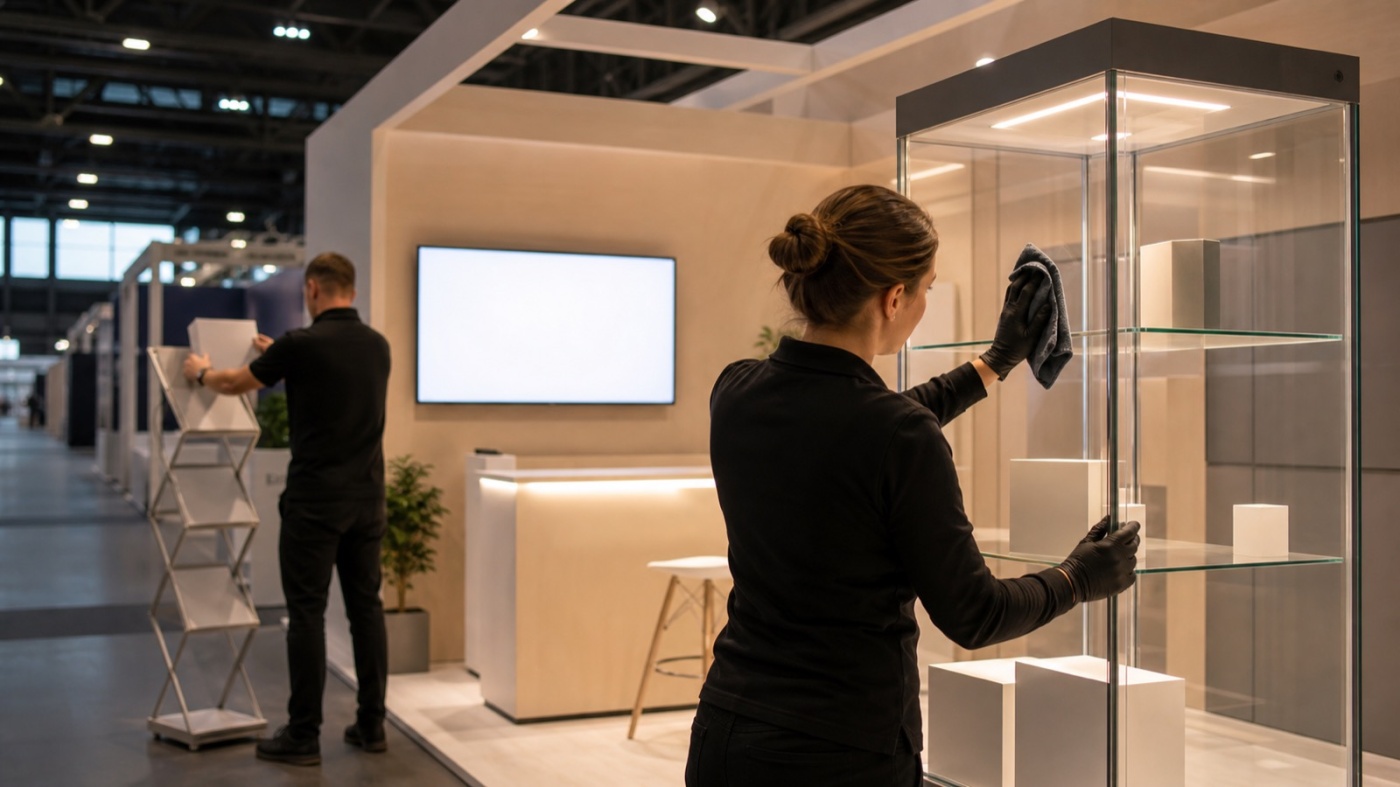
- Floor, counters and display cases checked, fingerprints removed from glass
- Screens and lighting switched on, playback running in the right loop
- Brochures, business cards and giveaways replenished, samples back in place
- Drinks chilled, glasses ready, coffee machine flushed
- Bins emptied, cables covered, personal belongings stored away
- Targets for the day and the appointment list shared with the team
Five of those minutes are worth spending on a walk-around from the visitor's side: look at your own floor from the aisle and clear away whatever stands in the way.
Keeping the technology on standby
At many venues the stand power supply runs in parallel with opening hours, often switched on around an hour before and disconnected around an hour afterwards. Equipment meant to run continuously, such as a fridge, a server, a charging cabinet or an aquarium, therefore needs a separately ordered permanent supply. Exact switching times sit in the technical regulations of the respective fair, and the connection is ordered through the exhibitor shop.
A small spares box in the stand storeroom saves long walks: lamps of the type installed, extension leads and multi-way sockets, HDMI and USB-C cables with adapters, batteries for remotes and presenters, cable ties, tape, cleaner and microfibre cloths, plus a spare key for display cases and the storeroom door.
Agree as well who steps in when something needs attention. With a full-service build, a technician stays reachable throughout the run and normally visits the stand daily, while power, water and network beyond the stand boundary belong to the venue's service partner. A contact list with names and mobile numbers by the storeroom brings both together. How we organise that support is described in our exhibition stand services.
Planning supplies instead of reordering them
Consumption can be estimated in advance. Start from the number of conversations you expect per day and add a buffer of roughly a third. Split the quantity into three portions: the daily requirement on the stand, the remainder in the storeroom, a reserve at the hotel or in the vehicle.
Three practical observations help with quantities:
- Heavy brochures travel home less often than short overviews with a QR code. A slim printed piece plus a digital follow-up after the conversation reaches more contacts.
- Giveaways disappear fastest on day one. A fixed daily ration kept in the storeroom holds stock stable through to the close.
- Tastings and drinks follow the hall climate. On warm days water consumption easily doubles against the plan.
Decide as well who tops things up. One person per shift with that job keeps the counter and the literature stands filled while conversations carry on undisturbed.
One point of contact on site
Cleaning, technology, catering and venue services all run alongside each other during a show day. A single named contact who holds those threads takes noticeable weight off the stand team and keeps it on the actual task: talking to visitors.
An evening walk-around after closing has proved its worth, together with your stand supervisor. What came up, what gets repaired overnight, what needs refilling in the morning, which valuables go into the lockable storeroom. Ten minutes in the evening save half an hour of rush the next day.
Overnight security belongs in the same conversation. Laptops, samples, documentation and high value exhibits are best kept behind a lock, and larger values can be covered by booking stand surveillance. House rules of the venue also set out how far the stand should be staffed during opening hours, so that point belongs in the shift plan early on.
Support that is agreed before the fair
On-site support during the run is a service like design, production and installation, and it belongs in the budget just as early. Before you place the order, clarify who is on the stand each day, within which time window, with what response time, and what standby includes. Record which organiser services you book yourself and which your stand builder orders for you, so every item lands in the basket exactly once.
Our overview of exhibition stand costs puts that into the context of a full budget. For your next fair, a short conversation settles which level of support suits your stand size, run time and team.