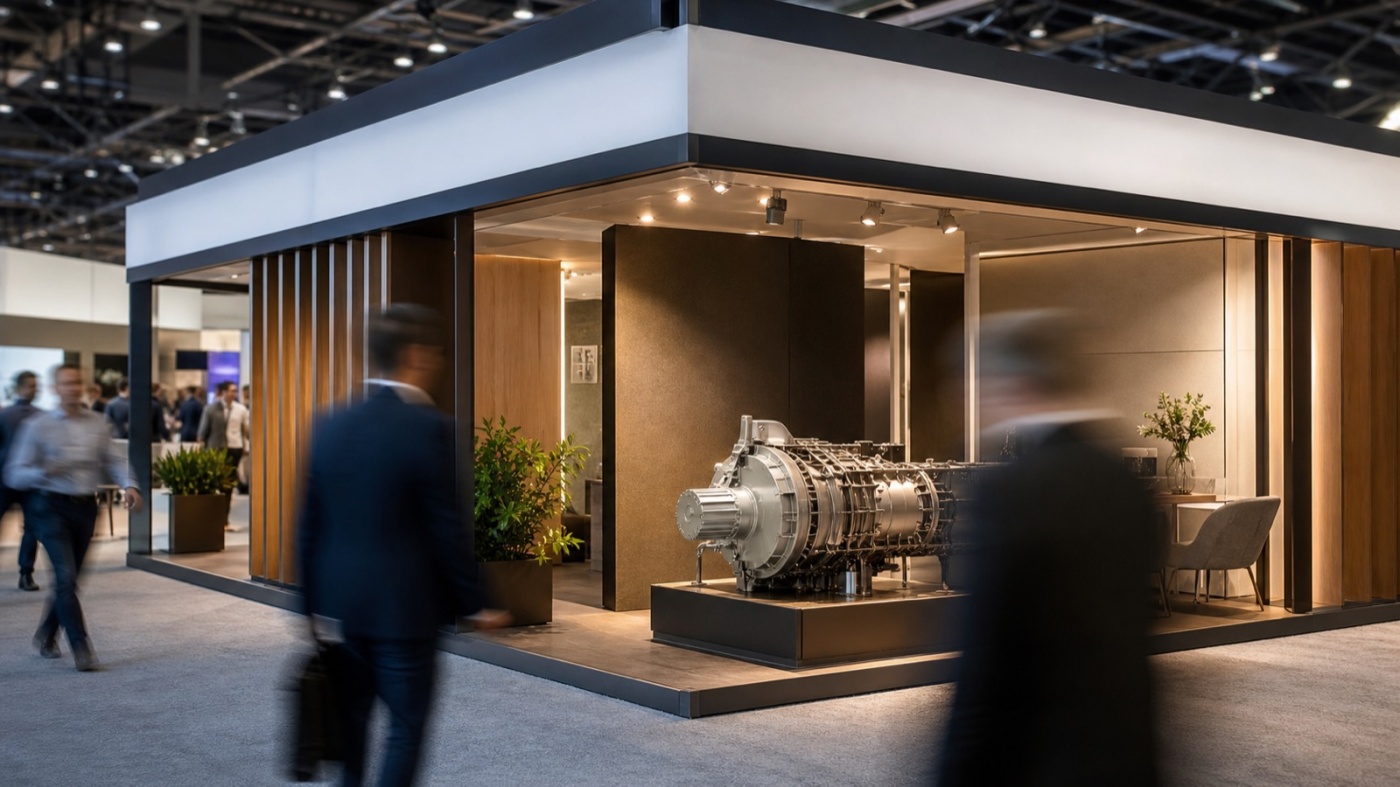
On a busy aisle, only a few paces separate one stand from the next. Within that short stretch a visitor decides whether to slow down or keep walking. The decision happens before a single word is spoken, based purely on what the eye picks up in passing.
How much time your stand front actually gets
The trade fair world likes the rule of thumb of three to seven seconds. Hard studies behind that figure are rare, yet the order of magnitude survives simple arithmetic. In a well filled hall people move slowly, roughly a metre per second. A six metre stand front therefore passes in about six seconds, and only part of that lands in the sharply focused centre of vision.
Peripheral vision does the pre-selection. It responds to brightness, movement, large shapes and blocks of colour, while letters become readable once they reach the central field. Your stand front therefore works in two stages: a signal that turns the head, and a message that rewards the turn.
Design both stages deliberately and you win visitors out of the flowing crowd. Serve just one of them and you stay largely limited to the people who came looking for you anyway.
A message that lands at walking pace
Put a single question to your stand front: does it answer within three seconds what you offer and who it is for? A company name on its own rarely manages that, and a brand claim such as "Passion for Innovation" manages it even more rarely. What works is brand plus substance. "Sealing technology for food production" says more in five words than any metaphor.
Height decides a great deal. On a busy show day the first two metres above the hall floor are filled with people, so the band above that carries the load. A fascia, the top edge of the back wall or a suspended element holds your core message most reliably. Construction heights and rigging rules come from the technical regulations of the respective venue, so clarify them before the design starts.
Legibility follows a wayfinding rule of thumb: roughly one centimetre of cap height per metre of viewing distance. Across a fifteen metre aisle diagonal that means letters around fifteen centimetres tall, set on a calm background, on matt surfaces, in few words. Everything that needs explaining belongs on a second level, visible from three metres and read standing still.
Movement and light collect the glance
The eye follows change. A machine running, an exhibit turning, a screen with slow full-frame transitions: those signals reach a visitor from the corner of the eye long before reading begins. Fast cutting sequences read as advertising and get filtered out within moments.
Light works just as directly. A stand brighter than its surroundings pulls attention, especially in halls with subdued ambient lighting. Accents on the exhibit and the core message earn more than an evenly lit surface, because the eye travels to the brightest point.
The strongest movement of all is people. A busy stand attracts more visitors, an empty one reads as avoided. Plan occasions that fill your floor during quiet hours: a short demonstration on the hour, a barista slot, a ten minute talk with an announced start.
The exhibit as an anchor at the aisle edge
A real object beats any photograph. It delivers scale, material and touch in one moment and answers the question about your offer faster than text. Place your most important exhibit well forward, within the first metre and a half behind the stand edge, at working height between roughly 90 and 110 centimetres, and within reach.
A single line beside it is enough: what it is and what it does. Anyone who stops will ask for the rest.
For services and software without a tangible product, a stand-in earns its space. A material sample, a cutaway model, a before and after comparison, a printed result: anything that occupies hands extends the visit. Our project references show how that looks in completed builds.
An open stand edge invites people in
The transition zone to the aisle decides whether attention turns into a step. Keep the first metre and a half clear. A counter set across the front, tall shelving on the corners or a seating group right at the entrance all read as a barrier, even with space beside them.
A chamfered or recessed corner works particularly well, because it guides the eye into the floor area and makes entering feel incidental. The visitor sees from the aisle what is waiting inside and decides with less effort.
Stand staff belong to that edge as well. A team standing in a circle talking to each other closes the space visually. One person facing the aisle, making eye contact and holding something worth showing, opens it. How routes, zones and dwell areas work together behind that edge is part of our exhibition stand services.
The walk-past test before the doors open
Check the effect while changes are still easy. During build-up, walk past your own stand at normal pace from both directions and note what actually registers in those seconds. Photograph the front from around fifteen metres and look at the image with your eyes half closed. Whatever stays readable there will hold up in a full hall.
The most useful test takes a minute: ask someone from the neighbouring stand to tell you, in passing, what you sell. If the answer matches your offer, stage one is working. If it drifts, move the type, the light or the exhibit before the doors open. For a stand front that works from the aisle from day one, a short conversation about your floor area settles the details.