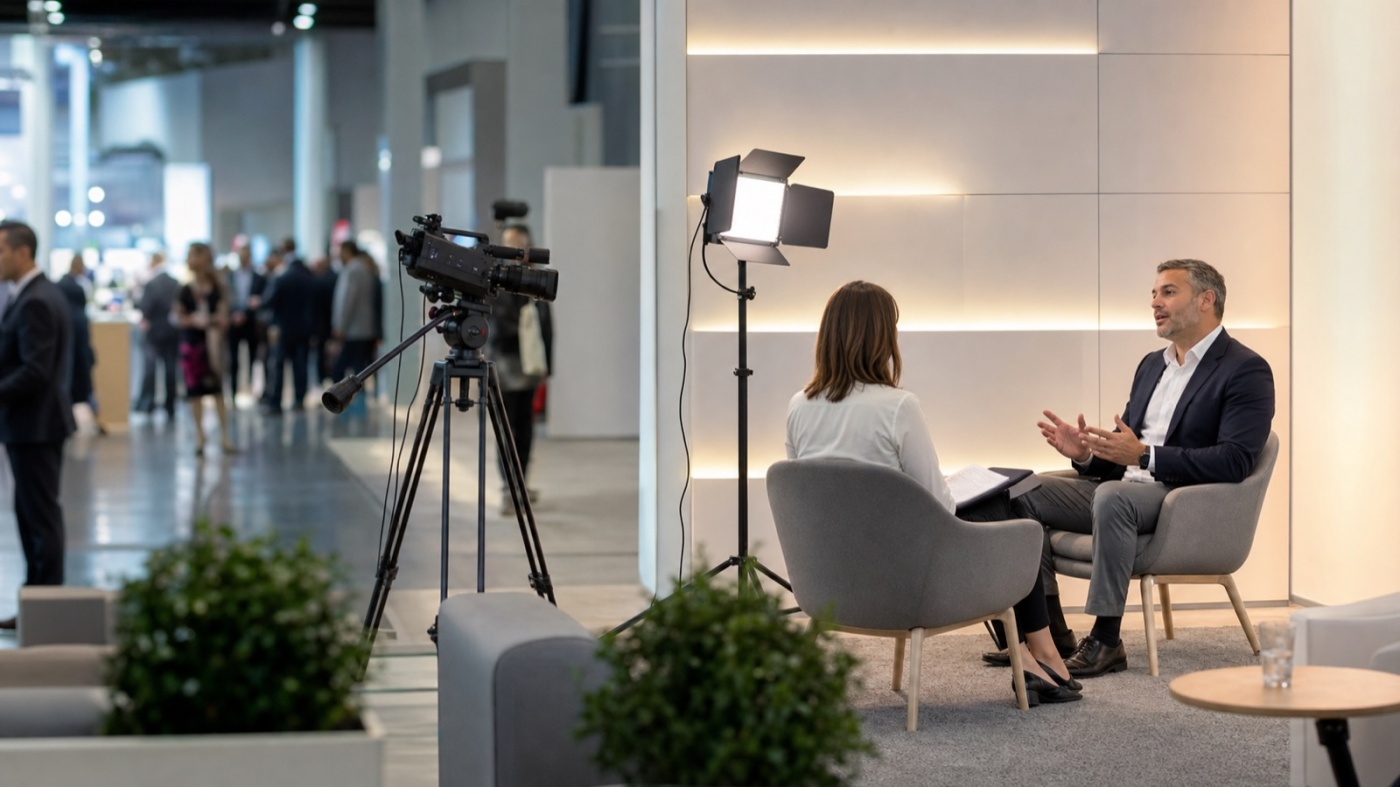
For every person standing at your stand, several more stayed away for perfectly good reasons: the buyer overseas, the engineer with a full calendar, the decision maker who sends a colleague instead. A hybrid trade fair presence brings that group in through streams, booked video meetings and content that keeps running after dismantling. Here is how it works in practice on the stand.
What the digital extension is meant to achieve
A stream is a tool, and tools need a job. So decide first who you want to reach digitally. Usually there are three groups: existing customers in markets where travel is a stretch, trade prospects whose calendar is already full that week, and the colleagues of your stand visitors who share the decision back at the office.
The format follows from that. Short live slots of ten to fifteen minutes at fixed times work well: a product demo, an interview with the developer, a customer conversation, a premiere on day one. Two or three broadcast slots per day carry more weight than continuous streaming, because they give the audience a reason to show up at a particular moment.
Treat that broadcast plan like a stage schedule. Build it weeks in advance, publish it with times, and send it out as an invitation to customers, press and sales partners. An announced stream finds an audience; a spontaneous one usually keeps itself company.
Technology on the stand: line, sound, light
The connection decides everything downstream. Order a wired internet line for the stand from the organiser, because the open hall wifi is shared by thousands of devices and many venues restrict private access points for radio interference reasons. Watch the upload rate, which is what streaming consumes, and keep a 5G mobile router on hand as a second layer.
Sound beats picture. A lavalier or shotgun microphone lifts the voice out of the hall's constant background level, and that is what the audience holds on to. Viewers forgive a slightly restless image; unclear speech sends them elsewhere within seconds.
Lighting needs little effort. Hall light falls steeply from above and carves hard shadows into faces, while one small soft light at eye level smooths that out immediately. Choose a fixed camera position with your stand graphic behind the speaker so every frame carries the brand.
All of this belongs in the floor plan rather than in the build-up week. Allow for a quieter corner, cable routes, a dedicated power circuit and somewhere to store equipment. Our exhibition stand services show how such requirements move into the design early. Run a local recording alongside the stream as well; it gives you the clean material for your media library later.
Booked meetings instead of hoping for footfall
The most effective digital building block is an unglamorous one: a booking page with open time slots. Customers pick a slot, the appointment lands in both calendars, and a vague intention becomes a commitment.
Offer two kinds. The on-site meeting brings visitors to the stand at a defined time and spreads out the peaks. The video meeting serves everyone who is elsewhere that week, and it can deliberately sit in the days after the fair, when your team has room to breathe again.
A QR code on the stand graphic, in the stream and in your email signature leads to the same page. Ownership matters just as much: one person on the stand looks after the digital track, answers chat questions and confirms appointments. Otherwise the channel runs alongside the event rather than with it.
Product demos that hold up on screen
A demo in front of a live audience works through proximity and questions. On screen you replace both with structure. A tight script with three questions, clear chapters and a fixed opening makes the demonstration repeatable, and repeatable has real value, because the same demo runs several times across three show days.
Technically, a second perspective helps: one camera close to the product, plus screen sharing for software or configurators. Where machinery is too large for the hall, 3D models, section views or a walkthrough of your production floor step in and show more than an exhibit could.
Keep the international audience in mind. Subtitles and an English version raise reach considerably, not least because many viewers watch with the sound off. And keep recordings short enough to work later as standalone clips.
Following up with clear consent
The second benefit starts after the show. Publish the recordings as a small media library, reachable through a sign-up form that states plainly what the contact will be used for. Anyone who registers there signals interest and decides for themselves about further contact.
Handle those sign-ups like every other show contact: document the consent, record where it came from, follow up promptly. The underlying principles stay the same and are described under lead capture at trade fairs.
The digital track also delivers figures that are hard to gather on the stand: stream registrations, viewers per slot, watch time, booked video meetings and views of the recording in the following weeks. Set those numbers against the cost of the digital track and your next budget conversation starts from solid ground.
What carries a hybrid presence
The stand remains the core. The personal conversation, the product in someone's hands and the chance encounter in the aisle keep their value, and that is exactly why your team travels. The digital extension adds reach where travel falls away, and it stretches the effect beyond the show week.
Three decisions carry the whole thing: an announced broadcast plan, an ordered line with a fallback, and a named person who looks after the channel. Set these points during stand planning and the hybrid part grows out of the design itself. For your next show, a short conversation about floor area and technology settles the open questions.