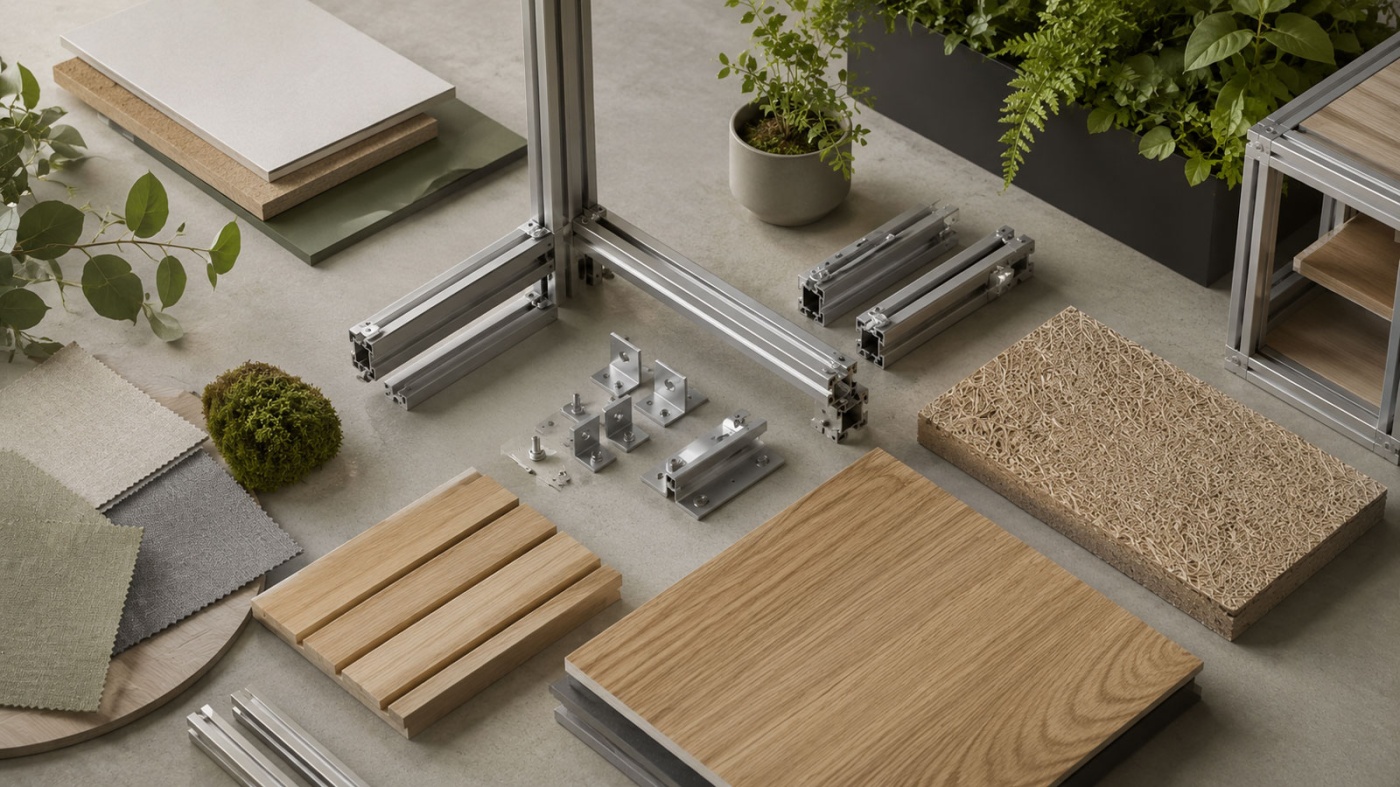
When you plan a trade fair appearance, you sooner or later face the question of how to combine an effective stand with a responsible use of resources. Sustainable exhibition construction is no longer a niche topic but a practical decision about how a stand is built, used and reused. The central point is the method of construction, meaning whether a stand is made for a single appearance or whether it can be reassembled in new forms over many years.
This article explains why modular systems are considered the future of exhibition construction and which concrete advantages they offer in everyday practice. It looks at the materials involved, at the idea of a cycle instead of single-use construction, and at the economic side across several appearances. The documentation of sustainability, meaning proof, reporting duties and certificates, is covered in a separate article on sustainability proof requirements. Here the focus is on the built substance itself.
What Defines Modular Systems in Exhibition Construction
A modular exhibition stand does not consist of a single glued construction but of standardised components that can be combined into different stands. The basis is usually an aluminium frame that is connected without tools or with only a few steps. A system stand can therefore be dismantled after the fair, put into storage and rebuilt in a new shape for the next appearance. The components are deliberately designed for repeated use rather than for a single occasion.
The difference from classic single-use construction is fundamental. Conventional stand building often produces custom walls and structures that are disposed of after the event. A modular system reverses this principle because the load-bearing components remain while only the configuration changes. From the same profiles, a whole series of very different stands can be created over the years, without building everything from scratch each time.
Reusable System Components: Aluminium, Fabric and LED
The durability of a modular stand depends on the materials used. In practice, three groups of components are especially common because they store well and can be used again and again:
- Aluminium frame profiles form the basic structure. They are stable, light and can be reassembled as often as required.
- Fabric graphics, meaning printed textile panels held in tension frames, replace rigid printed boards. The motif can be exchanged while the frame stays in place.
- LED elements and lighting are used as modules and can be installed in a different position from one fair to the next.
What these components have in common is that they can be separated from one another. Because graphics, frame, light and technology can be taken apart, a change of appearance does not require the whole stand to be produced again. Often it is enough to swap the fabric graphic for a new motif while the load-bearing structure continues unchanged. This saves material and keeps the existing components in circulation.
A Cycle Instead of Single-Use Construction
Sustainable exhibition construction relies on the idea of a cycle. A system stand does not end when it is taken down but goes through a recurring sequence of storing, checking, repairing and reconfiguring. After the fair the components are placed in storage, checked for completeness and condition before the next use, and repaired where needed. Damaged individual parts can be replaced without affecting the whole stand.
This cycle extends the service life of the materials considerably. A component that is cared for and stored properly is ready for many further appearances. Instead of a single act of consumption, there is a lasting use in which the same components stay in service for years and only the arrangement is adapted to each goal. A digitally managed warehouse helps to keep track of the stock and to plan components back into use in a targeted way.
Fewer Resources, Less Waste
Reuse leads directly to a lower burden. What is used several times does not have to be produced several times. As a result, material consumption falls and noticeably less waste is created, because fewer structures are discarded after a single use. Transport also benefits, since system components are usually built to be compact and light in weight and can be loaded in a space-saving way.
There is also a practical advantage on site. Modular systems can be set up and taken down in less time than elaborate custom constructions, because the connections are designed for repetition and the team knows the sequence. Shorter assembly and dismantling times mean less effort in the hall and a calmer process around the event, which matters in particular during the tight windows before a fair opens.
Economic Advantages Across Several Appearances
A modular stand is not necessarily cheaper to acquire than a simple single-use build. Its economic advantage shows across several appearances. Those who exhibit regularly spread the cost of the basic structure over many fairs instead of building anew for every event. With each further use, the share that a single appearance carries of the substance becomes smaller.
Added to this are the saved efforts for disposal and new production, together with the plannable processes for storage and assembly. For exhibitors with several dates per year, the modular approach therefore tends to become the more economical solution over time, without any loss in visual impact. You can find an overview of the approach on the page about sustainable exhibition construction.
Design Freedom Despite the System
A common misunderstanding is that a system stand inevitably looks uniform. In practice a modular system allows a great deal of freedom, because it defines the structure and not the appearance. Through fabric graphics, lighting, varying heights and the arrangement of components, very different appearances emerge that can be adapted to the individual brand and the individual fair.
This applies to small in-line stands as well as to large island stands. How a modular approach can look at a specific leading fair is shown in the article on the exhibition stand at Light + Building in Frankfurt. The construction method sets the frame, while the design remains individual. In this way modular exhibition construction combines a responsible use of resources with an appearance that suits the brand.
If you are considering switching your next trade fair appearance to a modular system, we are glad to advise you on the options for your fairs and stand spaces. You can reach trendSETZEREI GmbH by phone at +49 69 201 65 001 and by e-mail at info@dietrendsetzerei.de.