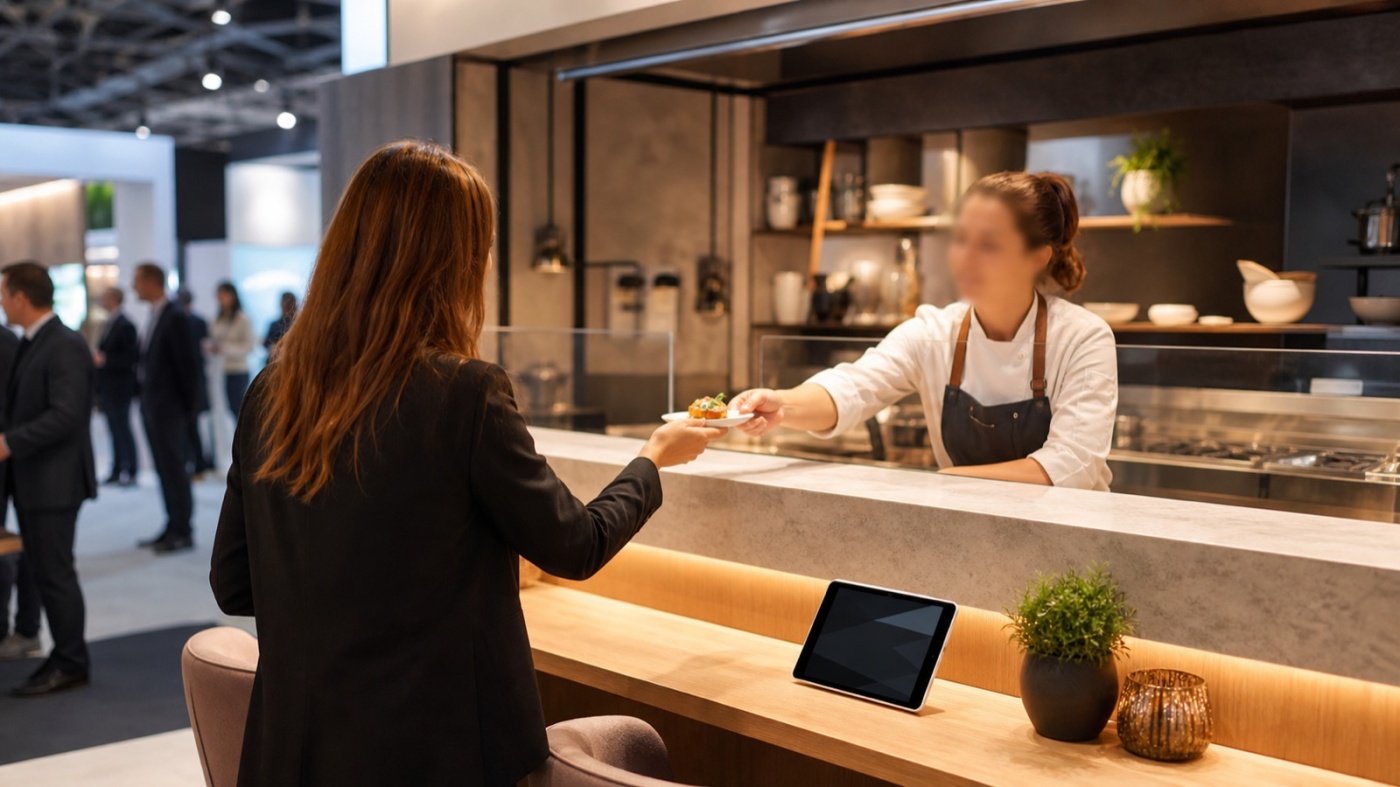
Intergastra fills ten halls in Stuttgart with kitchen technology, coffee, ice cream, beverages and interiors. Its visitors run businesses that keep operating while they walk the aisles, and they decide quickly. A well prepared stand team adapts to that long before the first sample crosses the counter.
Visitors who spend their day off at the fair
Intergastra is the largest industry gathering for the German hospitality trade and takes place every two years in February at the Stuttgart exhibition grounds, staged by Messe Stuttgart together with the regional hospitality association Dehoga Baden-Württemberg. The 2026 edition counted around 1,250 exhibitors and roughly 80,000 trade visitors. Its themed areas range from kitchen technology, food and beverages through coffee and confectionery to interiors, tableware, outdoor catering and digital solutions, with Gelatissimo running alongside as the fair for artisan gelato. Our trade fair calendar lists the coming editions in 2028, 2030 and 2032.
One characteristic shapes staffing more than anything else: the fair runs for five days and includes the weekend. Restaurateurs and hoteliers come on their day off, frequently on Sunday or Monday, often as a pair of owner and head chef, in family businesses as a trio. They have a few hours, a full notebook and one clear question in mind: does this fit my operation?
Who stands at the counter while people taste
At Intergastra people cook, brew, pour and taste. That changes how roles are distributed across a stand team. Four roles have proved their worth.
The practitioner at the machine is the most important of them: a chef, a barista, a pastry cook, someone who operates the equipment daily. Restaurateurs trust people who work the stove far more quickly than they trust a sales presentation.
Next to that stands consultation, turning interest into a concrete offer: size of the operation, output per service, kitchen layout, timing of the investment. The third role covers service and engineering with footprints, connection values, maintenance and spare parts. Finally the stand needs a host at the entrance who greets visitors and passes them on, so every guest receives attention even at peak times.
A short briefing keeps the team aligned. Three questions asked by everyone are enough: what kind of operation, what volume per day, when is the next investment due? Those three answers later set the priority for follow-up.
A shift plan for five days including the weekend
Five consecutive fair days demand stamina. At the cooking station heat and noise add to it, and during weekend peaks the team works through long stretches. A shift plan finalised before the fair keeps quality high right through to the final day.
A proven pattern combines a fixed core present every day, keeping the overview, with rotating staff on morning and afternoon shifts. Fixed breaks belong in that plan like appointments, complete with a named stand-in.
For staffing density a simple guide helps: allow one person per conversation seat and per demonstration station, plus the host at the entrance and a reserve. At Intergastra this calculation runs higher than at a purely technical fair, because demonstrations occupy people who can barely advise at the same moment.
Travel and build-up day deserve a thought too. Anyone taking the first Sunday shift travels the evening before. The grounds sit directly at Stuttgart Airport and are easy to reach, while hotel rates rise around the fair, which makes early booking kind to the staffing budget.
Capturing leads while hands are busy
Lead capture at a tasting fair calls for solutions that work with busy hands, and it always rests on the visitor's consent. The guest actively decides whether their badge is scanned and learns in one sentence what the data will be used for and how long it will be stored.
In practice this works best at points where visitors pause anyway: at the counter, at a seat, at the end of a demonstration. A tablet or scanner at those spots, with a short form of a few mandatory fields and one free text box, beats reconstructing contacts from business cards later.
Qualify immediately. Type of operation, requirement, timeframe and a rating of A, B or C take ten seconds and save hours afterwards. The sentence in the free text box often carries more value than any dropdown: a note such as "extending the terrace in April, looking for a second combi steamer" writes the follow-up email by itself.
Two technical hints help. Keep lead capture usable offline, since hall networks can run at capacity on peak days, and keep a paper pad ready as a fallback. Each evening the day's notes move into the list while the faces are still fresh.
The weeks after the fair shape the season
The February date is a gift, because it sits right before the season. Kitchen equipment, outdoor furniture and gelato machines should be running when terraces open in spring. Between the fair and the season start lie delivery times, planning appointments and installation weeks. Answering quickly often wins the order through availability alone.
For A contacts a reply within two working days has proved effective, referring to the actual conversation rather than arriving as a bulk mailing. B contacts receive a short, useful message, C contacts join the newsletter. What matters is that responsibilities are settled before the fair: who covers which region, who writes quotations, who picks up the phone?
In the end one figure counts: cost per qualified contact. It relates floor space, construction, staff and catering to the result and makes the next decision straightforward. Our page on exhibition stand cost explains what makes up the stand side of that calculation.
The stand itself contributes more to that result than it first appears. A seat, a shelf for bag and notebook, calm behind the demonstration area, a store room for supplies and a fixed place for lead capture: details like these are created during planning and pay off on every single fair day. That is exactly where our exhibition stand services begin.
From February into the terrace season
Intergastra rewards preparation. A team with clear roles, a shift plan that carries five days, a lead capture routine that follows the conversation instead of interrupting it, and a follow-up plan agreed before the fair: these four elements shape the return more than any additional square metre.
There is time before the next edition in February 2028 to assemble the team and tailor the floor space around it. We are glad to talk through both, from the first sketch to dismantling.