DOMOTEX in Hanover has reinvented itself. What began as the leading trade fair for floor coverings now presents interior finishing as a whole, and that changes what a stand needs to deliver. If you are exhibiting there for the first time, the task is an appealing one: turn a modest floor area into an appearance that retailers, installers and architects remember.
A trade fair that looks at the whole room
DOMOTEX takes place on the Deutsche Messe grounds in Hanover, traditionally in January. The most recent edition brought together more than 500 exhibiting companies from over 50 countries across twelve halls. With its repositioning, the fair now presents itself as the "Home of Flooring & Interior Finishing" and has widened its portfolio well beyond carpet, parquet, laminate and resilient flooring: ceramic tiles, wall and ceiling elements, paints and coatings, wallpaper, outdoor surfaces as well as sun protection and shading are part of the programme.
For a first-time exhibitor that is good news. Trade visitors from the flooring crafts, specialist retail, contract business and architecture walk the halls with a wider view and look for connections between products. A floor covering gets judged together with the wall surface, the lighting and the feel of the room. That interplay works on a compact stand just as well as on a large one.
Current dates and registration deadlines come from Deutsche Messe. You will find an overview of upcoming editions in our trade fair calendar.
How much space a first appearance really needs
Many companies start with a row stand in the lower double-digit square metre range. That is enough for a convincing debut, provided the area gets used with discipline. A row stand opens to one side, so the back wall carries the entire long-distance effect. A corner stand opens to two aisles and doubles the contact surface, usually for a moderate surcharge on the space rental. At the same square metre count, a corner position clearly raises the number of conversations.
Location inside the hall counts for more than any extra square metre. The Hanover grounds are generously laid out, distances are long, and visitors orientate themselves by thematic clusters. A small stand inside the right product environment gets found more often than a larger one at the edge of an unrelated neighbourhood. When you apply for space, ask specifically about main aisles, hall entrances and the companies around you.
Budget the area three times over: space rental and mandatory fees go to the organiser, on top of that come stand construction and operation with staff, travel and hospitality. Our overview of exhibition stand cost shows how these items relate to each other.
The floor as the exhibit: a presentation you can walk on
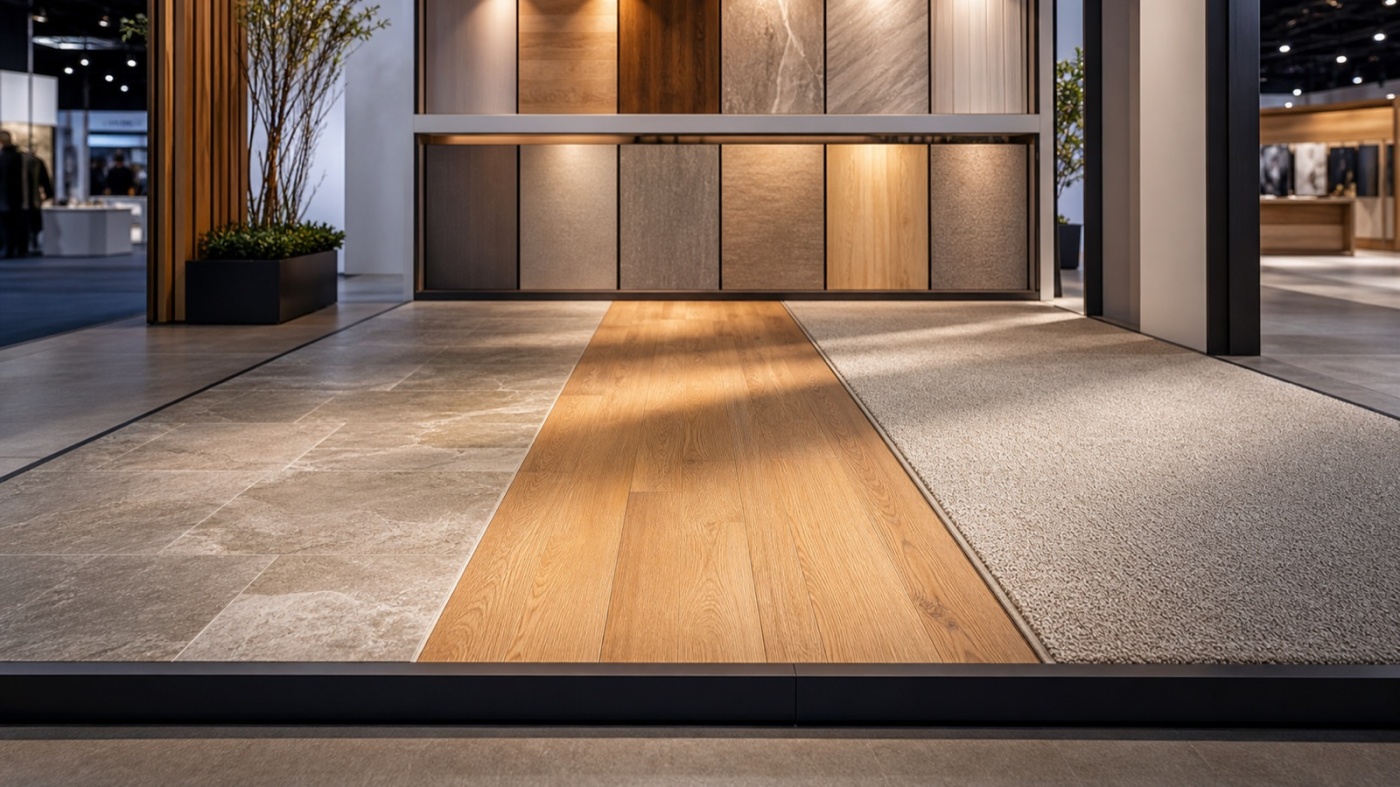
Floor coverings live from touch. Visitors walk across them, kneel down, run a hand over the surface and turn a sample into the light. On a compact stand one recommendation follows from that: make the stand floor itself the exhibit. Three or four coverings laid in generous walkable fields do more than twenty samples in a rack.
Show the details that professionals read as quality: transitions, skirting connections, joint patterns, laying direction. For a trade audience those are the real arguments. A narrow cut-away that reveals the build-up replaces several paragraphs of text.
Lighting decides as well. Grazing light emphasises structure and relief, even light renders colour correctly. Using both on the same stand pays off, so every covering shows its strength. Vertical sample holders on the back wall keep the floor free for movement, and seating for two is enough to deepen a conversation.
One theme rather than the full range
The most common wish among first-time exhibitors is to show the entire programme. On twelve or twenty square metres, concentration wins. Choose one collection, one innovation or one application and build the appearance around it. Everything else belongs in the conversation, the catalogue and the screen.
That decision reaches all the way into the signage. From five metres away a passing visitor reads exactly one line: your name and your topic. Once they stop, the second level follows with technical detail placed directly at the product.
Plan where your staff will stand as well. On small areas an occupied counter blocks the entrance, while an open position at the side of the stand feels more inviting. Two people taking turns are enough for a row stand, and appointments arranged in advance with existing customers fill the quieter morning hours.
Capture contact data in a way that lets the visitor agree openly and see what it will be used for. A short tablet form with a visible consent step builds trust and delivers clean data for the follow-up.
From a first appearance to a reusable stand
A modular system stand makes the entry particularly relaxed. Aluminium frames with textile prints assemble without tools, adapt in size and graphics and recombine year after year. Companies testing a fair for the first time often choose the rental route and decide later about owning stock of their own. Our page on how to rent an exhibition stand explains when that pays off.
On timing, one rule of thumb helps: the earlier, the calmer. Six to twelve months of lead time leave room for concept, visualisation, production and logistics. Dimensioned stand drawings go to the organiser well before build-up starts, materials meet the required fire classification, and special structures call for additional documentation. The technical regulations of the respective edition always take precedence.
Clarity outperforms extra square metres
A first DOMOTEX appearance thrives on clarity. A well-placed, manageable area, a walkable floor as the main exhibit, one theme and two attentive hosts create more effect than a bigger stand without a line. If your debut is coming up, we are happy to talk through space, stand form and the right construction method.