Few trade fair appearances are watched as closely as one at IAA MOBILITY. When the mobility industry returns to Munich in September 2027, it will show vehicles, software and charging infrastructure on the exhibition grounds and in the middle of the city at once. The stand itself becomes part of the argument, because it reveals how a company handles materials.
Two settings, two build tasks
Since moving to Munich, IAA MOBILITY has run in two formats. The Summit on the exhibition grounds in Riem belongs to the trade audience: procurement, engineering, fleet managers, investors and press. The Open Space spreads across the inner city, from Ludwigstrasse through Odeonsplatz, Wittelsbacherplatz and the Residenz courtyards to Koenigsplatz, Max-Joseph-Platz and Marienplatz. Entry there is free, the audience is broadly mixed, and the organiser reported more than 400,000 visitors in the city alone for the 2025 edition.
For stand construction these are two different worlds. Inside the halls, the technical guidelines of Messe Muenchen apply, covering build heights, escape routes, screening towards neighbours and fire safety classes. On a city square, weather, ground conditions and neighbours join the list: structures rest on ballast rather than anchors, cobblestones call for a levelling substructure, delivery windows are tightly scheduled, and every square comes with its own site regulations. Exhibitors who use both settings therefore plan two build methods with one shared design language, and they start early.
This is exactly where a decision taken long before the first sketch pays off: the choice of a system that stands more than once.
Reuse starts with the system you choose
An IAA MOBILITY appearance is created for a fair held every two years. A stand built for that single date spends the time afterwards in a container or at the recycling yard. A modular stand goes into storage instead, gets inspected, reconfigured and appears the following year at a trade fair, an in-house exhibition or a dealer event.
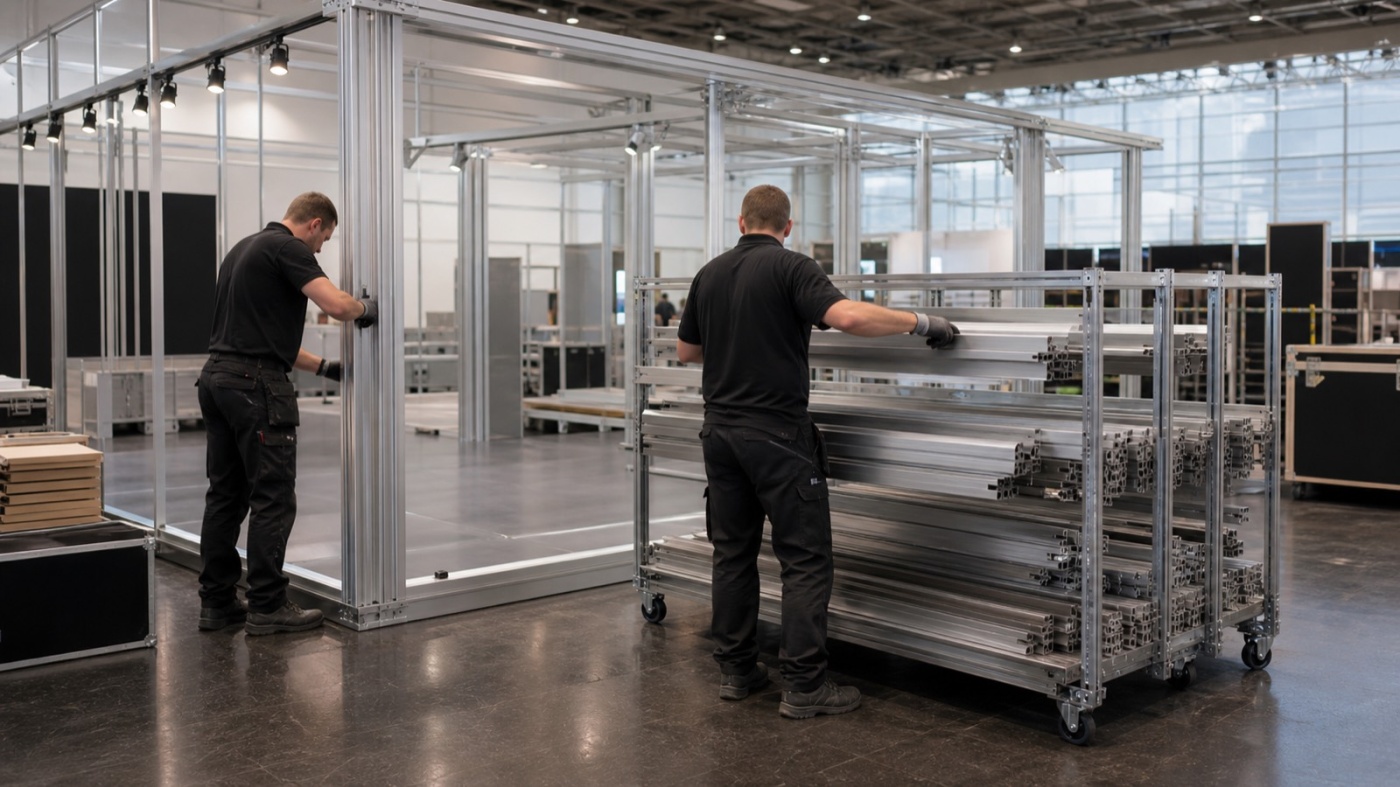
Modular aluminium frames with fabric graphics and LED tiles connect without tools, combine in standard dimensions and can be swapped individually. If transport damages one element, you replace that element rather than the whole wall. Graphics sit in the frame as printed fabric, so the image changes while the structure stays. For exhibitors with changing footprint shapes, the rental route deserves a look as well, because the substance stays with the stand builder and only the configuration changes (more on that under rent an exhibition stand).
The real gain appears at the second and third use. Only then do production effort and material input spread across several appearances, and only then does a statement of intent turn into a figure you can defend.
Dismantling belongs in the design
How well a stand can be reused is decided at the drawing board. Three questions lead reliably further.
First: how are the parts joined? Screwed, clamped and plugged connections open and close again. Bonded layers of timber, foam and film end up as mixed waste.
Second: how clean does the material stay? An aluminium profile, a timber panel and a fabric panel each return to their own material loop. A composite element made of three bonded materials goes to residual waste.
Third: how does the stand travel back to storage? Parts in standard dimensions fit existing transport frames, carry a label and hold a fixed place in a digitised warehouse. Special formats without matching packaging tend to disappear from the inventory within a few years.
Then comes the choreography of dismantling. A dismantling plan defines which trade works in which order, which parts go into storage, which fractions stay separated and who hands the space back. That single plan decides whether the end of the fair brings a controlled deconstruction or a demolition.
Figures that carry a report
In the mobility sector, sustainability gets audited. Procurement and sustainability teams ask for evidence, because reporting duties and supplier ratings call for numbers. For a trade fair appearance those numbers come out clean as soon as the recording runs from day one:
- material list with quantities per material
- share of reused components in the overall stand, evidenced through storage history
- transport distances and vehicle utilisation for delivery and return
- power consumption on the stand, split into lighting, media technology and exhibits
- recovery routes for each waste fraction after dismantling
- photo documentation of stored components as a basis for the next edition
The organiser sets a direction here. In the organisational and technical documents of earlier editions, IAA MOBILITY explicitly recommended reusable and recyclable materials and offered a compensation route through a climate partner for the Open Space. Which requirements apply to your edition is stated in the current guidelines; the underlying stance has stayed stable across several editions.
What matters most is honest labelling. A reuse rate remains a self-reported figure as long as it comes from your own storage history. That is precisely why every number deserves a stated source. How that works in practice is described on our page about sustainable exhibition stands.
What stays once the stand comes down
IAA MOBILITY rewards appearances designed to outlast the event. A stand that comes apart, goes into storage and returns in a new configuration eases the budget at its second outing and delivers the evidence procurement and reporting teams ask for. If you are planning one of the coming editions, it makes sense to start with the warehouse and the dismantling plan, and to reach the back wall afterwards. Completed work is shown in our project references, and we are glad to discuss the right build method for hall and city square early in the project.