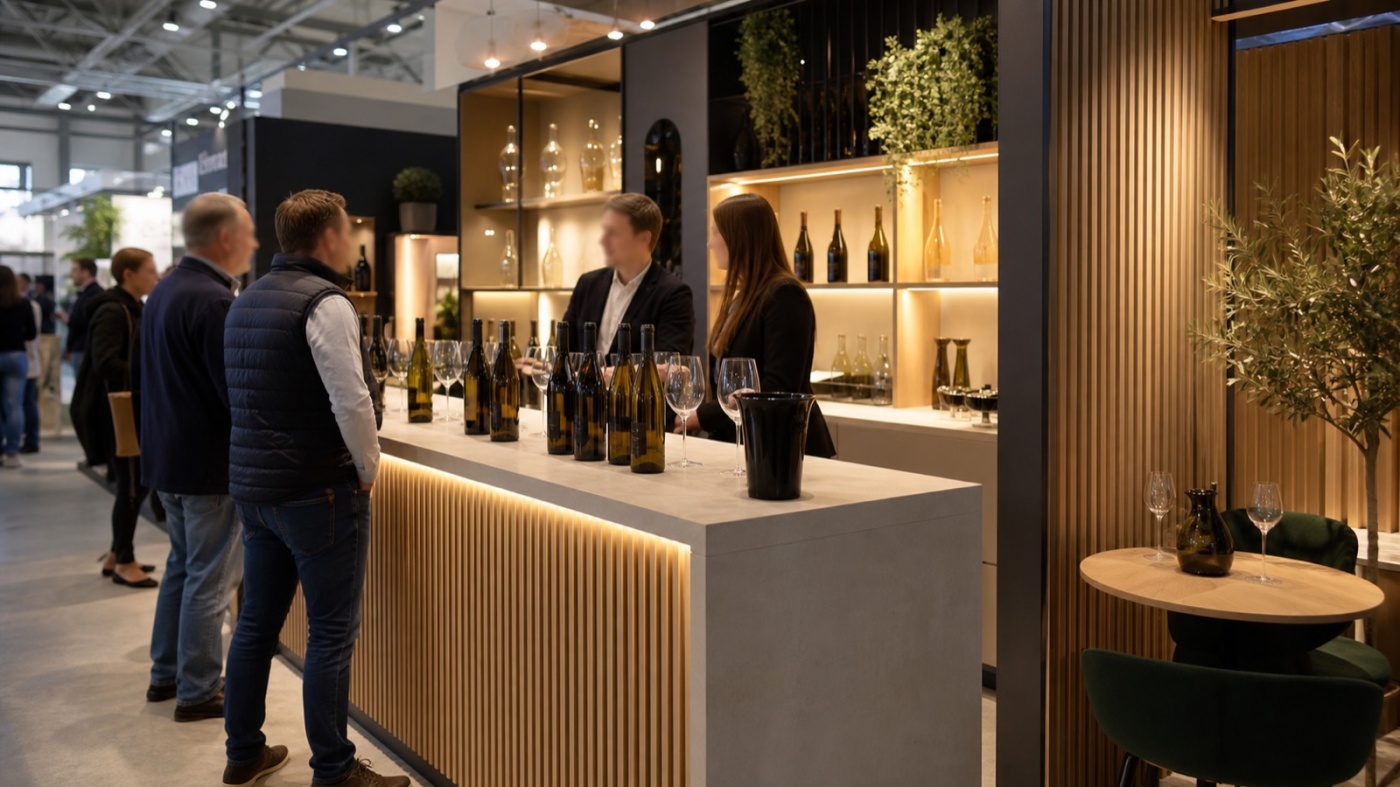
Three days in March, the Düsseldorf exhibition grounds full of buyers from retail, hospitality and import: ProWein is where tasting turns into listing decisions. Unlike a technology fair, a single piece of furniture carries most of the responsibility for how your show goes.
Who ends up at your counter
ProWein runs as a trade-only event. Visitors come from the wine and spirits trade, from restaurants and hotels, from food wholesale and retail, from importers, exporters and mail order businesses, joined by trade associations and specialist media. They arrive with a buying brief and work through a list at speed. Someone who tastes thirty wines in a day decides within seconds whether a stand deserves a second look.
The product range covers still and sparkling wine, spirits and alcohol-free alternatives, along with packaging, accessories and services for retail and hospitality. Themed zones group spirits, alcohol-free products, organic wines, sparkling wine, champagne as well as packaging and design. The hall plan of each edition shows where your growing region sits.
Stand sizes at this fair tend to be compact, frequently inside a joint presentation of a region or a producing country. On twelve, twenty or thirty square metres, every centimetre that opens a conversation earns its place ahead of decoration.
The tasting counter as your main furniture decision
At ProWein the counter serves as reception, workstation, stage and negotiating table at once. It governs how many people taste at the same time, how long they stay and how confident your team appears while pouring.
Three dimensions shape the effect. Length defines how many tasting positions sit side by side; as a furniture planning rule of thumb, allow sixty to seventy centimetres per guest so that two glasses, a notepad and a pair of elbows fit comfortably. Height governs posture: a bar-height counter keeps conversations brisk and mobile, a seated height invites people to linger. Depth creates the zone where bottle, decanter and spittoon keep a permanent place.
The surface deserves attention of its own. Wine leaves marks and so does water. A dark, matt, liquid-resistant top survives three show days visually intact, while a light gloss finish reveals every drop. A low upstand at the rear keeps spills contained, and a slim shelf on the guest side gives phones and catalogues somewhere to rest.
Sightlines matter just as much. Position the counter so that your team keeps the aisle in view and visitors approach from the side rather than facing a row of staff head on. Access from two sides lowers the threshold noticeably, especially for buyers walking the halls alone.
The back of the counter sets the rhythm
What visitors experience as calm at a good wine stand is created behind the counter. This service zone carries the entire logistics of three show days and deserves the same planning attention as the display side.
It holds chilled storage for white wine, rosé and sparkling wine, a section for red wine at room temperature, space for glasses in crates, a washing point with a water connection or with canisters and a collection container, bins for corks, capsules and empties, plus a lockable compartment for price lists, bags and personal belongings.
Power and water are ordered from the organiser; connection values, prices and deadlines appear in the exhibitor documents for each edition. Planning refrigeration early pays twice over: a cooling unit inside the counter body saves steps, and serving temperature stays stable throughout the day, which sparkling wine and light whites reward immediately on the palate.
One more detail earns its keep: a fixed position for a spittoon at every tasting spot, within easy reach and discreetly styled. Trade visitors use it as a matter of course, and when it stands ready as a matter of course, your counterpart tastes in a more relaxed way and stays longer.
Zones for quick pours and long conversations
A stand that handles everything at one counter reaches its limit on day two. As soon as an importer wants to talk volumes, prices and delivery routes, that conversation occupies a tasting position for half an hour.
A two-part layout works well. At the front, along the aisle, sits the open tasting: standing height, quick contact, changing audience. Behind it or to one side sits a second zone with seating, screened by a shelf unit, a half-height wall or a fabric panel. This is where scheduled appointments happen.
Even two seats change the quality of conversations noticeably. People who sit down take their time, note conditions and reach preliminary decisions. With more space, a table for four with room for samples plus a screen showing range, origin and awards adds real value.
Hospitality goes beyond the wine itself. Proper glassware, plenty of water, neutral bread and a small bite that matches the origin, cheese, olives or ham for instance, extend the visit and frame your range. Serving drinks and food follows the organiser rules on hygiene, waste and in some cases catering fees, so an early look at the exhibitor information pays off. Our page on exhibition stand services shows which parts of this we take on.
What a well-planned counter is worth after the show
The counter is the component that stays with you for years. Built modularly with aluminium frames and interchangeable fabric graphics, the base structure remains while vintage, imagery and range labelling change from edition to edition. That lowers cost noticeably from the second appearance onwards and makes planning calmer. Dates for the coming editions are listed in our trade fair calendar.
For your planning this means starting with one question: how many people should taste with you at the same time? Counter length, staffing level and service zone follow from the answer, and everything else falls into place around that core. To talk through your next ProWein appearance, send us your key figures and we will develop a proposal including a visualisation.