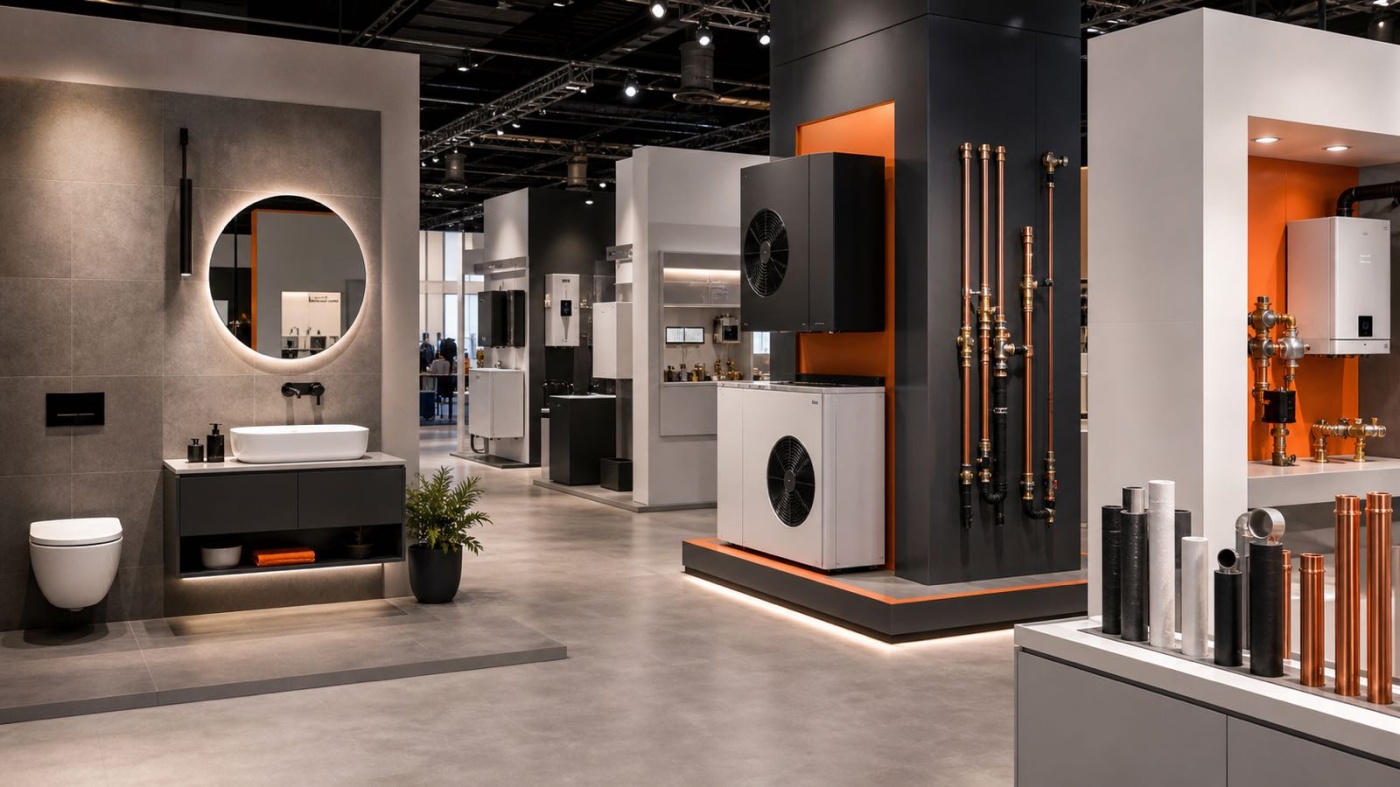
ISH in Frankfurt is the leading global trade fair for water, heating and air conditioning. Every two years, manufacturers and specialists from the sanitary, heating, ventilation and building services sectors, often summarised as HVAC and sanitary technology, meet here. For exhibitors from this field, the fair is a central date for showing products that have to perform in real operation: fittings that carry water, heating systems that give off heat, and ventilation technology that visibly does its job. An exhibition stand for ISH therefore comes with particular demands, because it has to supply technical exhibits safely while also offering a high-quality setting for detailed advice.
This guide is written for exhibiting companies from the HVAC and sanitary sector who are planning their appearance at ISH. It explains, in a factual way, what matters at the Frankfurt exhibition grounds, which connections working exhibits need, how to arrange consultation zones sensibly, and which deadlines the Technical Guidelines of Messe Frankfurt set out. The aim is a realistic overview that makes planning easier, without presenting any single value as universally binding.
ISH at a glance
ISH is regarded as the world's largest trade fair for the responsible use of water and energy in buildings. It covers a broad field: bathrooms and sanitary technology, building and energy services, heating, and renewable energy. The fair takes place every two years. According to the current editorial planning, the next edition is scheduled for 15 to 19 March 2027 in Frankfurt am Main. The binding date is confirmed by the official channels of Messe Frankfurt, so you should verify it there before making any firm booking.
The range of topics extends from water-saving fittings and accessible bathrooms through heat pumps and surface heating to ventilation and air conditioning technology. For stand construction, this means that many exhibitors do not show mere mock-ups but real, connected technology. That shapes the requirements for floor space, media supply and safety more strongly than at many other fairs.
The Frankfurt exhibition grounds
The Frankfurt exhibition grounds are centrally located and well connected by motorway, rail and airport. For a stand at ISH, however, the general transport links matter less than the technical infrastructure of the halls. Four points deserve particular attention.
Water and drainage connections come first for HVAC and sanitary exhibitors. If you want to demonstrate fittings, showers, toilets or heating components in operation, you need a controlled fresh-water supply and a functioning drainage connection. These utilities are not provided across the board at every stand position, but through defined connection points in the hall floor. You should therefore check your intended stand location for available water and drainage points early and register your requirements with the organiser. The exact connection values and ordering deadlines are governed by the Technical Guidelines of Messe Frankfurt.
Delivery is the second critical point. Sanitary and heating exhibits are often heavy and bulky. During the build-up and dismantling phase, the exhibition grounds work with regulated access routes, time slots and, in places, a traffic management system, so that the halls do not become blocked. Plan delivery times, forklift requirements and the routes to your stand position early, especially if heavy technology or a double-decker stand is being transported.
Power and compressed air form the third aspect. Heating, ventilation and sanitary technology usually needs an appropriately sized power supply, and in some cases compressed air for demonstrations. These connections are also ordered separately from the organiser and billed separately from the stand construction.
The hall structure is the fourth aspect. Frankfurt has several large halls with different heights and ceiling load capacities. Wherever you plan a rigging suspension, tall structures or water-carrying installations, the hall and stand position should suit them. An early look at the hall plan prevents a concept from later failing at structural limits.
Stand requirements for HVAC and building services
An exhibition stand for ISH differs above all in that the exhibits work. This places additional demands on construction and safety:
- Working water exhibits need tight pipework, a clean transition to the drainage, and often a small services zone that houses the supply line, distributor and shut-off.
- Heating and heat pump technology produces heat, weight and sometimes operating noise. The stand floor should carry the loads, and the layout should separate noisy technology from the consultation zones.
- Ventilation and air conditioning exhibits require an unobstructed airflow and must not disturb neighbouring stands.
- Bathroom and product presentation depends on high-quality surfaces, good lighting and a clear layout that lets ceramics, fittings and materials come into their own.
These points show why the various crews have to interlock closely on a working HVAC stand: stand construction, water and electrical installation, lighting and product presentation depend on one another. If coordination is missing at any one point, the demonstration comes to a standstill.
Consultation and presentation zones
ISH is a pronounced trade visitor fair. Many conversations are technical and last longer than a brief contact at the counter. It is therefore worth planning consultation and presentation zones deliberately.
A division into several areas makes sense: an open presentation space that shows products and exhibits and draws in passing visitors, together with quieter consultation zones for in-depth talks with planners, installers, architects or buyers. Keep these conversation areas set back a little, both acoustically and spatially, from noisy demonstration technology. A small storage and service area for samples, documents and refreshments rounds off the stand. If demonstrations take place at fixed times, a compact presentation stage can help to focus attention.
Technical guidelines and deadlines
The Technical Guidelines of Messe Frankfurt apply to stand construction at ISH. Among other things, they regulate building heights, restricted-construction zones, sight screens to neighbouring stands, escape routes and fire safety. Stand construction materials generally have to be at least flame-retardant, which corresponds to fire safety class B1.
For approval, exhibitors submit dimensioned stand plans to the organiser. Special constructions, superstructures or double-decker stands often require an additional structural analysis. The exact deadlines, heights and requirements are set by the Technical Guidelines of the respective edition, which is why you should review them before detailed planning. As a rough orientation, stand construction generally works with a planning lead time of around six to twelve months, along with submitting the stand plans several weeks before the build-up begins. Only the values that Messe Frankfurt publishes for ISH 2027 are binding. You can find details on the official fair page ish.messefrankfurt.com.
Choosing a stand builder for ISH
Location plays a practical role in the choice of stand builder. It is only a few kilometres from Offenbach am Main to the Frankfurt exhibition grounds. Short distances mean shorter journeys during the build-up and dismantling phase, a faster response for follow-up deliveries, and a direct line during the fair itself. trendSETZEREI GmbH is based in Offenbach and plans trade fair appearances as a full service, from the concept through design and production to logistics and assembly.
A modular system build lends itself well to ISH. Aluminium frames, textile skins and LED technology are combined into a stand that can be adapted and reused. Across several fairs, this reduces effort and material consumption while still allowing a high-quality, individual design. You can find more about services and process under exhibition stand construction in Frankfurt.
Choosing stand size and form
Stand size and form determine how your appearance at ISH comes across and how well working technology can be accommodated. The floor area depends on the number of exhibits, the space needed for water and services zones, and the desired number of consultation places. For many working exhibits, more space tends to be required than for a purely visual product display.
With the stand form, much depends on the position in the hall. A row stand is open on one side, a corner stand on two sides, a head stand on three sides, and an island stand is accessible from all sides. More open sides mean more visibility, but also higher demands on a well thought-out flow of visitors and on the placement of the technology. Which form suits your goals is set out concisely in the overview of stand types.
Conclusion
A successful appearance at ISH combines two things: a robust technical foundation and a high-quality presentation. If you clarify the water and drainage connections, the power supply and the delivery early, and coordinate the stand construction closely with the installation of the exhibits, you avoid the typical problems around working HVAC and sanitary technology. The Technical Guidelines of Messe Frankfurt and the binding date of ISH 2027 should always be verified through the official channels.
If you are planning your trade fair appearance for ISH in Frankfurt, trendSETZEREI GmbH from nearby Offenbach supports you from the first idea to the dismantling. For an initial conversation, you can reach the team by phone at +49 69 201 65 001 or by email at info@dietrendsetzerei.de. You can find further ways to get in touch on the contact page.