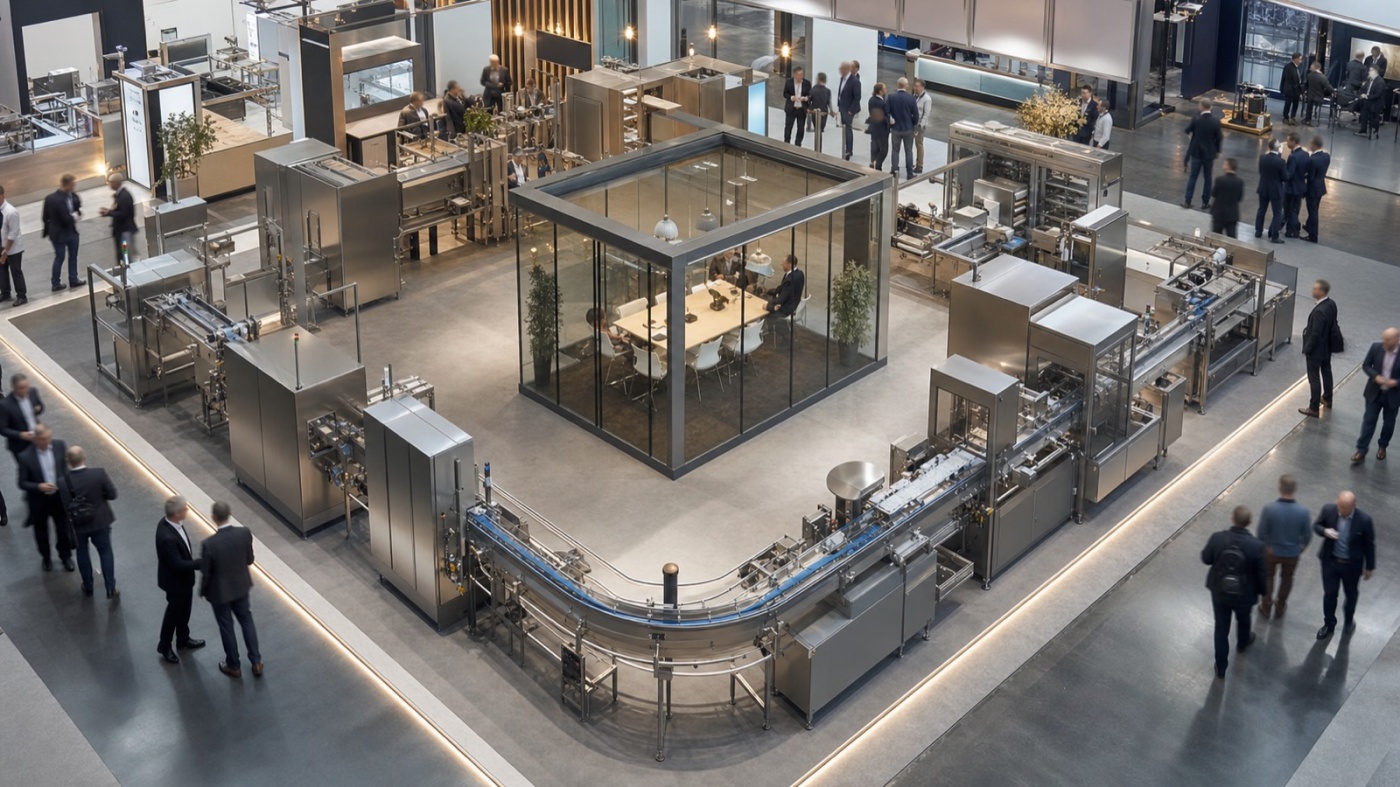
Packaging lines running at full speed next to shelves full of material samples, labelling printers next to palletising robots, cartons next to films and closures: FachPack in Nuremberg presents an industry whose exhibits range from a hand sample card to a machine weighing several tonnes. Around 1,400 exhibitors spread across eleven halls. What you show decides more strongly here than almost anywhere else how your floor area should be cut.
Four focus areas, eleven halls and a clear brief for the layout
NürnbergMesse structures FachPack into packaging, technology, finishing and logistics. The packaging area is subdivided further into packaging materials, packaging containers and packaging aids, and occupies several halls. Trade visitors arrive from food, beverages, pharmaceuticals, cosmetics, chemicals, medical technology and from consumer and industrial goods. Current hall allocation and binding dates are published in the hall plan and exhibitor documents for each edition.
For stand planning, this order has a pleasant side effect: you know quite precisely what a guest expects when entering your hall. Anyone looking for packaging containers wants to compare, touch and take samples. Anyone looking for machinery wants to see a line running. The right stand shape follows directly from that.
In-line stand: one open side with a clear message
The in-line stand sits with one open side towards the aisle and three closed walls. For suppliers of packaging materials, containers and aids it is often the most economical choice, because the rear wall becomes one large sample wall: folding cartons, films, labels or closures can be shown sorted in a shelf grid, and a visitor grasps the range at a glance.
The craft lies in the open edge. It has a few seconds to convey industry and benefit. One large, calm graphic above and a single highlighted exhibit at eye level achieve more here than a crowded display. An in-line stand also suits a first appearance at FachPack, because area and budget stay easy to oversee. Our page on exhibition stand cost explains the main cost drivers.
Corner stand: two aisles, two opportunities
The corner stand opens towards two aisles and therefore sits at a crossing of visitor flows. For exhibitors with a smaller machine this is often the turning point: the corner itself becomes a stage, the exhibit runs visibly from two sides, and the two remaining walls take on sample storage, cloakroom and a small meeting alcove.
What counts is how you assign the two sides. A proven approach dedicates one side to demonstration and the other to conversation. Crowds and detailed technical talks then coexist comfortably, and your team keeps an eye on both entrances.
Peninsula stand: three sight lines for a mid-sized line
The peninsula stand closes a row of stands and opens towards three aisles. At FachPack it plays to its strengths with machinery of medium size, for example a case erector, labeller or closing station that works visibly from every direction. All round visibility of a running exhibit creates exactly the pull that machinery suppliers rely on.
The price is precisely one remaining wall. Storage, technical cabinets and a retreat area therefore move into a built-in cabin that doubles as a carrier for graphics and monitors. Plan that cabin early, because it defines the walking routes around the machine.
Island stand: a circuit around the complete line
Anyone presenting a full packaging line with infeed, packaging process and outfeed arrives at the island stand. Four open sides allow the material flow to be staged as a circuit: the visitor follows the product from infeed to finished pallet and understands the process with few words.
Three points deserve particular attention. First, routing: a clearly marked circuit with a safety distance to the machinery keeps the flow of visitors moving. Second, signage: with no rear wall, a ceiling element, a tower or a rigged banner takes over long distance visibility, and rigging runs through the exhibition company and deserves an early booking. Third, acoustics: running machinery generates sound, which makes an acoustically calmed meeting room in the centre of the stand a wise investment.
From use to shape: the order of the decision
In practice, the right stand shape emerges from four questions answered before the space is booked.
- What is running? A moving exhibit calls for visibility from several sides plus figures on floor load, power and frequently compressed air.
- How many samples? Breadth of range needs wall surface, which points towards in-line or corner.
- How many appointments? Scheduled meetings need seats and quiet, which raises the share of closed area.
- How often do you exhibit? A modular system stand can be reassembled in a different shape for the next edition and moves into storage in between.
Only then does the conversation about square metres begin. Examples of built solutions in different shapes are shown in our project references. Special structures, overhead builds and two-storey solutions additionally follow the technical regulations of NürnbergMesse, including approval deadlines.
The shape that matches your exhibit
At FachPack, stand shape follows the task: sample wall and a clear edge on the in-line stand, a stage at the crossing on the corner stand, all round visibility on the peninsula, tangible material flow on the island. Thinking this decision through from the exhibit outwards yields noticeably more effect from the very same area.
We are glad to look at your preferred space together and develop a layout from it. A short enquiry is all it takes to begin.