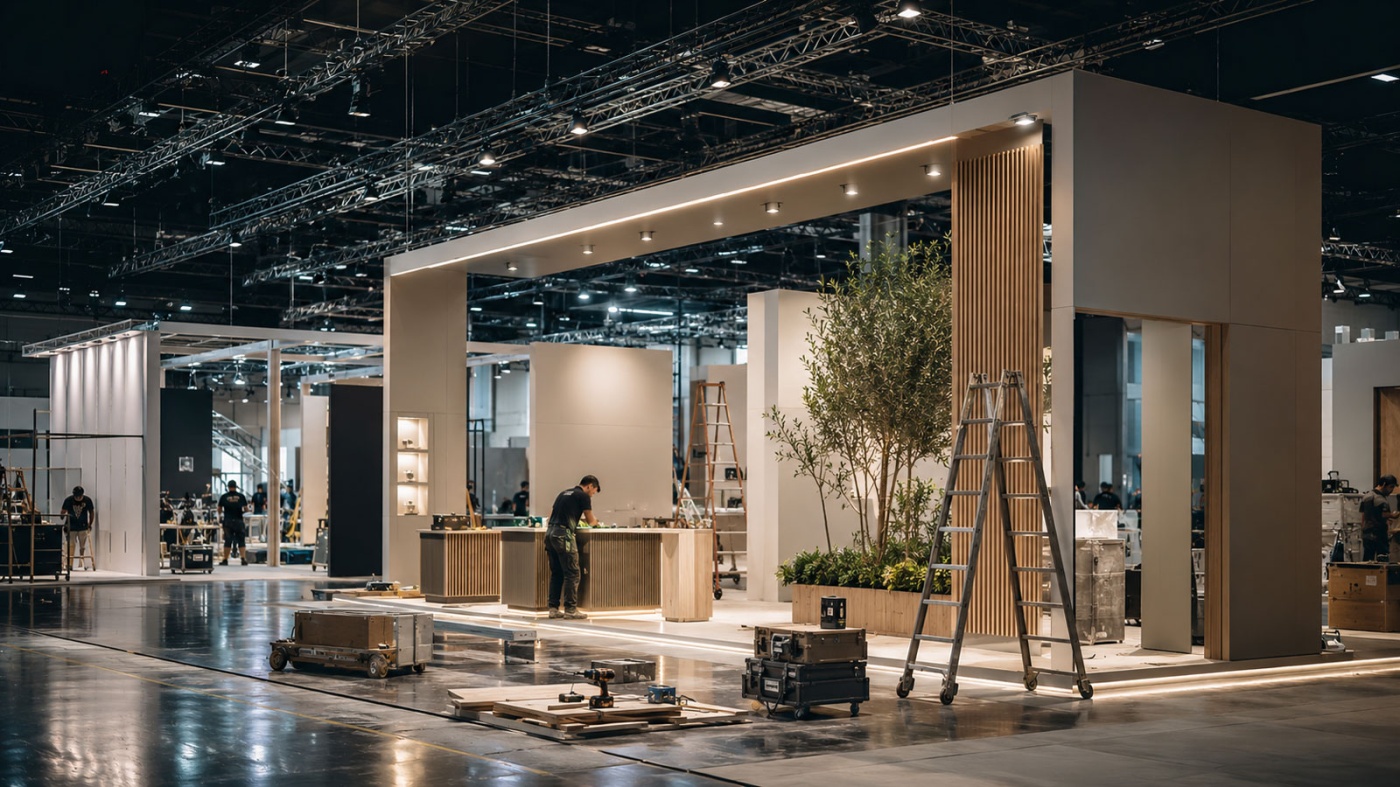
Ambiente is one of the most important international trade fairs for consumer goods, and it takes place every year at the exhibition grounds in Frankfurt am Main. It brings together manufacturers, retailers and buyers from around the world and covers a very broad range of products, from the set table through home accessories to gift articles. For exhibitors, a well thought out exhibition stand for Ambiente is the foundation for making products visible in this dense and competitive setting and for drawing trade visitors to the stand.
This guide is written for companies planning an appearance at Ambiente. It describes the Frankfurt exhibition grounds, explains what matters when presenting consumer goods, and puts the formal requirements into context. We deliberately avoid quoting specific technical values and deadlines as fixed figures, because they can change from one edition to the next. The official specifications of Messe Frankfurt are always the ones that apply.
Ambiente at a glance
Ambiente is a leading international trade fair for consumer goods. It is organised thematically into several large product areas that give structure to the route trade visitors take through the halls. These include Dining with tableware and kitchen culture, Living with home accessories and decoration, Giving with gift articles and stationery, and the Working and Kitchen areas. This arrangement helps buyers head straight for the ranges that are relevant to them.
For the next edition, the period from 29 January to 2 February 2027 is currently named. Because dates can shift, you should confirm the timing through the official channels of Messe Frankfurt before you begin your planning. The fair falls in the first half of the year and therefore marks the start of the trade fair season for many exhibitors, which means preparation needs to start correspondingly early.
The Frankfurt exhibition grounds
The Frankfurt exhibition grounds rank among the largest in the world. During Ambiente they are especially busy, because an international consumer goods fair of this scale occupies a large number of halls at the same time. The individual product areas are spread across several hall levels, so visitors cover long distances and your stand has to hold its own against a very dense environment. Knowing the hall allocation early lets you match the position and orientation of the stand to it more effectively.
Visitor flows during Ambiente are high and international in character. Trade visitors move through the halls with clear intent and often make their selection in a short space of time. A stand therefore benefits from clear sightlines and easily recognisable entry points, so that it registers with people passing in the stream. A position at aisle intersections or on well frequented routes can have a noticeable effect on the number of contacts.
One point that is often underestimated with consumer goods is the delivery of merchandise. At Ambiente, large quantities of sample goods, tableware, decoration and packaging are brought to the stand, unpacked and replenished over the course of the show. The grounds have a well developed logistics setup with delivery zones and time windows for setup and dismantling. Plan for storage space at the stand and coordinate deliveries with the organiser's requirements, so that goods reach the hall on time and without congestion.
There is also the question of access. The grounds are connected to long distance and local transport as well as motorways, and can be reached through several entrances. What is relevant for exhibitors is that setup, delivery and later dismantling all fit into tightly scheduled processes. The better you understand these conditions, the more smoothly your fair appearance will run.
Stand requirements for consumer goods
Consumer goods live from immediate impact. At Ambiente it is decided at the stand whether a product is picked up and taken into a buyer's range. Product presentation is therefore at the centre of everything. Shelves, plinths and tables should show the goods in a way that makes material, colour and finish instantly clear. A calm, orderly presentation helps more than an overloaded surface, because buyers want to gain an overview quickly.
A tactile brand world reinforces this effect. Surfaces, materials and the design of the stand should suit the brand and the product, so that the appearance feels credible. With tableware and home accessories, the impression a visitor gains from touching and examining an item is what counts. Here the stand is less a backdrop than a stage for the product.
Lighting plays a central role. Good, purposefully placed light brings colours and surfaces to life and directs the eye to selected pieces. Even general illumination provides orientation, while accent lighting highlights individual products. With glass, porcelain and decorative articles in particular, the lighting design can determine the overall effect.
Consultation and experience zones
Ambiente is where deals are initiated, ranges are discussed and orders are prepared. Your stand therefore needs consultation zones where conversations can take place undisturbed. Seating and an area that offers a little distance from the bustle of the aisle support focused meetings with buyers. A small counter area for greeting visitors complements this well.
Experience zones invite visitors to stay longer at the stand. That might be a set table, a staged living scene or an area where products can be tried out. Zones like these create a reason to pause and give your sales team the chance to start a conversation. The balance is important: presentation, consultation and experience should complement each other on the available space without blocking one another.
Technical guidelines and deadlines
Stand construction at Ambiente is subject to the technical guidelines of Messe Frankfurt. Among other things, these govern building heights, construction restriction zones, screening towards neighbouring stands, fire protection and the requirements placed on materials. These specifications are binding, and compliance is checked. Taking them into account early avoids later changes and delays.
For certain structures, stand plans have to be submitted and approved, and special constructions call for additional documentation. The connections for power, water and technical services, along with the deadlines for setup and dismantling, also have to be arranged through the organiser. We deliberately do not name specific values and deadlines here, because they can differ from one edition to the next. Consult the current technical guidelines of Messe Frankfurt for each edition and plan the approval steps with sufficient lead time.
An exhibition stand builder for Ambiente
An experienced exhibition stand builder takes many of these steps off exhibitors' hands, from the concept through production to assembly in the hall. For an appearance at Ambiente, proximity to the location is a practical advantage. trendSETZEREI GmbH is based in Offenbach am Main and therefore has a short journey to the Frankfurt exhibition grounds. Short distances make setup, dismantling, delivery and on site support during the show easier.
Modular system construction is particularly well suited to consumer goods fairs. Modular stands are made up of reusable components that can be combined for different spaces and layouts. This saves material across several appearances and makes it possible to adapt the stand to the respective hall situation. If you exhibit regularly, a stand concept developed once can be reused over the years. You can find an overview of services and how a project runs at exhibition stand services.
Choosing stand size and stand form
Stand size and stand form determine how a stand works in the hall and how many sides are open to visitors. The size depends on your range, the space needed for presentation and consultation, and your budget for the area and the build. With consumer goods that involve many individual items, sufficient presentation space is important so that the goods do not look crowded.
The stand form describes how many sides of the stand are open to the aisles. The common forms are:
- Row stand: open on one side, set between two neighbours.
- Corner stand: open on two sides at a corner, offering more visibility.
- Head stand: open on three sides at the end of a row of stands.
- Island stand: free standing, accessible from all four sides.
Which form makes sense depends on the position, the area and your goals. A corner or head stand offers more views and makes it easier for visitors to enter the stand. An island stand gives the greatest scope for design, but requires a well considered concept for every side. You can find a detailed comparison at exhibition stand types. Further information about the fair itself is available on the official Ambiente page from Messe Frankfurt.
Conclusion
A successful appearance at Ambiente combines several layers: a clear product presentation, a coherent and tactile brand world, good lighting, functioning consultation and experience zones, and compliance with the technical guidelines of Messe Frankfurt. Anyone who factors in the Frankfurt exhibition grounds with their visitor flows and their logistics from the outset plans the stand more realistically and avoids friction losses. Because Ambiente falls early in the year, an early start to preparation is worthwhile.
If you are planning an exhibition stand for Ambiente, trendSETZEREI GmbH supports you from the concept through to dismantling, with a short journey from Offenbach to the Frankfurt grounds and modular system construction. Get in touch by phone on +49 69 201 65 001 or by email at info@dietrendsetzerei.de. You can also send your enquiry through our contact page.