In mid February the organic sector meets in Nuremberg for four days. Around 2,200 exhibitors from almost 90 countries present their ranges at BIOFACH, VIVANESS for natural cosmetics runs alongside, and roughly every second trade visitor arrives from abroad. The difference between two jars on a shelf rarely sits in the jar itself, it sits in the journey behind it. An exhibition stand can make that journey visible.
An audience that reads past the label
Buyers at BIOFACH examine origin, farming, processing and certification as closely as taste and price. Organic retail, grocery chains, wholesale, food service and processors meet producer groups, importers and brands here. The halls are broadly sorted by the origin of the exhibitors, with separate areas for international and German suppliers, while the BIOFACH Congress runs in parallel in the congress centre with forums, lectures and special displays.
That congress structure shapes visitor flow. Aisles fill and empty in time with the lecture schedule, so your stand experiences waves: busy phases, and between them quieter phases with fewer yet highly attentive guests. Media technology serves both. It keeps telling the story during quiet minutes and shortens the wait at the tasting counter when the aisle fills up.
What the screen reveals and the packaging only hints at
Organic products carry their story on the label, though in highly compressed form: one seal, one country of origin, one list of ingredients. Moving images unpack that compression. They show the growing area, the cooperative, the harvest, the processing plant, the testing laboratory. Sixty to ninety seconds are enough to turn a line on a label into a chain a buyer can follow.
Evidence decides the effect. Every claim in the film deserves backing: association membership, certificates, project figures, audit reports. In front of a professional audience, one concrete shot from the field carries further than any statement in a subtitle. So show the thing itself, the hands, the machine, the date on the certificate, and leave the grand wording out.
A second thought on picture selection: the Nuremberg audience knows this industry. Footage from your own production, with your own people, travels much further than stock material many visitors have already seen at other stands.
Running quietly: sound, subtitles and almost 90 countries of origin
In a full hall of conversations and tastings, sound struggles to get through. Design the film so it works without a voice-over: clear images, short text panels, legible subtitles. That solves the language question at the same time, because subtitles in two or three languages come together faster than several audio tracks, and an international audience prefers reading along to listening through hall noise.
Three rules have proven themselves in practice. First, run a seamless loop with no obvious beginning, so every guest can join at any point. Second, size type for the real viewing distance, which on an LED wall also determines the sensible pixel pitch. Third, use portrait format for people and products, landscape format for fields and scenery.
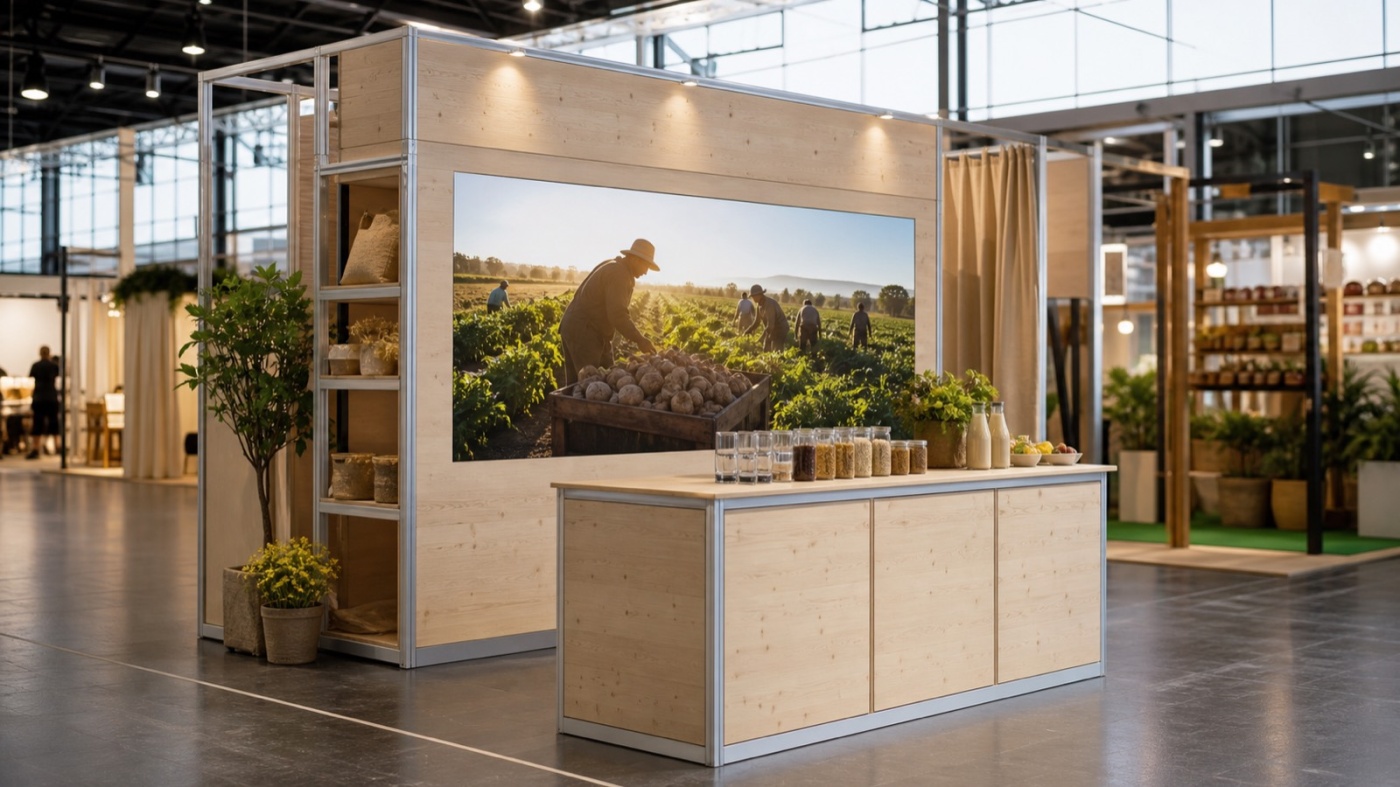
And build the screen into the stand. A display sitting flush in a timber frame or in the system wall reads like a window into the origin of the product. A free-standing monitor on a rolling base reads like equipment.
Digital elements that take pressure off the tasting counter
A second layer pays off alongside the film: short digital routes to information that otherwise consumes talking time. A QR code on the shelf leads to the data sheet, certificates, pack sizes and availability. A tablet at the side collects sample requests. A digital schedule shows when the next tasting starts.
Your team gains time for what technology replaces only poorly: letting people taste, giving context, answering follow-up questions. Contact details are collected purely with explicit consent, for example when a guest fills in a short form personally or has a visitor badge scanned while seeing which details are stored. That openness suits an audience that treats transparency as a standard anyway.
Technology that matches your sustainability promise
At an organic trade fair, visitors also look closely at the stand itself. Screens fit that setting well, provided the decisions around them fit too: rent equipment instead of buying new each year, integrate displays into a reusable system grid, match brightness to the hall lighting and switch everything off overnight.
The comparison across several editions is telling. Changing content digitally saves printed wall surfaces that would otherwise be produced and discarded every year. Together with a modular structure this creates a record that stands up to scrutiny, and retail buyers increasingly ask for exactly such records. Our page on sustainable exhibition stands shows how we put this into practice.
Footage that keeps working long after the four show days
The largest lever lies in reuse. A film about growing and processing runs on the stand, then on the website, in sales meetings, in retail presentations and as short clips on social channels. The production pays for itself across the whole show year rather than across four days.
Examples of stands with integrated media technology appear in our project references, and upcoming editions are listed in the trade fair calendar. For a first proposal, your floor area, preferred hall, existing footage and the number of tasting positions are enough.