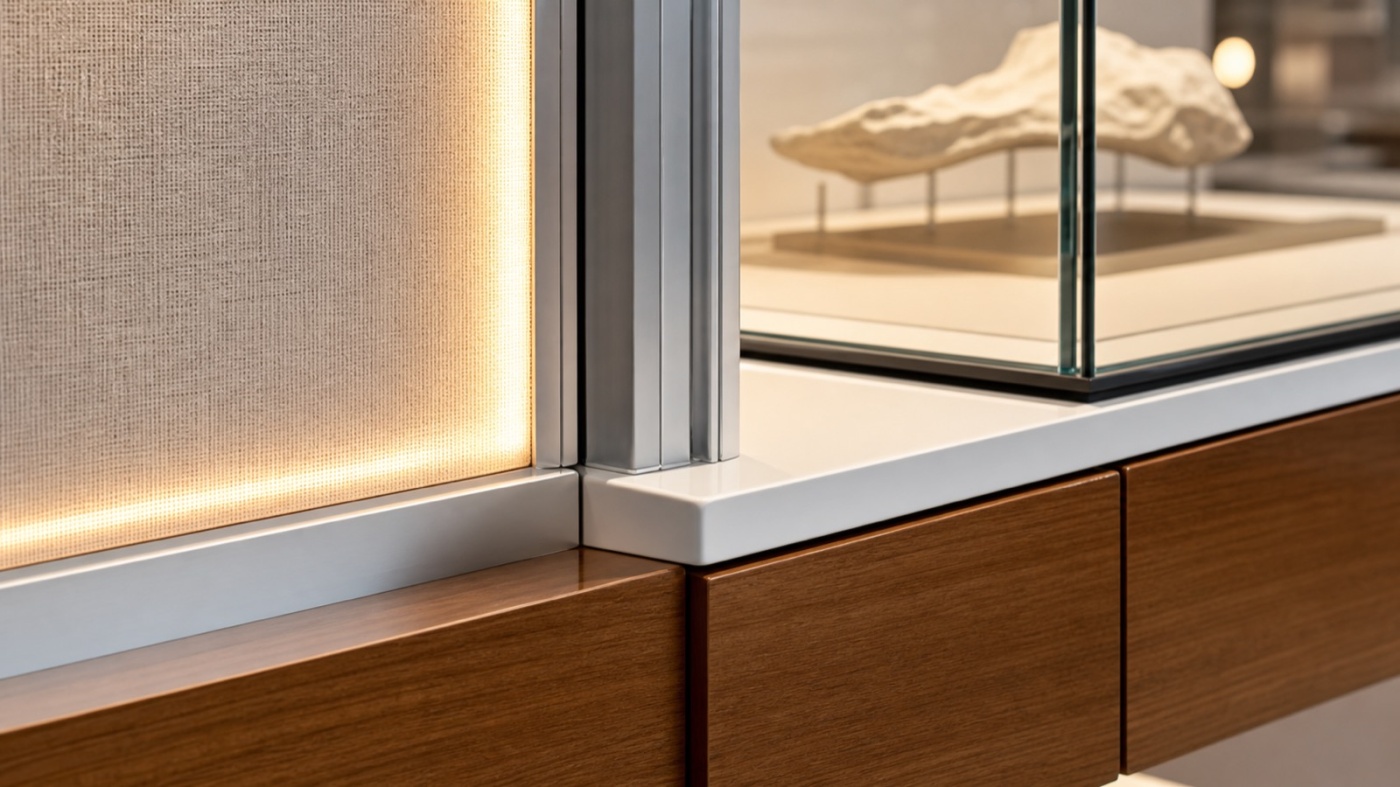
An exhibition stand comes down to a handful of base materials. Where aluminium, wood, fabric and glass each sit determines the look, the shipping weight, the build time and how often the same stand returns to a hall. A sober look at four materials and what each one does best.
Aluminium: the skeleton everything hangs on
Aluminium profiles form the load-bearing structure of most contemporary stands. System manufacturers such as Aluvision, beMatrix and Octanorm work with frames in fixed grid dimensions that connect tool-free or with very few movements. Walls, gantries, ceiling frames, plinths and the mounts for LED tiles all grow out of that grid.
The advantage lies in the ratio of weight to load capacity. Aluminium keeps its shape, resists warping and survives many build and dismantle cycles while still looking new. Surfaces are anodised or powder-coated and clean up easily. A damaged profile is swapped for an identical part instead of replacing a whole wall.
The budget picture shifts over time. A system stand starts above a simple timber construction and drops below it per appearance once several shows add up. Companies that exhibit occasionally reach the same look through rented modules and leave the warehousing to someone else.
The grid also sets the limit. Free curves, sloping planes and highly individual geometries call for additional construction, frequently in combination with wood.
Wood: warmth, workshop and precise form
Timber materials come in wherever form and touch matter: counters, plinths, display cabinets, alcoves, benches, curved wall segments. Birch ply, MDF and blockboard can be milled into almost any contour on a CNC router, then sprayed in an exact brand colour, veneered or wrapped.
The result reads solid and considered. A lacquered timber counter feels different from a fabric-covered surface, and visitors register that difference. For product presentations carrying real weight, wood or a wood and steel combination remains the natural answer.
Mass is the price. Wood is heavy and bulky, which drives freight volume, storage footprint and handling during build-up. Modules sized to standard pallet dimensions ease this noticeably, because they stack and move with ordinary equipment. Honeycomb panels shave weight further wherever a surface carries little load.
Reuse follows a simple rule: edges and lacquered faces collect the marks. Furniture bodies and plinths run for years, while large sprayed wall surfaces show wear after several shows and want refinishing. Fire safety depends on the build-up: stand materials are generally required to be at least flame-retardant to class B1, with the exact framework set by each organiser's technical regulations. Keep the certificates with the documents for stand handover.
Fabric: large surfaces, low weight
Tensioned fabric has changed stand building more than any other material in recent years. An aluminium frame receives a printed textile that is pressed into the groove all round with a silicone welt. The surface reads seamless, and backlit it becomes a light wall.
Three points matter most to exhibitors. Weight comes first: a wall graphic of several square metres folds into a carton and travels as a parcel. Second is the change of motif, because the frame stays and only the textile is reprinted, so a new campaign costs a fraction of a new wall. Third is durability, since washable fabrics handle storage and transport well and reprint on demand.
Watch two details. Colour drifts slightly between print runs, so a proof and a single production run for connected surfaces are worth insisting on. And for use in the hall, choose B1-certified textiles and keep the supplier certificate to hand.
Where depth and materiality carry the message, combine fabric with real surfaces. An entirely textile environment flattens out as soon as a visitor stands directly in front of it.
Glass and acrylic: transparency with clear rules
Glass appears selectively: display cases, counter tops, dividers between zones, balustrades on a second level. It protects exhibits, lets sight lines through and signals quality.
In exchange, glass is heavy, fragile and demanding to handle. Crates with edge protection, upright transport and two-person installation belong in the calculation. Organisers regulate glass separately in their technical rules, covering safety glass requirements, edge finishing and the marking of large panes at eye level. Balustrades and overhead situations additionally call for structural verification. Read the rules of your specific show early, since they differ from venue to venue.
Acrylic is the lighter, more affordable alternative for case covers, price holders and small guards. It scratches considerably faster, which makes it suited to surfaces that get renewed between shows anyway.
The material mix: how the decision is made
In practice a single material rarely wins. What wins is a division of labour. A typical stand uses an aluminium skeleton for structure and height, tensioned fabric for brand and light, wood for everything visitors touch, and glass where products stay visible and protected.
Five questions lead reliably to a decision. How often will this stand travel? How much weight and volume does your freight budget carry? How many build hours fit into the allotted time slot? Which surfaces should take a new motif in future? And which areas do visitors actually touch?
Calculate across the lifespan rather than across the first invoice. A component that survives five shows behaves entirely differently in a budget than one built for a single appearance, and our overview of exhibition stand costs shows which items add up along the way.
The fastest route to a solid selection is samples on the table with the floor plan lying next to them. That is exactly how the concept phase runs with us, and you can see the individual steps in our exhibition stand services.