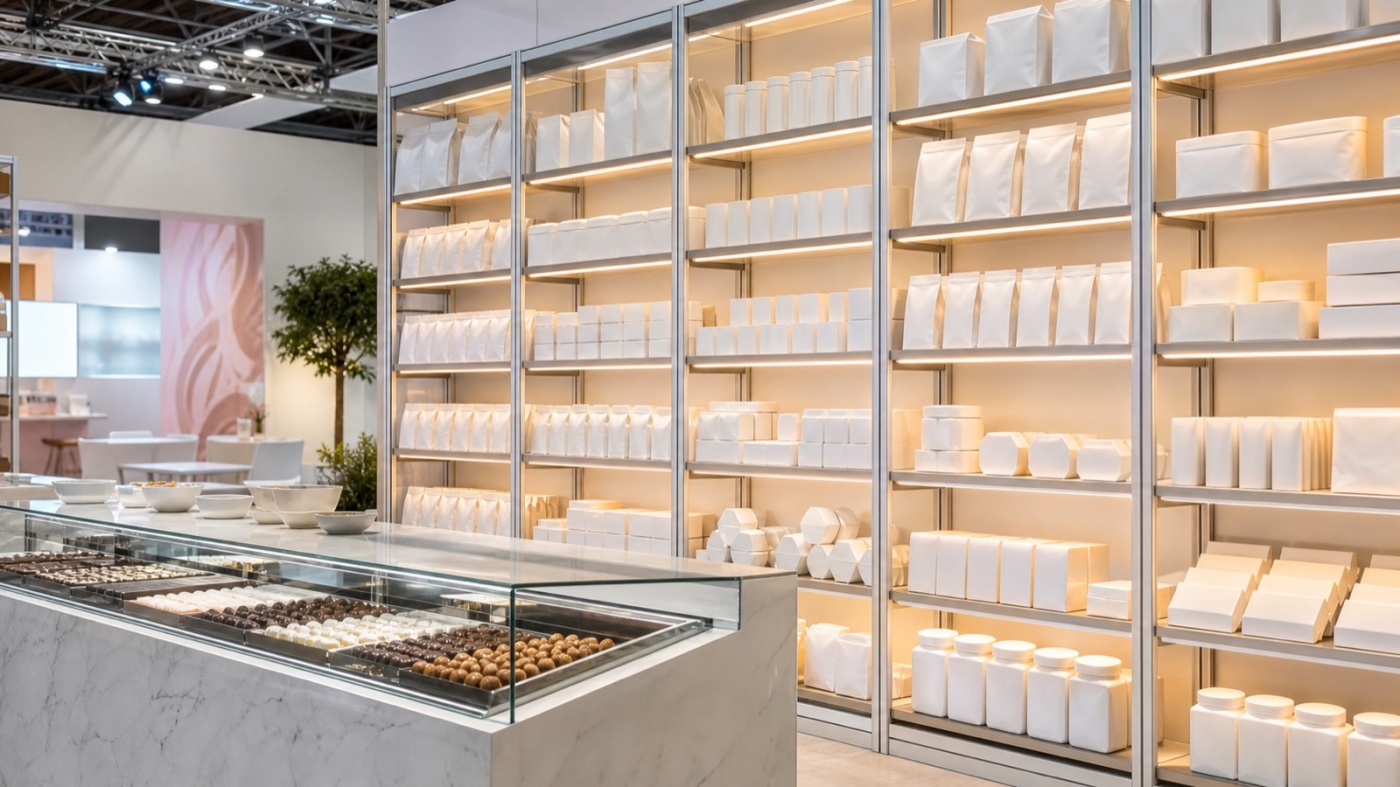
Every year the confectionery trade settles its orders in Cologne. Around 1,600 suppliers from more than 70 countries present chocolate, sugar confectionery, fine bakery, ice cream and savoury snacks at ISM, and the large majority of them travel in from abroad. An exhibit here rarely appears on its own: it appears in rows, stacked, several hundred times over.
Four days of order business: who stops at your stand
ISM is a buying fair. Purchasers from retail, wholesale, import and food service arrive with range lists and with a fixed metre of shelf space in mind. They compare products side by side, pick up packs, turn them over, read weight, ingredients and price, and they decide on listings that carry a full year.
That kind of conversation shapes the build more than any design idea. What works is a floor area showing a complete range at once while staying calm, plus sheltered seats for price talks. From 2027 the value chain moves closer together: ISM Ingredients covers raw materials and semi-finished goods, while ISM Manufacturing, formerly ProSweets Cologne, covers technology and production. A stand presenting machinery meets a different audience than one presenting a finished range, and the design may show that difference clearly.
Weight adds up: what shelves, counters and floors carry
A single chocolate bar weighs around a hundred grams. A product wall holding several hundred bars puts the weight of a small motorcycle onto a back wall that looks like pure graphics at first glance. With jars, tins, drinks or raw masses that figure rises further.
Stand planning for ISM therefore starts with a plain inventory: how many articles do you show, in which pack size, on how many shelves? The structure follows from that list. Shelves belong in a system with a specified load rating and its own supporting frame, brackets transfer their load into the frame profiles rather than into an applied fascia, and heavy packs travel to the lower levels. The wall then holds its shape across four show days, including the morning refill.
Count the storage room in as well. Four days of replenishment, printed material and chilled goods sit behind the back wall and add their own weight. Parts of the Cologne halls have two levels, and the permitted floor load differs between them. The values that apply to your space appear in the Koelnmesse technical guidelines, and an early look at them saves rework later on.
Chilling, power and water: the services behind the tasting counter
Sweets respond to warmth. A busy hall grows noticeably warmer over the course of the day, and chocolate shows this faster than any other exhibit. Anyone presenting temperature-sensitive goods plans for chilled display cabinets, cooled showcases or at least a chilled reserve behind the counter, so the display is restocked fresh several times a day. Ice cream calls for freezing capacity and a circuit of its own.
Tastings call for more than power: water, drainage, a washing-up point, coffee equipment, waste separation. You order these services from the organiser, and each edition publishes its own deadlines. What really shapes the layout is the position of the supply points on your space. Ask for that position before the floor plan is fixed: counter, sink and chilled units belong close to it, otherwise cabling runs straight through the meeting area.
One detail that keeps the show days calm: give appliances with high connected loads their own fuses. The lighting then stays steady while chilling and brewing continue in the background.
Sightlines: what a buyer takes in while walking past
In the range halls, a few steps decide whether someone turns in. Build three levels for that: brand mark and category high up for distance, range blocks at eye level, and the reach zone below with samples and tastings. Group the goods by product world rather than by article number, and the wall stays readable from five metres away.
Keep one sightline into the depth of the stand clear as well. When the view reaches from the aisle to the back wall, the space feels larger and more welcoming than a closed front. Meeting seats sit to the side, lightly screened, facing the goods rather than the aisle.
Surfaces deserve attention too, because film packaging reflects strongly. Even base brightness, glare-controlled spots and accent light angled from the front keep colours and lettering legible while reflections on the film step back.
A stand that takes in a new range every year
ISM runs annually, and the range changes faster than the architecture. Modular system construction suits exactly this rhythm: aluminium frames on a fixed grid, textile skins for the graphics, shelf brackets on the same grid, LED surfaces as the changeable element. Before the next edition you swap the skin and the product image, while structure, counter and storage stay in place.
Across three or four editions this shifts the calculation noticeably, because construction, storage and reuse spread over several appearances. Our overview of exhibition stand cost shows how the individual items come together. Whether buying or renting suits your show year better depends mainly on how often you exhibit, and the page on renting an exhibition stand covers that question.
When the goods carry the stand
At ISM the exhibition stand works as a sales shelf with architecture: it carries weight, supplies chilling and tastings, guides attention and creates room for confidential talks. Bring those four requirements together early and you gain the scarcest resource of the show days, which is quiet time with the right buyer.
Upcoming editions and further leading trade fairs are listed in our trade fair calendar. For a first solid proposal, your preferred hall, floor area, number of articles and the tasting equipment you have in mind are enough.