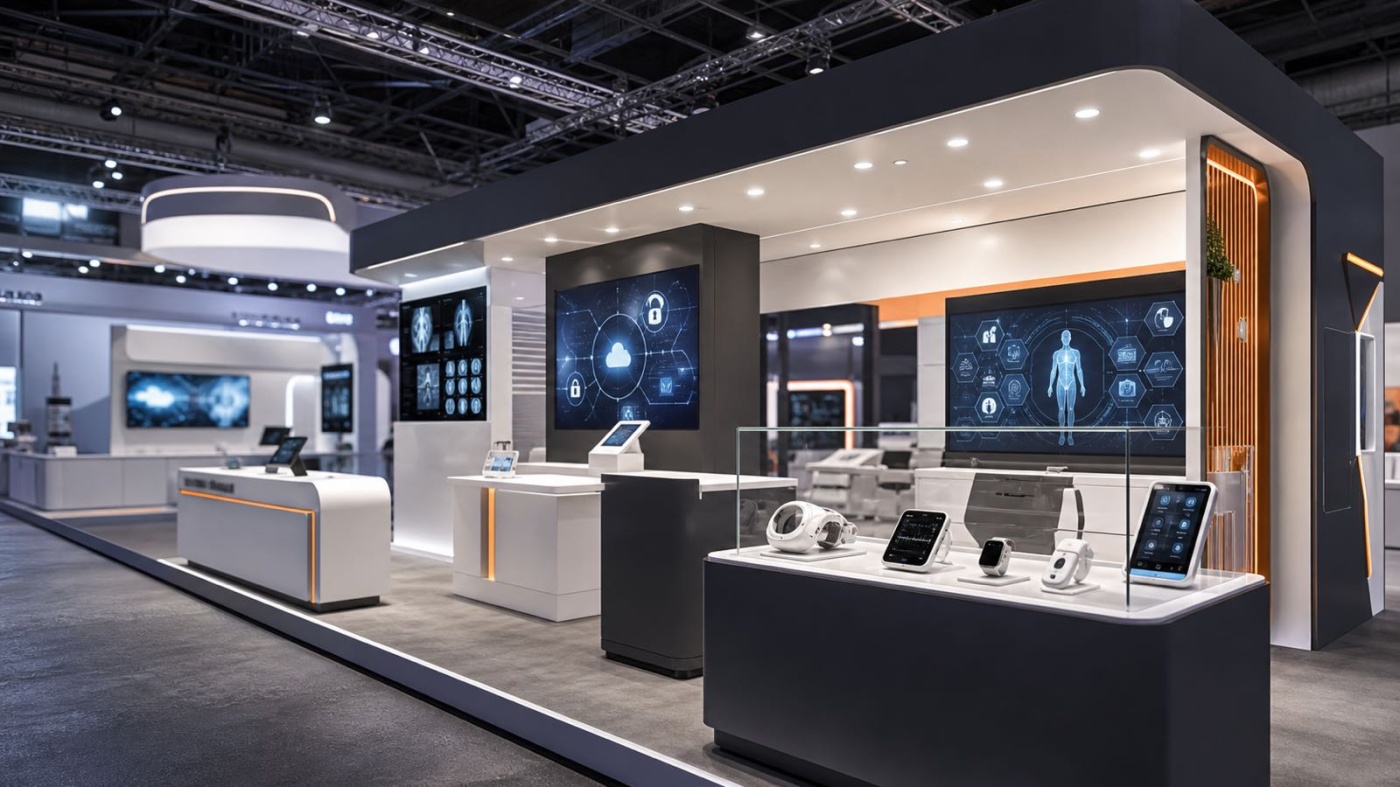
DMEA is Europe's leading trade fair for digital health. Exhibitors present software, infrastructure and applications for hospitals, medical practices, care facilities and payers. From 2027 the event takes place in a new location: it moves from Berlin to Munich. An exhibition stand for DMEA therefore needs to convince not only in terms of content, but also in the way it fits the conditions of the Munich fairground. This is exactly where the questions begin that you should clarify before planning starts.
This guide summarises, in a factual way, what matters for a successful appearance: from the particularities of the venue to the requirements for a DMEA stand and the choice of the right stand form. It is written for marketing and sales managers in the digital health field who are preparing their first or next appearance in Munich and who depend on reliable timing and execution.
DMEA: Europe's leading fair for digital health
The abbreviation DMEA stands for Digital Medical Expertise & Applications. The organiser is the German Federal Association of Healthcare IT (bvitg). Thematically, it revolves around the digitalisation of healthcare, meaning hospital IT, telemedicine, data infrastructure, the exchange of health data across sectors and, increasingly, artificial intelligence in medicine. The fair combines a classic exhibition with an extensive congress in which lectures, panels and masterclasses take place across numerous sessions. For you as an exhibitor this means a professionally informed audience made up of physicians, IT management, administration and policy makers.
DMEA takes place every year. From 2019 to 2026 Berlin was the host city. From 2027 the fair moves to Munich. For the 2027 edition the organiser names the period from 13 to 15 April at the Trade Fair Center of Messe Munich. The binding dates and all further details are published by the organiser through the official channels, for example on the official DMEA website. If you plan early, you secure a good stand position and enough lead time for the necessary approvals.
The Munich fairground at a glance
The Munich fairground is located in the east of the city, in the Trudering-Riem district, on the site of the former Munich-Riem airport. It comprises 18 halls with around 200,000 square metres of hall space as well as extensive outdoor areas covering several hundred thousand square metres. The large halls in blocks A and B each have a floor area of roughly 171 by 72 metres, so that large-scale appearances can be realised well.
Access is well developed. To the north runs the A94 motorway, to which the site is directly connected via two exits. For trade visitors, the Messestadt West and Messestadt Ost underground stations provide short routes to the entrances. Munich Airport is also within a manageable travel time, which is particularly relevant for the international guests of the digital health sector.
For set-up, delivery and dismantling, fixed time slots and traffic regulations set by the organiser apply. Material is delivered through the hall gates and designated logistics zones. The exact procedures, the permitted floor and ceiling loads and the allowed construction heights are governed by the technical guidelines of Messe Munich. These guidelines are binding for every stand and should feed into your planning early on.
Stand requirements for digital health
An appearance in the digital health field thrives on making abstract software tangible. The focus is therefore usually on demo stations where visitors try out applications themselves or have them demonstrated. For this to run smoothly, a few points need to be considered early:
- A stable data connection through a fixed network port, since the open wifi at fairs is often overloaded.
- Enough screens and presentation surfaces for the software demonstration, positioned free of glare.
- Sufficient power and connections for computers, displays and charging points.
- Quiet areas for confidential conversations about sensitive topics such as patient data.
The look and feel of a stand in this environment should be serious and calm. Clear shapes, good lighting and a tidy material language come across as more credible than flashy effects. Because the subject often involves data protection and sensitive health data, discretion plays a major role. Visual screening and a well thought-out visitor flow ensure that conversations are not overheard by passers-by.
Consultation and meeting zones
At DMEA, much of the business is initiated not at the counter but in conversation. It is therefore worth planning enough space for consultation and meeting zones. Depending on the stand size, the options range from an open lounge with seating to separated, acoustically effective meeting rooms. For confidential appointments with hospitals or payers, an enclosed room is often the better choice.
When planning these zones, the balance between open presentation and a protected conversation atmosphere is what counts. Good zoning clearly separates the loud, open area for the first approach from the quiet area for appointments. Seat heights, table sizes and lighting should suit the length of the conversations. If you expect many firmly scheduled appointments, plan the number of meeting places generously, so that prospects do not have to wait.
Technical guidelines and deadlines
For every exhibition stand, the technical guidelines of the responsible fair company apply, in this case Messe Munich. Among other things, they govern construction heights, escape routes, fire protection and the acceptance inspection of the stand. As a rule, a stand construction permit is required, for which dimensioned stand plans with floor plan and elevation are submitted. For special constructions such as overhead structures or platforms, proof of structural stability may also be requested.
When it comes to fire protection, stand construction materials are usually at least flame-retardant, which means they fall into class B1. Depending on the position, visual screens towards neighbouring stands are prescribed. What matters is the lead time, because permits and certificates have to be available several weeks before set-up begins. The exact deadlines and values differ from fair to fair and from year to year, which is why the currently valid technical guidelines of Messe Munich are always the decisive reference here. An experienced exhibition stand builder takes care of the submission and keeps an eye on the deadlines.
An exhibition stand builder for your DMEA stand
die trendSETZEREI GmbH plans and builds exhibition stands as a full-service provider, from consulting through 3D visualisation and production in its own workshop to logistics, set-up and storage. For an appearance at DMEA, the entire process can be handled from one team, so that you have one fixed point of contact. You will find an overview of the individual services on the page about the exhibition construction services.
To be honest, the company is not based in Munich but in Offenbach am Main in the Rhine-Main region. trendSETZEREI nevertheless works throughout Germany and has its own vehicle fleet, with which material and the assembly team also reach the Munich fairground, around 400 kilometres away. The journey and the logistics are planned accordingly, so that the set-up is completed within the given time slots.
Choosing stand size and stand form
The right stand form depends on area, budget and goals. With a row stand, only the front is open; this is the most affordable and most common variant. A corner stand sits at the corner of an aisle and is accessible from two sides, which brings more visibility. A head stand opens on three sides, while an island stand stands freely and can be reached from all four sides. Island stands offer the most design freedom, but require more space and planning. Which form suits your appearance is shown in the overview of the stand types.
Beyond the form, the internal zoning is decisive. On a digital health stand, the open demo area, the consultation zone and the storage or retreat room should be sensibly coordinated. Rather plan a little more space for conversations than filling every square metre with exhibits. An early sketch helps you to think about stand form and zoning together.
Conclusion
DMEA moves to Munich in 2027 and remains the central industry meeting point for digital health. A convincing appearance combines tangible demo stations with quiet consultation zones, a serious look and feel and the protection needed for confidential conversations. If you take the particularities of the Munich fairground and the technical guidelines into account early on, you avoid time pressure with approvals and during set-up.
If you are planning an exhibition stand for DMEA in Munich, trendSETZEREI supports you from the first idea to dismantling. Get in touch through the contact form, reach the team by phone at +49 69 201 65 001 or write an email to info@dietrendsetzerei.de.