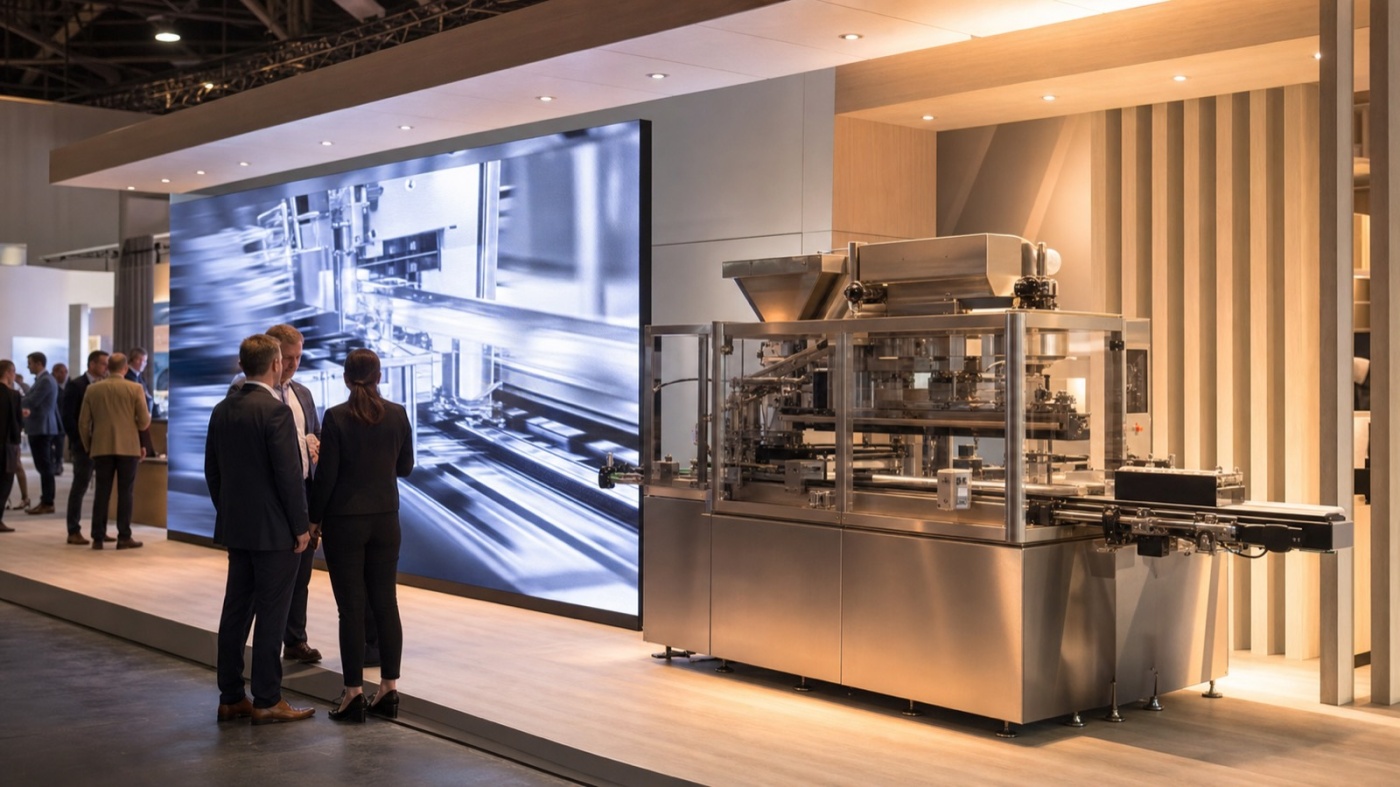
Seven show days, halls full of running lines and, at the last edition, more than 2,800 exhibitors from 65 countries: interpack in Düsseldorf presents packaging and processing technology in live operation. That creates an unusual brief for exhibitors, because the decisive part happens in fractions of a second and often deep inside the machine. This is exactly where screen media start to work.
A trade fair where the machines keep running
interpack takes place every three years at the Messe Düsseldorf grounds. The calendar lists the 2029 and 2032 editions, usually in May. The 2026 edition ran from 7 to 13 May across seven days in halls 1 to 17, joined by a temporary hall for the parallel supplier show components. Exact dates and hall allocation for the coming edition are published by the organiser in good time, and you will find an overview of your season in our trade fair calendar.
The grounds are sorted by target industries and by process stages. Food, beverages, confectionery and bakery, pharmaceuticals, cosmetics, non-food consumer goods and industrial goods each have their area, alongside the chain that runs from processing through filling and packaging to labelling, inspection and the production of packaging materials. Standing in front of your booth you will therefore find plant managers, packaging developers, maintenance engineers, buyers and brand owners side by side.
The lead themes of the last edition show where the industry is looking: smart manufacturing with data-driven production, innovative materials including design for recycling, and future skills. All three live in software, data and process. Digital elements on your booth become part of the exhibit itself.
Slow motion shows what happens in a fraction of a second
A sealing jaw closes, a film wraps around the product, a label meets the bottle. At operating speed the eye registers one single fluid movement.
High-speed footage turns that around. In slow motion visitors see how cleanly the seam forms, how calmly the transfer runs, how precisely the gripper takes hold. That is your argument, and the screen is the only place where it can be told.
Macro shots add the inside view to the outside view. A camera move along the product flow, a cutaway of the format set, an animation of the hygienic design in areas that stay covered during operation: images like these answer the questions a maintenance engineer will ask anyway.
A silent build pays off here. The hall is loud, so moving images travel furthest when they work without sound and carry clear captions in two languages.
The complete line is larger than any booth space
Your booth holds one module while the customer plant runs a line of thirty metres and more. Digital elements close that gap.
A 3D model of the entire plant lets visitors walk it station by station on a touchscreen, with a data sheet at every position. 360 degree footage from a completed installation shows the environment your technology works in, including infeed and palletising. A live link into a running plant is an option wherever the operator agrees and the connection has been tested beforehand.
A configurator goes one step further. Visitors choose product format, output range and packaging type, and the screen shows the matching machine configuration. A presentation turns into a conversation, and your sales team sees straight away what matters to the person in front of them.
Data that is created on the booth itself
A running demo module produces numbers, and those numbers carry more weight than any slide, because the machine stands right beside them. A dashboard above the unit shows cycle rate, availability, reject rate and energy draw from the past hour of operation.
The format changeover works especially well as an announced demonstration. A counter runs on screen, the team swaps the format set, and the result stays visible afterwards. Moments like this gather an audience and give your team something to talk about for the rest of the day.
A tablet with an augmented reality view adds detail. Pointed at the machine, it overlays maintenance points, wear parts and cleaning routes.
For the follow-up a QR code at the exhibit is enough. Visitors call up the documents themselves and decide in that moment whether to leave their contact details and receive further information. Lead capture stays voluntary and documented, and your team keeps both hands free for the conversation.
Seven days of continuous operation
Media technology belongs in the booth design early, because it shapes the structure. Cable routes disappear inside the frame profile, players and computers get a ventilated place in the storage room, mounts and rigging follow the technical guidelines of Messe Düsseldorf and form part of the stand approval. The organiser's specifications for the respective edition always take precedence.
Connected load grows with every LED surface and every computer, and heat comes with it. Register both with the organiser early and the climate in your meeting area stays pleasant.
Seven days are long. Packaging halls carry dust from paper, film and product in the air, and tastings add moisture. A daily wipe across the display surfaces, a spare unit in storage and a player that holds the files locally keep operation calm. Stand construction, graphics and media technology interlock directly at this point.
The booth shows the module, the screen shows the plant
A three year interval argues for treating media as an asset. Films, animations, 3D models and the configurator can be split into building blocks that keep working at open house events, in field sales and at smaller specialist shows. LED tiles, frames and mounts travel back from Düsseldorf into storage and stand ready for the next appearance.
One trade fair appearance then becomes a library that carries your sales year. Examples from completed projects are collected in our exhibition stand projects. If you are preparing your appearance in Düsseldorf, we are glad to talk through floor space, media concept and schedule: request an exhibition stand.