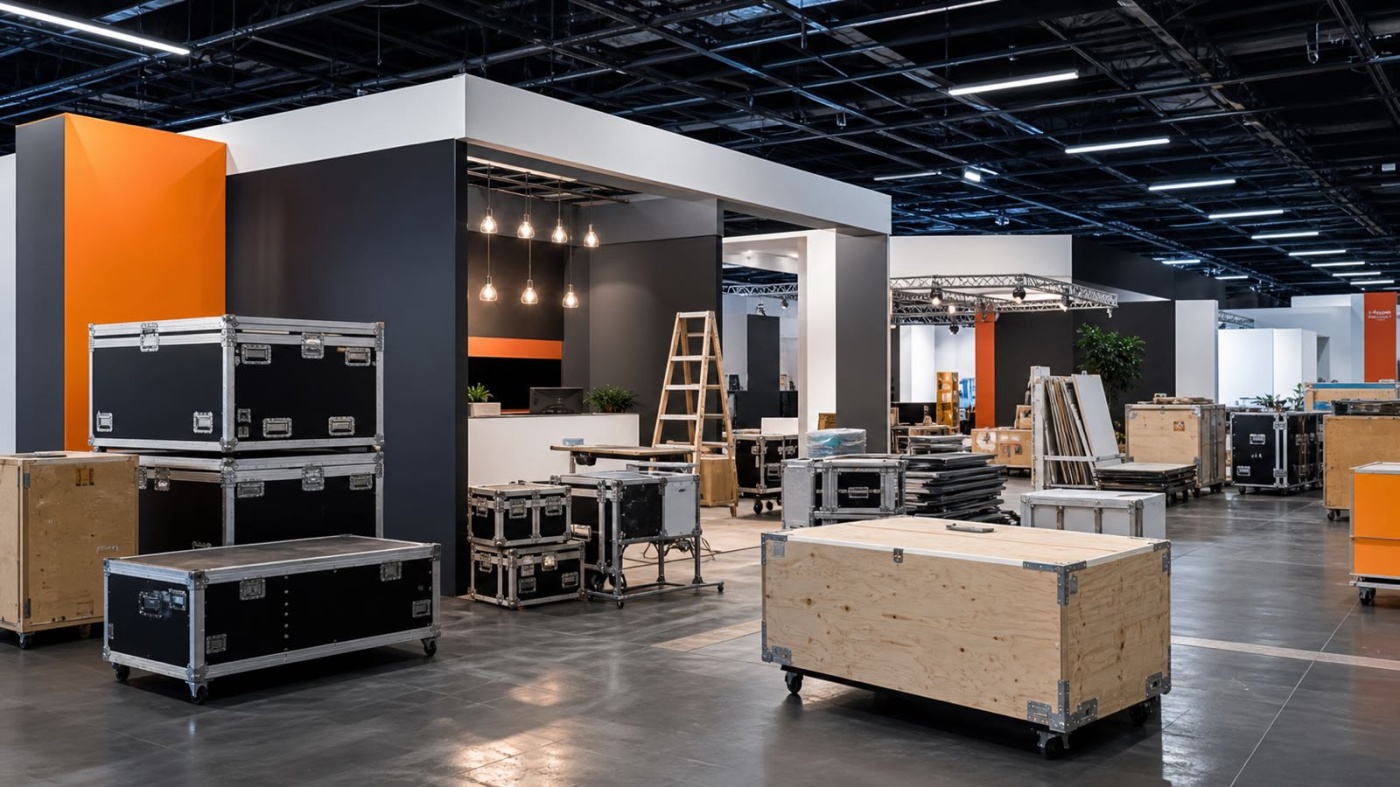
Once your exhibition stand has been planned, approved and produced in the workshop, a very practical question follows: how does the stand reach the hall on time and in order, and how does the build-up on site actually unfold? Build-up on the exhibition grounds is less a single act than a chain of steps that have to mesh together in time and in logistics. If you understand how these steps connect, you avoid waiting times, wasted trips and stress in the final hours before the opening. The overview below explains how delivery, time slot control and build-up relate to one another, and what matters most along the way.
Delivery and time slots: control at the freight yard
Larger trade fairs do not handle delivery in an uncontrolled way but route it through a freight yard. This is a designated area at the edge of the grounds where vehicles register, wait and are released for access to the hall. Without this control, too many trucks would stand at the hall gates at the same time and block one another.
To prevent that, many organisers work with what are called time slots. A time slot is a period booked in advance during which a particular vehicle is allowed to deliver, comparable to a fixed appointment at which you are expected. Booking these slots, meaning the individual time windows, is usually done through a portal run by the exhibition company or its logistics provider. Whether time slots have to be booked and in what form, from when and with how much lead time, is set by each trade fair in its own requirements. This information appears in the technical guidelines and the logistics documents of the respective exhibition company and should be checked early, because popular slots are limited.
A well planned transport also takes the approach itself into account. From the Rhine-Main region, the Frankfurt exhibition grounds can be reached in a short time, which makes the scheduling easier. Delivery also raises the question of how the material gets from the vehicle to the stand. Large or heavy components are moved in many halls by forklift or crane, provided by the organiser or its logistics partner and, in turn, ordered in advance. If this need is registered early, the right equipment is ready in the correct time slot, rather than having to improvise on the build-up day. For an example of how a delivery through a freight yard works in practice, see the report on an exhibition stand transport to transport logistic in Munich.
The build-up sequence: from the bottom up
Once the material is at the stand, the build-up follows a sensible sequence. It is guided by which trade builds on the next and which work is hard to add later. In simplified form, the typical order looks like this:
- Floor: First the substructure is set, meaning platforms and floor build-up, followed by the floor covering. Everything else is aligned to this level.
- Walls and structure: Next the frames, walls and load-bearing elements are assembled, in modular systems the aluminium profiles and stand walls.
- Technology: Then come the electrics, lighting, screens and the necessary cabling, while the walls are still easily accessible.
- Graphics: The textile coverings, logos and large-format motifs follow, giving the stand its appearance.
- Furnishing: Finally the counters, furniture, display cases and decoration are brought in and the stand is prepared for inspection.
This order is not a rigid scheme but a proven logic. Walls are difficult to clad once furniture already stands in front of them, and cables belong in place before the covering hides them. Before build-up, the exhibition company in many cases also checks whether the stand matches the approved plan. The time frame for the build-up days is likewise set in the requirements of the respective trade fair.
Dismantling and teardown after the fair
With the last day of the fair, the work is not finished. Dismantling runs in principle in the reverse order to build-up: first furnishing and decoration are removed, then graphics and technology are taken down, after that the walls and finally the floor. Here too the time slot control applies, because for collection, vehicles again have to be let onto the grounds through the freight yard. After dismantling, the stand space has to be left in the condition the exhibition company prescribes, as a rule swept clean and free of residue.
It is precisely during teardown that the difference between single-use construction and modular building shows. A modular system stand is not disposed of but taken apart, checked and returned to storage, where the components are ready for their next use. Whatever actually has to be disposed of, such as packaging material or spent small parts, is separated and removed properly. This return to an orderly warehouse is the precondition for stand elements to be reused across several trade fairs. For a description of how dismantling and the return after a multi-day fair are organised, see the report on the exhibition stand at Ligna in Hanover.
Common mistakes and how full service eases the process
Most problems during build-up arise not at the stand itself but in the logistics beforehand. Three mistakes recur particularly often. First, delivery without a booked time slot: whoever drives up without a fixed slot risks long waits at the freight yard or is turned away, while the build-up time grows tighter. Second, the missing registration: some trade fairs require prior registration of vehicle, driver or trades, and without this registration access is blocked. Third, unclear responsibilities: when transport, build-up, technology and teardown lie with different parties, in case of doubt no one is clearly in charge, and the interfaces lead to delays.
This is where a continuous full service takes effect, with planning, production, transport, build-up and storage with one team. An own vehicle fleet means that delivery does not depend on the availability of external hauliers and that deadlines can be kept more reliably. Because the same team that built the stand also sets it up, the build-up sequence is familiar and the responsibility is clear. A fixed contact coordinates time slots, registrations and the deadlines of the exhibition company, so you can concentrate on your appearance. Which services belong to logistics and assembly in detail is described on the Logistics and Assembly page. When the individual steps fall due in relation to the fair is set out in the timeline for the trade fair appearance.
Conclusion
A smooth build-up on the exhibition grounds is the result of good preparation: time slots booked in good time, correct registration at the freight yard, a well thought out build-up sequence and an orderly teardown with return to storage. The concrete deadlines and rules are always set by the respective exhibition company in its requirements, which is why these documents should be checked early. If you are planning your next trade fair appearance and have questions about delivery, build-up and logistics, you can reach trendSETZEREI GmbH by phone at +49 69 201 65 001 or by email at info@dietrendsetzerei.de.