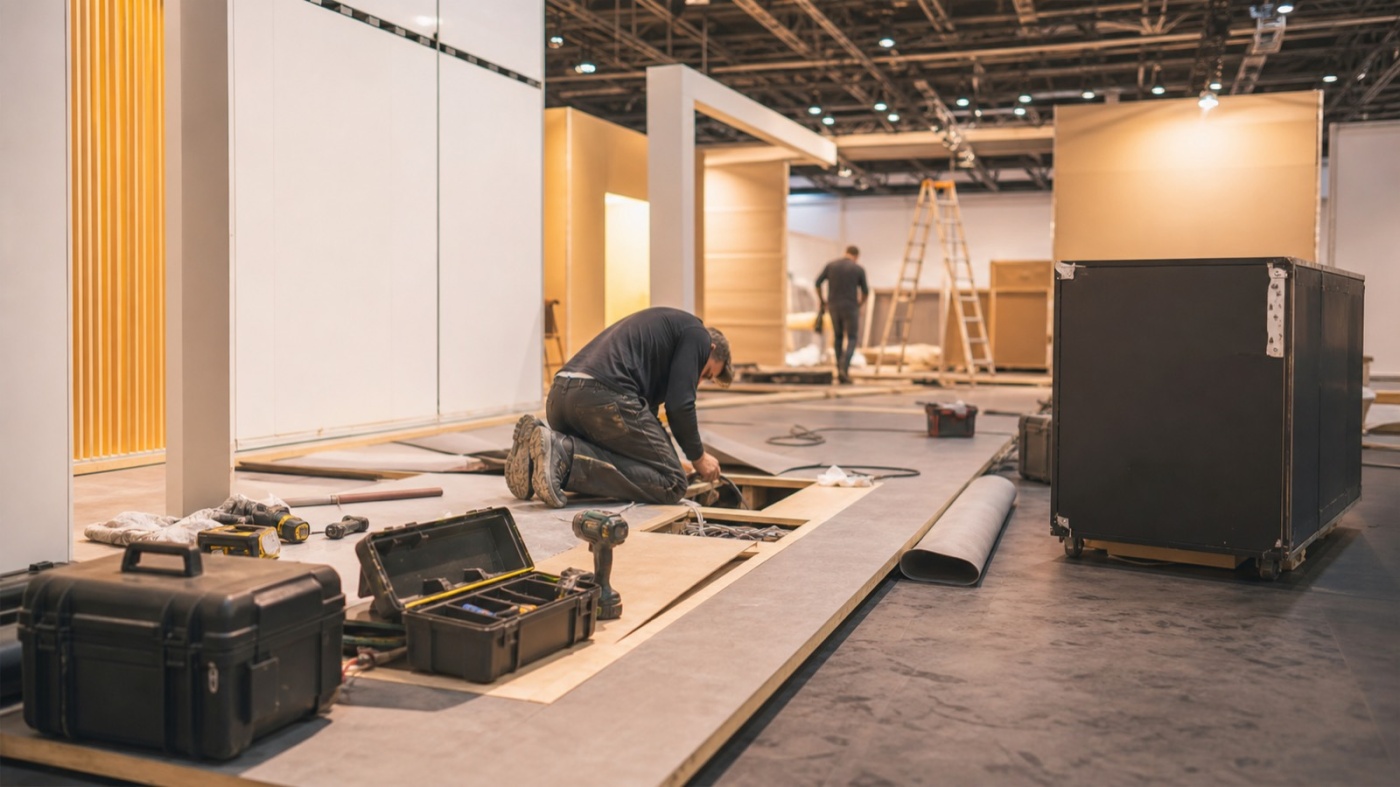
A trade fair presence brings people, materials and technology together in a small space for a few days. That raises questions which rarely come up in office life: who answers for a loose carpet edge, for a mark on the hall floor, for the exhibit the freight forwarder collects on dismantling day? The answers sit in the organiser's terms of participation, in the technical guidelines and in your own policies.
Who answers for what on the fairground
The fair organiser rents out the space and runs the venue. It provides general supervision in the halls and outdoor areas, in a reduced form during build-up and dismantling days. Guarding an individual stand stays with the exhibitor, and many venues award stand security exclusively through the security company they have appointed, bookable through the service shop.
The exhibitor is responsible for the build, the design and the operation of the rented space. The technical guidelines put it plainly: structural stability and safe use of the stand rest with the exhibitor, across build-up, show days and dismantling alike. Where there is reasonable doubt, organisers have stability checked on site by a structural engineer at the exhibitor's expense, in some cases even after stand approval has been granted.
Your stand builder works on your behalf. That makes a contract with clear allocation valuable: who submits the stand approval, who supplies structural and material certificates, who secures the space during build-up days, who walks the final handover? One named contact for all trades keeps that chain short and responsibility unambiguous.
Safe use of the space you rent
In everyday show practice, safe use means one thing: everything visitors walk on, touch or pass stays in sound condition. A handful of recurring points cover most of it.
Floor coverings lie flat, end at the stand boundary and are fixed with tape that comes off without residue. Cables disappear into floor channels, platforms or certified cable ramps. Free-standing walls, tall exhibits and decorative elements receive tilt protection designed for the horizontal load the venue prescribes. Koelnmesse, for example, applies 0.125 kN per square metre; other venues set this value in their own guidelines, which is why the current edition belongs in your preparation. Glass edges, steps and railings follow the technical guidelines as well, and double-deck stands add requirements for escape routes and loads.
A joint walk-through with the build team the evening before opening settles the remaining details. Record the result with photos, which helps with any later query.
Three building blocks of cover
Organisers point out in their guidelines that protecting the stand and the exhibits rests with the exhibitor, and they expressly recommend your own cover for build-up, show days and dismantling including inbound and outbound transport. Some venues arrange a partner insurer. A combination of three building blocks is common practice.
Exhibition insurance covers exhibits, stand material and technology, usually on an all-risks basis and often including transport plus a limited storage period before and after the show. Transport insurance protects the journey there and back, which matters particularly for events abroad and for groupage shipments. Liability cover responds to damage your team or your stand causes to others: to visitors, to a neighbouring stand, to parts of the hall.
Three points deserve a conversation with your broker. First, damage to rented items, relevant for rental stands, hired furniture and borrowed technology. Second, geographical scope, since presences in North America are frequently agreed separately. Third, the valuation basis for exhibits, whether replacement value, current value or an agreed sum. Scope, deductibles and exclusions differ noticeably between insurers, so reading the conditions before you register for the fair pays off.
Hall floor, building fabric and the stand next door
Parts of the hall and technical installations stay untouched: drilling, nailing, screwing, painting, wallpapering and gluing are ruled out by the guidelines, as is loading hall elements with stand structures or exhibits. Hall columns may be built around within your own space as long as they remain undamaged and connection boxes stay accessible. Rear walls facing a neighbouring stand stay plain so that their presence works freely.
Organisers usually repair damage to the venue themselves after the event and invoice the party that caused it. Documentation therefore earns its keep: photos of the empty space before build-up, photos after dismantling, plus a short record with date and time. Two minutes of effort save long clarification loops later.
Build-up and dismantling: the hours that carry the most risk
Most losses happen in open halls. During build-up days forklifts move, gates stand open and many companies work side by side in a tight space. On dismantling day technology disappears quickly once graphics come down and crates stand open.
A lean routine works well: an inventory list with serial numbers and values, lockable storage inside the stand, small devices kept in the storeroom overnight, one named person for the handover to the forwarder and a look at the notification deadlines in your policy so a claim is reported in time.
A calm show week starts at the planning desk
Liability at an exhibition stand follows a clear logic: the space belongs to you for a few days, along with the duties that come with it. Reading the technical guidelines early, allocating tasks by contract and matching cover to the specific project keeps you in control throughout. For an overview of what comes from a single source, see our exhibition stand services. With rented stands, renting an exhibition stand adds useful context. For a specific project we are happy to go through the points together: request an exhibition stand.