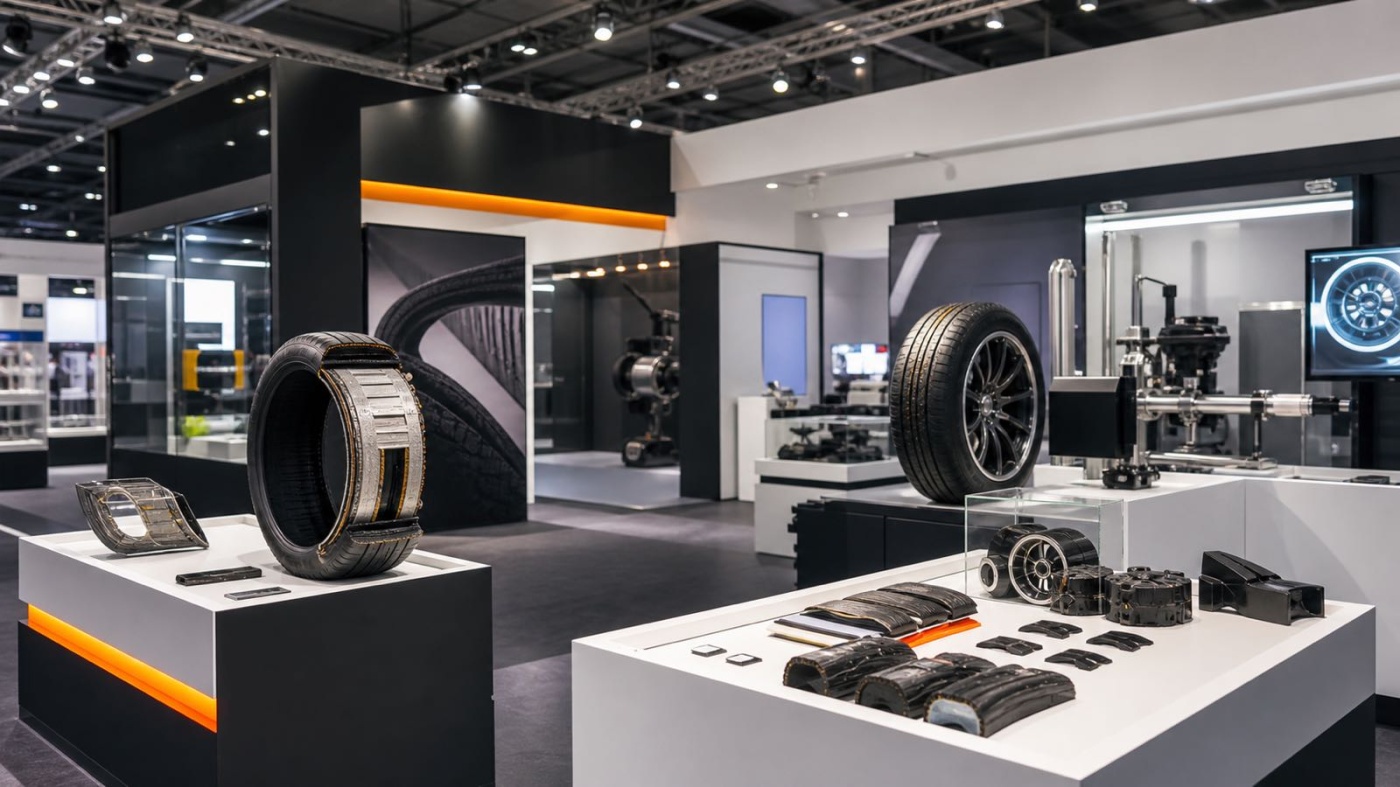
The Tire Technology Expo is the central meeting point for the international tyre industry. Specialists from tyre manufacturing, materials development, machinery and testing technology come together here to present new processes, materials and equipment. If you are planning an exhibition stand for the Tire Technology Expo as a supplier, machine builder or materials producer, you will meet a highly technical audience that looks closely and expects real substance. Your presence should therefore rely less on spectacle and more on clear information, sound function and good conditions for conversation.
This guide summarises what matters during planning: the character of the event, the Hannover fairground with its halls and transport links, the demands of technical exhibits from the tyre industry, and the technical regulations and deadlines every exhibitor should know. That way you can structure your appearance early and avoid costly mistakes.
The Tire Technology Expo: a trade fair for the tyre industry
Based on its established rhythm, the Tire Technology Expo takes place once a year, usually in early March, and is accompanied by a specialist congress, the Tire Technology Conference. The exhibition and the conference are closely linked in content: technologies are shown on the stands and explored in more depth through the talks. For exhibitors this means many visitors arrive with specific technical questions, and conversations often go into detail.
In terms of topics, the fair covers the entire chain of tyre production. This includes raw materials and compounds, mixing and manufacturing technology, machinery and equipment, automation as well as measurement, testing and quality technology. Sustainability and safety are recurring focus areas. The audience is international and technically minded, with engineers, materials scientists, representatives of vehicle manufacturers and suppliers at various tiers. If you exhibit, align your stand concept with this specialist audience and set aside room for calm, factual conversations.
It is best to confirm the exact date of the 2028 edition directly through the official Tire Technology Expo, since the dates are fixed year by year. Based on the current contractual and location situation, Hannover is expected as the venue, but verify a firm date officially before you book.
An overview of the Hannover fairground
The Tire Technology Expo is held at the Deutsche Messe fairground in Hannover, traditionally in halls 19, 20 and 21, with the conference area around halls 19 and 20. The site is among the largest exhibition grounds in the world. According to the fair operator, around 392,000 square metres of hall space are available across roughly two dozen halls and pavilions, together with an open-air area of about 58,000 square metres. The expo occupies only part of this, but the sheer scale shows that logistics and routes across the site need careful planning.
The location is a practical advantage for a specialist event with international participation. Hannover-Langenhagen Airport is close to the grounds and, depending on traffic, can be reached by taxi in around half an hour. From Hannover central station you reach the grounds by light rail in a few minutes up to the northern entrances. For arrival by vehicle or freight forwarders, extensive parking areas are available.
For deliveries, the site uses the fair's own logistics infrastructure with access roads and hall gates. How the approach, time slots and manoeuvring traffic are organised is set by the fair operator for each event. The same applies to build-up and dismantling: there are fixed build-up days before the fair opens and defined dismantling times after the final show day, before which no exhibits may be removed. Binding for all of these points are the technical regulations of Deutsche Messe AG.
Stand requirements for the Tire Technology Expo
Exhibits from the tyre industry are often heavy and technically demanding. Mixers, testing machines, test rigs or plant components carry weight that the stand must absorb. The permissible floor load of the hall, stated in the technical regulations, is therefore important, and heavy machines may require a load-distributing substructure so that point loads can be carried safely. Clarify these baseline figures before stand planning with the fair operator and your stand builder.
Beyond structural aspects, the supply of services plays a major role. Running demonstrations need power at the right rating, sometimes compressed air, water or a network connection. You order these connections from the organiser and should determine your needs early, so the supply lines are provided for in the stand layout. Sensitive testing and measurement equipment additionally requires protection from dust, vibration and unfavourable lighting, and often a quieter area where readings can be shown without disturbance.
If you plan a live demonstration, factor in safety and clearance. Moving parts need guards and enough space so that visitors can watch without risk, yet the specialist audience wants to come close enough to see the details. A well thought-out stand for the tyre industry brings both together: a safe, clearly visible demonstration zone and routes that guide visitors without disrupting operation.
Consultation and meeting zones
At a specialist fair, much is decided in conversation. Exhibitors should therefore not only show exhibits but also plan zones for consultation and negotiation. A graduated approach works well: an open area for brief contacts at the edge of the stand, a semi-open meeting area for longer talks and, depending on stand size, a separate room for confidential appointments.
For these conversations to succeed, acoustics and atmosphere matter. In a busy hall the noise level is high, and running machines add to it. Sound-absorbing materials, closed wall surfaces and a considered arrangement of seating help dampen the noise. Enough surface for samples and screens, a small catering point and pleasant lighting all help partners take their time. On technical fairs, these zones are often more decisive for success than the display area alone.
Technical regulations and deadlines
Every fair operator issues technical regulations that are binding for stand construction. For the Tire Technology Expo these are the regulations of Deutsche Messe AG. Among other things, they govern permissible construction heights, building restriction zones, screening towards neighbouring stands, escape routes and fire safety requirements. Know these specifications before you design, because they directly influence the concept.
For the implementation, the following points are particularly important:
- Stand approval: dimensioned stand plans with floor plan and elevation are submitted on time before build-up begins, and construction only starts after clearance.
- Structural verification: special constructions, overbuilds, platforms or rigging points generally require a verifiable proof of structural stability.
- Fire safety: the materials used must meet the required flammability classes, with at least flame-retardant class B1 being common.
- Lead time: approvals and connections have deadlines well ahead of the fair, so an early start to planning is important.
The specific deadlines, dimensions and proofs differ by event and year. Do not rely on rules of thumb, but use the technical regulations of Deutsche Messe that apply in each case and align your schedule with them. In practice, an experienced stand builder handles communication with the fair operator and makes sure all proofs are complete and submitted on time.
A stand builder for the Tire Technology Expo
A full-service stand builder accompanies your appearance from the first idea to dismantling: advice and concept, design and three-dimensional visualisation, production in an in-house workshop, logistics and on-site assembly as well as storage and follow-up. For an exhibition stand for the Tire Technology Expo, coordination with the technical requirements of the exhibits is especially important: floor load, service supply and safe demonstration areas.
To be honest: trendSETZEREI is based in Offenbach am Main in the Rhine-Main region, not in Hannover. We work throughout Germany, however, and are equipped with our own vehicle fleet, so we bring material and assembly to Hannover as well. A location outside Lower Saxony is no disadvantage; what counts is clean planning, knowledge of the technical regulations and a reliable process on site. You can find an overview of our services under exhibition services.
Choosing stand size and stand form
The right stand form depends on space, budget and goals. There are four positions. The row stand is open only towards the aisle and suits compact appearances. The corner stand sits at the junction of two aisles and is accessible from two sides. The end stand opens on three sides and offers plenty of contact area. The island stand is free on all four sides and gives the most scope, but requires more space and a well thought-out concept.
For heavy technical exhibits and live demonstrations, more open forms are often at an advantage, because they create room for machines, safety clearances and visitor routes. Within the chosen form, clear zoning helps: the separation of display area, demonstration area and conversation zones. Which form suits your project and how to arrange the zones is explained under stand types.
Conclusion
A successful appearance at the Tire Technology Expo in Hannover thrives on technical substance and good preparation. With its halls, its proximity to the airport and its strong transport links, the fairground offers solid conditions. What matters are the technical demands of the tyre industry: load-bearing floors, suitable service supply, safe demonstration areas and quiet conversation zones, combined with a clean implementation of the technical regulations and their deadlines. Planning early avoids time pressure and makes the most of your stand.
If you are preparing an exhibition stand for the Tire Technology Expo, we support you from concept to dismantling, even across the distance from Offenbach to Hannover with our own vehicle fleet. Get in touch by phone at +49 69 201 65 001 or by email at info@dietrendsetzerei.de. You can find further ways to reach us on our contact page.