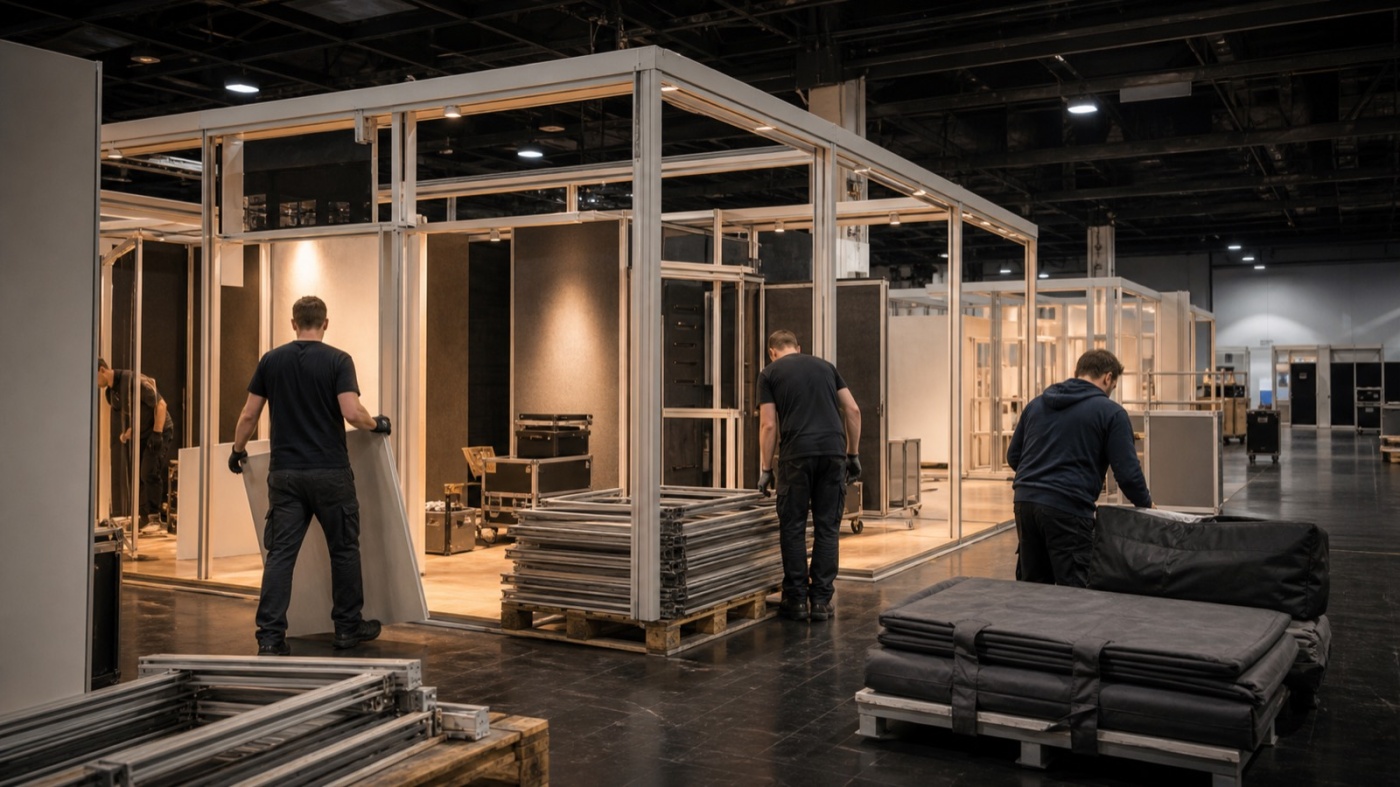
Winter in Nuremberg is the moment when the toy industry sorts its year. In halls arranged by product group, more than two thousand exhibitors from around seventy countries present their novelties, and retail buyers order what will fill the shelves in the coming season. Many brands return to comparable plots year after year. Exactly there lies the biggest sustainability opportunity in stand construction.
A trade audience that returns every year
Spielwarenmesse in Nuremberg is a trade-only event with decades of routine behind it. The halls are sorted by product group, from wooden toys, model making and board games to baby and toddler articles, licensed products and outdoor. Buyers from specialist retail, chains and international wholesale move through this order with purpose, often with a fixed schedule and a route they have known for years.
For exhibitors this carries two implications. The position within the hall tends to stay similar across editions, and floor area grows or shrinks in steps rather than leaps. An appearance designed for repetition suits that reality far better than a set built for one week.
There is a content argument as well. Sustainability has long been part of the product conversation in the toy business: materials, packaging, durability, take-back schemes and circular use appear on the novelty sheets. A stand speaking the same language as the range reads as credible here, and buyers notice the difference.
The grid is what makes a stand reusable
A stand becomes reusable as soon as it is planned as a system. Aluminium frames in a fixed grid connect without tools, textile skins and graphics are finished to exactly those dimensions, LED tiles sit in the same grid. As an Aluvision system partner, trendSETZEREI works with a frame format that recombines freely.
The practical benefit shows in the second year. The material pool of a 40 square metre stand becomes a 60 square metre appearance with a few additions, because the same frames form different walls. Counters, plinths, display cases and shelf carriers follow the same principle: standardised bodies, exchangeable fronts.
Custom-built elements keep their place, in measured doses. One characteristic piece from our own workshop, such as a play area, a brand object or a signature counter, gives the appearance personality while the surrounding area stays modular. That balance keeps the cost per edition steady and preserves recognition at the same time.
What changes each year and what stays
A clear split into two layers pays off. The permanent layer holds frames, flooring, lighting, technical carriers, counters and the storage cabin. The annual layer covers graphics, textile skins, the colour world and the heights of display units, plus the arrangement of zones for novelties and order talks.
That split shows directly in the budget. The initial investment sits above a conventional build, and from the second use onwards the cost per appearance drops noticeably, because only the changing layer goes into production. Our page on exhibition stand cost breaks the individual items down.
A side effect concerns scheduling. With the core already in stock and inspected, production time before the fair shrinks to graphics and additions. That creates breathing space in a season when many exhibitors plan simultaneously.
Teardown by plan: separated, checked, stored
Sustainability is decided on the last show day as much as in the first sketch. A dismantling process aimed at reuse follows a plan: textiles go into labelled bags, frames onto pallets, technology into flight cases, graphics onto rolls. Residual materials are separated on the stand rather than collected in one container.
The second half of the work happens in the warehouse: checking, cleaning, testing, repairing and recording. A digitised warehouse knows how often each frame has been in use and which components stand ready for the next edition. Whatever leaves the pool goes into material cycles sorted by type, aluminium and textile apart.
This routine is also the basis of every statement about reuse. An inventory list is what turns an intention into a figure you can prove.
What you hold in writing after the fair
Tenders and framework agreements of large retail groups increasingly ask for evidence, and in corporate groups trade fair appearances feed into sustainability reporting. Five figures are documentable above all: the material list of the stand, the share of reused components in the overall build, transport distances including the vehicles used, the energy demand of lighting and technology, and where the materials go after dismantling.
trendSETZEREI states a reuse rate of up to 85 percent for its system stands, measured across the components in service. This is an in-house figure from our own warehouse practice, broken down per project rather than claimed in general terms. At industry level, certifications for sustainable projects exist as well, for example through FAMAB. For procurement and reporting teams, the project-related documentation you hold after the fair carries the most weight in daily practice.
Our page on sustainable exhibition stands describes what that substance looks like in detail.
Looking ahead: the stand that still stands in two years
An appearance in Nuremberg rewards the longer perspective. Planning the stand as an asset pays off with every edition: lower cost per show, shorter lead times, growing recognition in the aisle and documentation that answers questions from procurement and reporting with confidence.
Upcoming editions are listed in our trade fair calendar. For a first concept, your floor area, your product group and the number of fairs you plan each year are enough to start.