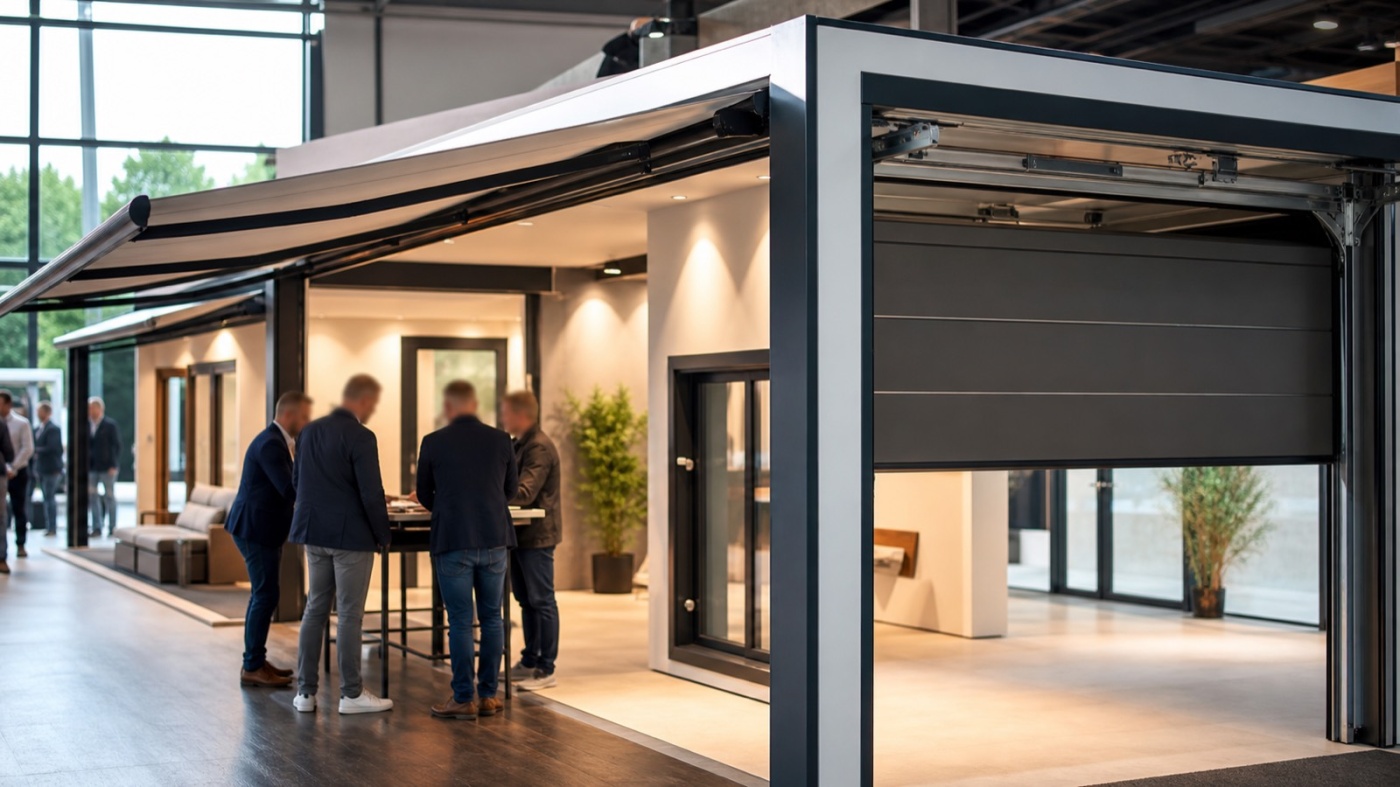
Every three years the sun protection and door industry turns its attention to Stuttgart. R+T gathers more than a thousand exhibiting companies there, and its audience is as international as it is expert. Tailor the stand to that visitor structure, and a handful of fair days delivers noticeably more substantial conversations.
A rhythm of three years
R+T is the world's leading trade fair for roller shutters, doors, gates and sun protection, held on the Stuttgart exhibition grounds in February at three-year intervals. The 2024 edition welcomed more than 61,000 trade visitors from 146 countries, and around 1,000 exhibiting companies presented their programmes, roughly four fifths of them from outside Germany. The next date falls in February 2027, followed by 2030. We keep the current dates in our trade fair calendar.
That rhythm shapes the appearance. A large share of exhibitors develops innovations specifically for R+T and shows them there for the first time. For you that means the stand carries three years of product story, and the attention of the whole sector concentrates into a few days. An appearance that uses this stage keeps working long afterwards.
Who walks the R+T: four visitor groups
Installers and fabricators. Roller shutter and sun protection technicians, metalworkers, joiners and electrical contractors form the backbone of the audience. They care about installation time, spare part availability, serviceability and how a product behaves on site. The right approach is to show rather than describe. Cut-away models, an element they can assemble by hand and an experienced fitter on the stand convince faster than any brochure.
Specialist retail and distribution. This group thinks in ranges, availability, terms and margin. It appreciates a quiet table, firm figures and a contact with the authority to decide. Appointments booked in advance are the norm here, and a reserved slot in the calendar keeps the morning free for your most important partners.
Specifiers and architects. They arrive with questions on shading concepts, summer heat protection, façade interfaces, tender texts and planning data. R+T runs a dedicated architecture programme for them. On the stand, section details, reference projects and a clear note on which planning data formats you supply do the work.
International buyers and sales partners. Around two thirds of visitors travel from abroad. They look at export capability, standards and certificates, order volumes and territory representation. Bilingual signage and a named contact for export markets open these conversations.
Zones instead of one flat area
Four groups with four depths of conversation call for a stand in zones. A sequence from outside in has proven itself: a display face towards the aisle showing movement and novelty, an open counter for first contact, a semi-open advisory area with seating, a closed meeting room for terms and contracts, plus storage and cloakroom.
Weight the zones according to your sales goal. Chasing many installer contacts favours display face and counter. Negotiating framework agreements calls for more closed meeting time. Where floor area is tight and meeting demand is high, a double-decker stand is worth considering: it lifts the negotiating level upstairs and keeps the ground free for products. Examples from our work are on our projects page.
Think the routes across the area through as well. An installer spending ten minutes on a drive unit should ideally stand where he stays visible while the entrance remains clear. A sales conversation about terms, by contrast, gains from distance to the aisle and a door that closes.
Showing movement: plan the demonstrations first
Exhibits at R+T move. Awnings extend, doors open, external venetian blinds tilt, drives run, controls respond. That movement is what pulls eyes in from the aisle, and it sets requirements for the build at the same time.
Account for the full extension and opening envelope within your own area and keep safety distances to the aisle. Build heights, rigging and special structures follow the technical regulations of Messe Stuttgart and call for stand approval submitted in good time, with structural documentation for load-bearing elements. Size the power supply with headroom so several drives can run in parallel.
A short demonstration script at fixed times concentrates attention and gives the stand team a structure. Two minutes of movement, one sentence on the benefit, then the conversation: that pattern works across all four visitor groups.
An international audience: language, samples, follow-up
Bilingual signage in German and English belongs to the basic kit, supported by symbols for drive type, wind class, material and application. Technical data sits directly at the product, so a visitor stays informed while your team is in conversation elsewhere.
Samples you can touch are this industry's strongest argument: fabric collections, slat profiles, surfaces and fittings. A well-sorted sample wall saves floor area and invites people to linger. Place a short overview beside it showing which versions are available at short notice.
For the follow-up, capture contacts in a way that lets the visitor agree openly and understand the purpose. A brief form with a visible consent step delivers clean data, and a call within the first days after the fair meets a fresh memory.
Four audiences served by one clear layout
R+T rewards exhibitors who know their audience: the trades want something tangible, retail wants figures, specifiers want detail, export wants reliability. A stand with clear zones, planned movement and bilingual orientation serves all four. And because three years pass until the next edition, modular construction pays off: store it, reconfigure it and use it at other fairs. More on that under sustainable exhibition stands.