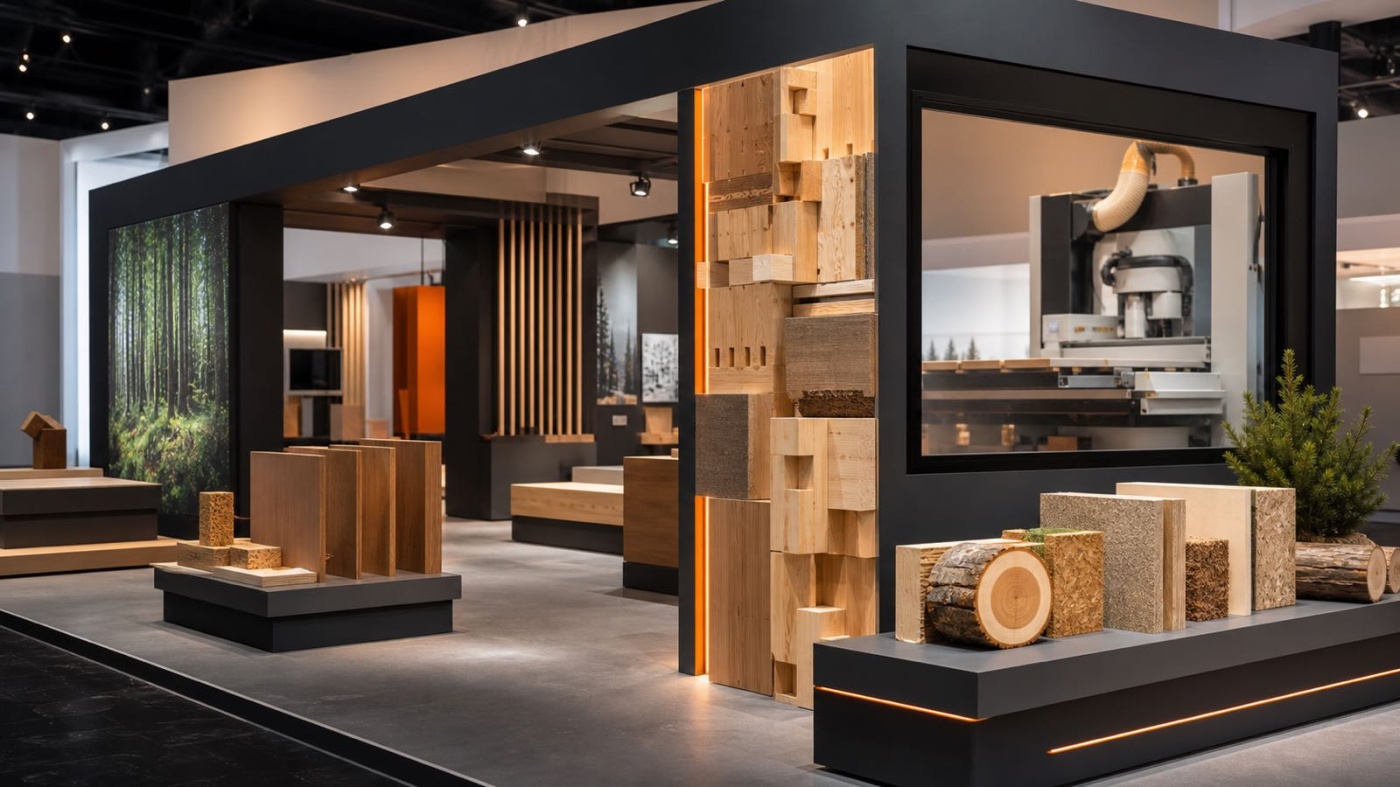
LIGNA in Hannover is regarded as the world's leading trade fair for tools, machinery and plants used in woodworking and the wood-based materials industry. It takes place every two years in odd-numbered years in spring and brings mechanical engineering, tool manufacturers, forestry technology and surface technology together in one place. According to the organiser, Deutsche Messe, the next edition is planned for 10 to 14 May 2027 (Monday to Friday). Because trade fair dates can still shift, you should confirm this before you build your whole schedule around it. Exhibitors here rarely show small tabletop items. They often present machines of considerable weight that run in live demonstration.
That is exactly what makes a LIGNA exhibition stand a special task. A stand at this fair has to carry heavy technology, cope with chips and emissions during live operation and still offer your visitors a quiet place to talk. This guide explains, in a factual way, what matters when it comes to the exhibition grounds, the stand requirements, the demonstration areas and the deadlines, so that your appearance is technically sound and ready on time.
LIGNA: the leading trade fair for woodworking and wood-based materials
LIGNA is organised by Deutsche Messe AG together with the VDMA and covers the entire value chain of the wood processing industry. The range of topics reaches from woodworking and wood-based materials through machinery and tools to forestry technology and surface technology. In recent editions, digitalisation and automation have also been strongly in focus, for example networked machines and automated production.
From 2027 onwards, LIGNA leaves its familiar slot around Ascension Day. It stays on its two-year rhythm in odd-numbered years, however, and continues to be held in spring in Hannover. The organiser publishes the binding date and the current conditions on the official LIGNA website. Check these details early, because your entire planning depends on the exact date.
The Hannover exhibition grounds at a glance
The Hannover exhibition grounds are among the largest in the world and, alongside the halls, they include an extensive outdoor area. For LIGNA this outdoor area is particularly important, because large and especially heavy exhibits such as sawmill technology, forestry machines and equipment for the log yard are often shown there under the open sky. If you are planning such a presentation, you should clarify early whether your exhibit fits into a hall or belongs outdoors.
The decisive question is floor load. Very heavy machines place high point loads on the hall floor or on the outdoor surface. Which loads are permitted and how they have to be distributed is governed by the technical guidelines of Deutsche Messe. These values are binding for stand planning and should be known before construction begins, so that the floor is not overloaded and the exhibit is set up safely.
On top of this comes moving the machine into place. An exhibit weighing several tonnes cannot simply be pushed to its position. A crane, a heavy-duty forklift or rollers are often needed, and the routes through the hall as well as the doors set limits for size and weight. This logistics work has to fit the build-up time window, because a crane operation needs to be registered and scheduled in advance.
Closely linked to this is delivery. Large machines usually arrive by heavy transport, sometimes with a special permit. Access, unloading points and the order of the build-up determine whether construction runs smoothly. A well-considered delivery plan takes into account that the heaviest exhibit arrives first and the rest of the stand equipment follows, so that vehicles and crane do not block one another.
Stand requirements for woodworking
A stand for woodworking is first of all a question of statics. The floor load of the machines determines whether a load-distributing substructure is needed and how the stand area is prepared. When machines are moved into place with a crane or forklift, the routes have to stay clear and the setup points have to be load-bearing. These points belong at the start of any planning, not at the end.
Media supply is added to this. Woodworking machines often need three-phase power, compressed air and an efficient extraction system. The power requirement should be calculated realistically and ordered from the organiser in good time, because connections for power, water and compressed air are among the additional costs that the exhibitor orders directly from the trade fair company.
Anyone running machines live has to control chips, dust and noise. An extraction system keeps the stand clean and protects visitors and staff alike. For a safe LIGNA exhibition stand, the following points in particular need to be clarified:
- Load capacity and load distribution in line with the technical guidelines
- Moving exhibits in, meaning crane, forklift and sufficiently wide routes
- Power, compressed air and extraction for live operation
- Shielding against flying chips and dust, plus noise protection
- Guards and clear escape and rescue routes around running machines
Safety comes before appearance. Running machines need protective distances, clear operating zones and a safe area for spectators.
Demonstration areas
The real strength of a LIGNA appearance is the live demonstration. Visitors want to see how a machine cuts, mills or coats, and not just look at a static exhibit. It therefore pays to plan the stand around the demonstration rather than squeezing the demonstration into a finished stand afterwards.
A good demonstration area separates three zones from one another. There is the zone of the running machine with a protective distance, the spectator area with a clear view of the work process, and the quiet conversation area where the follow-up talk takes place. This keeps your visitor safe, helps them understand the technology and still gives them calm for the expert discussion. A raised platform or a slightly stepped floor can improve visibility, but it has to fit back into the load and deadline planning.
Technical guidelines and deadlines
The technical guidelines of the respective trade fair company apply to every exhibition stand, in this case those of Deutsche Messe in Hannover. Among other things, they govern construction heights, rescue routes, sight screens to neighbouring stands and the permitted materials. As a rule, stand construction has to pass an approval process for which dimensioned stand plans with floor plan and elevation are submitted. For special structures such as platforms, double-decker areas or suspended constructions, proof of structural stability is often required.
For fire protection, the usual rule is that building materials must be at least flame-retardant to class B1. You should take the specific deadlines and values for your edition of LIGNA from the technical guidelines of Deutsche Messe, because they can differ from fair to fair and from year to year. As a rule of thumb, the stand plans should be ready several weeks before the build-up starts, and the planning itself sensibly begins many months earlier. If you take the lead time seriously, you avoid expensive extras and night shifts shortly before the opening.
Exhibition stand builder for LIGNA
A full-service exhibition stand builder accompanies a LIGNA appearance from the first idea to dismantling. This includes the consultation and the stand concept, the design with 3D visualisation, the construction in an in-house workshop, the logistics and assembly, and the follow-up and storage. The advantage lies in a single point of responsibility, because one fixed contact coordinates all trades and the coordination with the trade fair company.
die trendSETZEREI GmbH is based in Offenbach am Main and works throughout Germany, which includes Hannover. An in-house vehicle fleet helps to bring material and assembly teams to the exhibition grounds on time, which matters especially with the tight build-up windows at LIGNA. You can read which services are included in detail on the exhibition services page.
Choosing stand size and stand form for your LIGNA exhibition stand
The stand form depends on the location in the hall plan and on your goals. A row stand is open only to the aisle side and suits compact appearances. A corner stand sits on two open sides and gains visibility. A head stand opens to three sides and feels generous, and an island stand is accessible all the way around and offers the most space for large machines and demonstrations that are visible from every side. Which form suits your exhibit is explained in the overview of stand types.
With heavy machines, it is not only the area in square metres that decides, but the zoning. The machine and its protective distance need space, and to this you add the spectator area, a quiet conversation zone and often a small storage or technical room for tools and extraction. If you plan these zones together with the floor load and the moving-in logistics, the stand size you choose will also fit the project technically.
Conclusion
A successful LIGNA exhibition stand begins with the technology and not with the appearance. Floor load, moving exhibits in, media supply and safe live operation determine whether a heavy machine can be shown at all in a meaningful way. If you clarify these points early, observe the technical guidelines of Deutsche Messe and keep to the deadlines, you free yourself for what really counts, namely a convincing appearance in front of a professional audience in Hannover.
If you are planning an appearance at LIGNA 2027, die trendSETZEREI GmbH supports you from concept to dismantling, with an in-house workshop and its own vehicle fleet, from Offenbach and throughout Germany. Get in touch by phone on +49 69 201 65 001 or by email at info@dietrendsetzerei.de. You can also send your enquiry directly via the contact page.