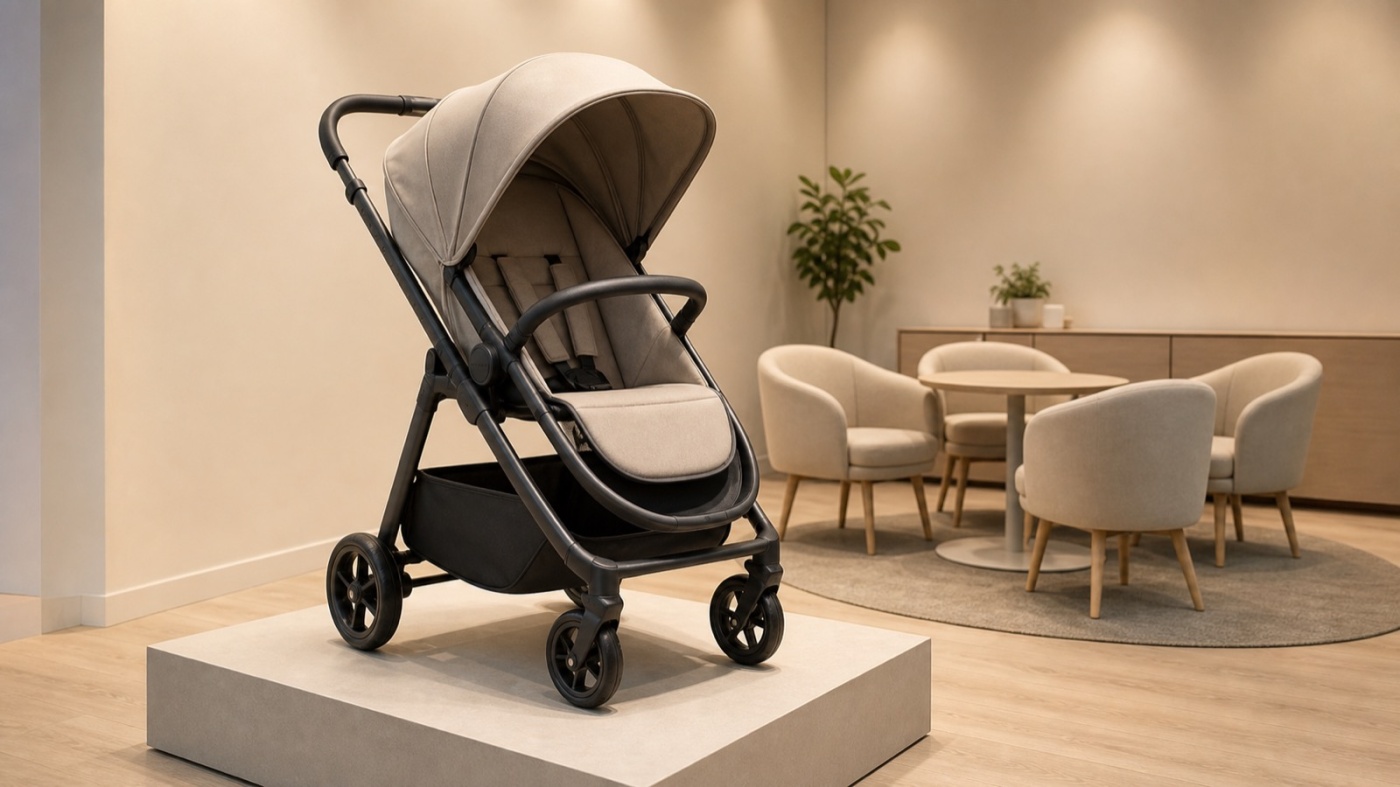
In September, Cologne fills up again with pushchairs rolling across exhibition carpet, car seats clicking into demo shells and cots standing in fully furnished room scenes. Kind + Jugend brings the international retail trade for baby and child equipment together at Koelnmesse. How well your appearance performs there depends on a decision taken long before the first sketch: the shape of your stand space.
Who walks into your stand in Cologne
Kind + Jugend is an ordering fair with a distinctly professional audience: buyers from specialist baby retail, importers, wholesalers, department stores, online retailers and international distributors, alongside trade press, midwives and sales agencies. They arrive with appointment lists, compare collections and decide on next season's ranges.
That creates two demands on the same floor space. The product wants to be handled: a pushchair proves itself when it is steered and folded, a car seat when it is installed, a high chair when it is adjusted. And the order conversation wants calm, seating, surface for samples and price lists, plus a degree of privacy, because terms and volumes are on the table.
How gracefully movement space and meeting zone combine depends on the stand configuration. Row, corner, head and island stands are more than floor plan categories. Each one carries its own visitor flow, its own presence along the aisle and its own logic for counter, back wall and storage.
Row stand: one frontage, one clear message
A row stand opens to a single aisle, with neighbours to the left and right. For brands with a focused range that works in your favour, because a narrow frontage forces a choice: one hero product and one statement take the stage, everything else supports them.
A proven layout keeps roughly the front third of the depth open, with a platform for the product of the season. The counter moves sideways against the dividing wall so the view stays clear. The meeting zone follows behind, with a closed storeroom at the back for samples, catalogues and coats.
On a row stand the back wall is your strongest advertising surface. One continuous backlit fabric panel carrying brand image and product motif reaches further than many small graphic panels. Build heights and sight screens towards neighbouring stands follow the Koelnmesse technical guidelines in the version valid for each edition.
Corner and head stands: more open sides, more movement
At an aisle junction the choreography changes. A corner stand opens to two sides, which allows a clean split: one side becomes the shop window for new products, the other the entrance to your meeting area. Pushchair, buggy and bicycle seat brands gain the most here, because a corner creates a short test track where buyers experience suspension and steering for themselves.
A head stand sits at the end of a block and shows three open sides. It works like a stage and suits broad ranges that tell their story in themed groups: mobility, sleeping, feeding, care. Visibility comes in exchange for wall surface. Vertical supports, free-standing wall panels, a portal or a rigged element then carry the brand mark, as far as the hall offers rigging points.
For both configurations, study the walking direction. Where does the visitor flow come from once the hall opens? The busier open side deserves the exhibit that explains your brand within three seconds.
Island stand: a brand world to walk around
An island stand stands free and is entered from four sides. For established brands with a wide range it is the most generous option, because it lets buyers circle a complete brand world. Themed islands per product group linked by a clear circular route work well, together with one central landmark: a tall structure, an LED ring, a luminous element carrying the logo.
Order conversations move inwards on an island. Enclosed meeting rooms in the core of the space, or a second level, create calm while the open character remains. A double-decker booth doubles the usable area on the same footprint and asks for structural calculations, longer build-up and dismantling windows and earlier submission of the stand approval.
Allow generous circulation. Four open sides come into their own when two people with a pushchair pass each other comfortably between the islands.
Configuration, hall position and budget belong together
Kind + Jugend occupies several halls and levels in Cologne, complemented by country pavilions, start-up areas and special zones around the Innovation Award. Booking early widens your choice of position and shape. And knowing your preferred configuration gives you a concrete case to make during space allocation.
Budget has a say as well. With many organisers the price per square metre rises with the number of open sides, while space rental, services and mandatory fees are invoiced by the fair organisation directly. Which items belong to the stand construction itself is set out in our overview of exhibition stand cost.
A modular system stand keeps all four configurations available: this year's row stand becomes next year's corner stand with additional frames and fresh fabric graphics. For a first appearance in Cologne, the rental route described under rent an exhibition stand offers an easy start.
Decide early, plan calmly
The sequence that works: usage profile first, configuration second, design last. Write down how many order conversations should run in parallel, how much movement space your exhibits need and how much sample stock stays on the stand. Those three figures point towards the right shape almost by themselves.
Dates for the coming editions are listed in our trade fair calendar. As soon as your space in Cologne is confirmed, we sketch the options together and show what your floor plan allows.