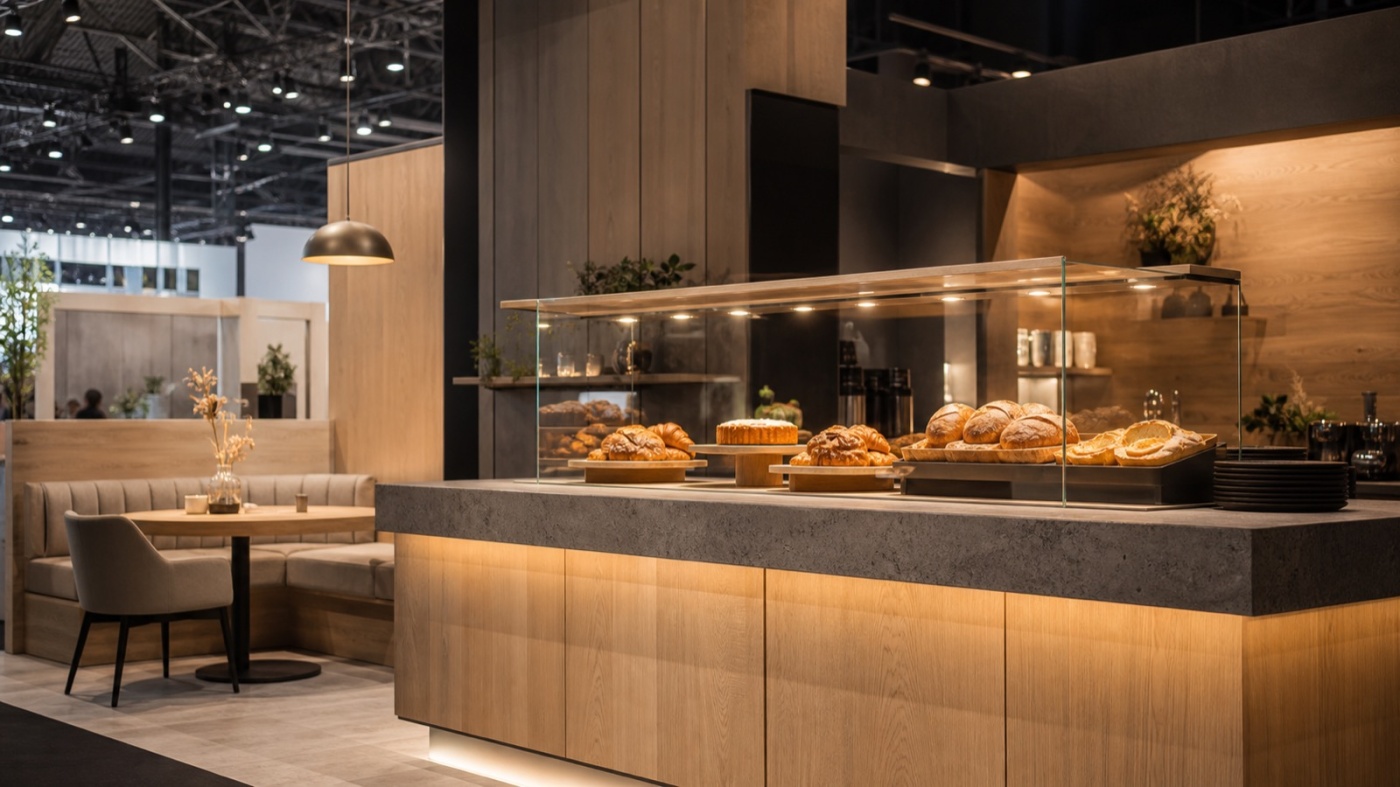
Every March, Hamburg belongs to hospitality for five days. Around 1,200 exhibitors show at INTERNORGA how hotels, restaurants, bakeries, canteens and cafés will work in the years ahead, and more than 85,000 trade visitors arrive to judge exactly that. This audience designs rooms for a living. It therefore reads very precisely how an exhibition stand handles light and material.
Five days in front of guests who design interiors
INTERNORGA ranks among the oldest trade fairs in Germany and today covers the full out-of-home catering market: food, beverages and coffee, kitchen technology, furnishing and equipment, the baking and confectionery trades, plus digital applications and a growing area for start-ups and new concepts. Hamburg Messe und Congress publishes the hall allocation for each edition, and areas do move between halls from year to year.
For stand design, the composition of the audience matters most. The people in these aisles plan dining rooms, choose counters, buy lighting and assess surfaces by how much care they take. They notice in passing whether an edge is solid, whether a lighting mood holds together and whether a seat suits a longer conversation. Your stand therefore performs as a work sample long before anyone asks about the range.
Warm tones for the food, clear light for the equipment
Food calls for warm light. Bread crust, pastry, meat, timber and laid tables look appetising and inviting at roughly 2,700 to 3,000 Kelvin, while cooler light drains them. Stainless steel, refrigeration and appliances take neutral light well, because it makes them read as clean and precise. Show both on one floor area and it pays to separate the zones deliberately, with a transition between them, rather than blending the two light colours.
Colour rendering deserves as much attention as colour temperature. Luminaires with high colour rendering quality show reds, browns and greens as they truly are, and product presentation in this industry lives on exactly that. Cheap fittings with weak rendering leave tomatoes grey and cake flat, and visitors put the blame on the product without realising it.
Work with contrast as well. Hall lighting is even and flat, so attention comes from accents: narrow-beam spots on the counter, the display cabinet and the exhibit, over a distinctly calmer base level across the rest of the space. Glare-controlled fittings keep that light on the goods rather than in the eyes of seated guests.
Material that convinces the hand
Visitors at INTERNORGA touch things. They run a hand along table edges, tap on worktops, check joints and turn handles. It pays to place genuine material exactly where hands land: counter edge, table top, seat, door handle. For large surfaces at a distance from the guest, printed textile skins achieve the same effect at far lower weight.
Material choice also states your position. Pale timber with visible grain, stone or terrazzo at the counter, ceramics, linen and matt metals read as calm and crafted. High gloss reads as technical and records every fingerprint, which becomes visible after five show days. Matt, lightly textured surfaces stay fresh longer and take accent light more softly.
Textile surfaces bring a second benefit: they absorb sound. In a hall full of conversation, acoustics decide whether a sales talk feels comfortable. A textile ceiling frame, an upholstered bench or a curtain between the meeting area and the aisle lower the noise level noticeably and extend the time guests stay.
The stand as a sample room: counter, seat, storage
Many visitors translate what they see straight into their own premises. Use that: build the stand as a section of a well-resolved hospitality space. A counter as the clear centre, a leaning zone in front of it for short contacts, seats at table height behind or beside it for longer conversations.
Plan your team's working route into the design too. Behind the counter you want room to move, sockets at working height, space for glasses and samples, plus a closed area for stock and coats. A stand that solves this everyday choreography elegantly convinces restaurateurs more than any rendering.
What five show days can take
INTERNORGA runs longer than many trade fairs, and surfaces reveal it. Pale, smooth flooring shows marks by the second day, while darker or textured flooring stays presentable. Edges in busy positions welcome a protective detail, and textile skins can be washed before the next appearance instead of replaced.
A small care kit on the stand helps as well: microfibre cloth, suitable cleaner for timber and stone, spare lamps, tape in the stand colour. Ten minutes before the halls open are then enough to make the space look fresh again every morning.
Atmosphere that still works next March
Light and material combine very well with modular system construction. Aluminium frames carry lighting tracks, cabinets and wall panels, skins and surfaces change with each appearance, and the structure stays. The result is a presence that evolves every year instead of being created from scratch every year. Our overview of exhibition stand services shows how design, production and assembly come together.
Upcoming editions and further leading trade fairs are listed in our trade fair calendar. To think your Hamburg appearance through in concrete terms, a short enquiry is the quickest route: floor area, preferred hall, product group and the kind of conversation you want are enough for a first draft.