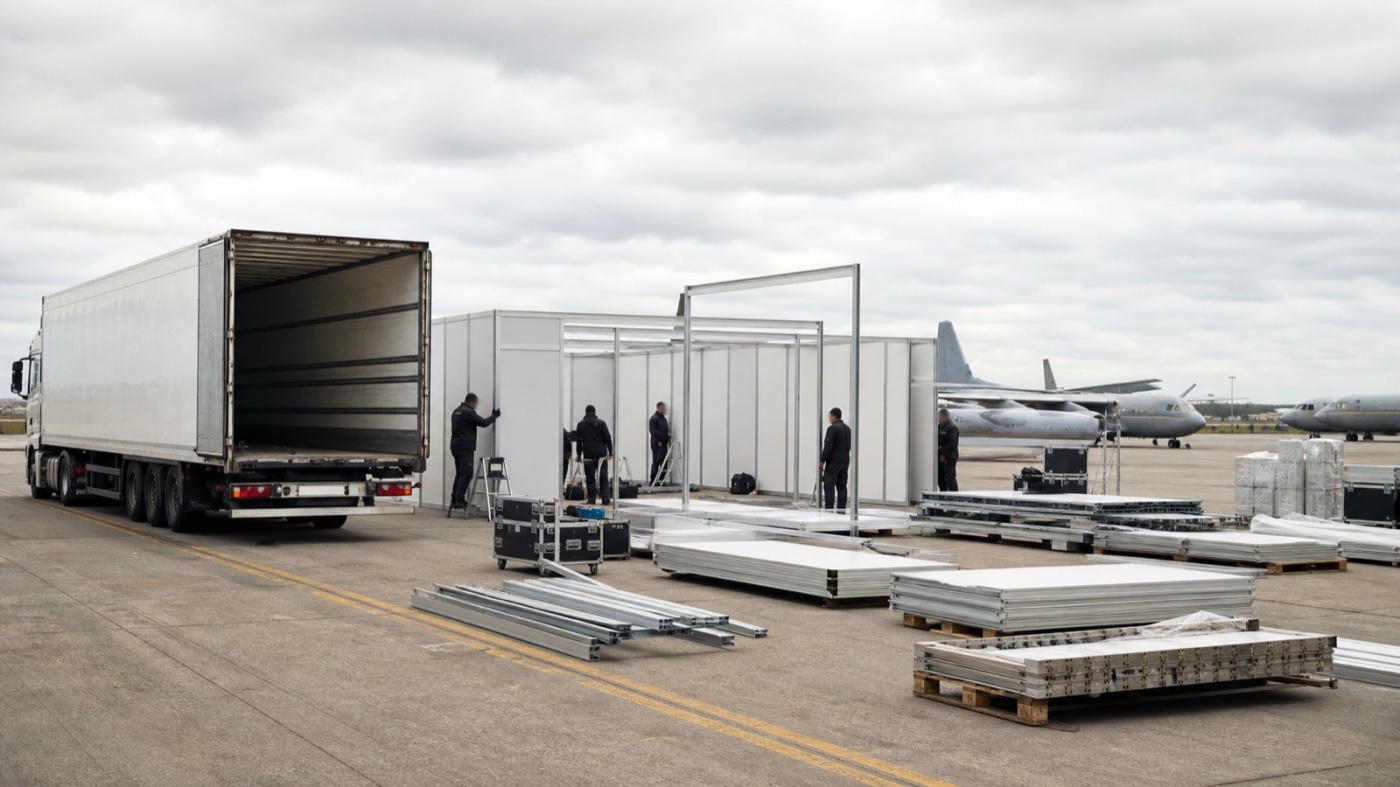
ILA Berlin takes place where aviation actually happens: on a site directly beside BER airport. Exhibition halls, chalets and a static display holding more than a hundred aircraft sit side by side. For stand construction that creates a logistics picture unlike any conventional indoor trade fair.
Halls, chalets and an apron next door
Berlin ExpoCenter Airport covers roughly 250,000 square metres with permanent halls, chalet areas and wide open spaces. At the 2026 edition more than 600 exhibitors from over 35 countries presented their technology there. Six halls carry thematic focus areas ranging from aerospace and space through defence to suppliers, unmanned systems and a career centre. Outside, the static display adjoins the halls, complemented by the flying display above the neighbouring airfield. The show runs every two years and splits into trade visitor days and public days.
The decisive difference from an established inner-city venue lies in the neighbourhood. Exhibition areas here border an active commercial airport. Access, traffic routes and time windows follow from that, and planning around it early buys real calm on build-up day.
Passes first, delivery second
Access is regulated, and the regulation starts weeks before the first truck arrives. Personnel and vehicle passes, access permits and, depending on the area, additional clearances run through the Messe Berlin exhibitor shop. Which documents each edition requires and by when they are due is published by the organiser with the exhibitor manual.
Assemble the details early: names of every fitter including subcontractors, vehicle registrations and dimensions, preferred delivery windows. Where teams rotate, registering one person more than needed beats sorting it out at the gate. A well maintained list held by the stand builder, with a copy in the driver's cab, saves noticeable time at the entrance.
A second point concerns availability. Name one person who stays reachable throughout build-up and mediates between the freight forwarder, the drivers and the stand crew. On this site that single measure delivers the biggest effect.
The build-up plan follows the access concept
Deliveries run through defined gates, with a limited number of vehicles admitted at once, a check-in and a waiting area. One simple rule follows: the loading order in the truck matches the build order on the stand. Whatever goes up first sits at the tail of the trailer.
This sequence has proven itself: flooring and trussing first, then the stand structure, followed by technology and media, and finally graphics, furniture and exhibit preparation. Empties go back or into storage promptly, since buffer space on the plot stays scarce. Register crane and forklift requirements as early as special transports for large exhibits.
Allow for the rhythm of the site as well. Positioning and movement of the displayed aircraft set the pace during certain windows, and while they run, vehicle traffic on adjoining areas pauses. Build those pauses into the schedule from the start and they stay a planned quantity rather than a surprise.
Building outdoors: ground, wind and weather
Chalets, exhibition areas along the static display and accompanying tent structures stand on paved ground. Anchoring into the surface is generally ruled out there, so ballast carries the stability. Flags, banners, tent roofs and free-standing walls call for a structural stability certificate matched to the wind loads of an open airfield.
Weather plays a larger part here than inside a hall. Raised floors get a fall and clean edge details, cable runs across driving lanes receive ramps, and surfaces and graphics work best in weatherproof execution. Materials with the required fire classification and verified structures ease the stand handover, the details of which are set out in the technical regulations of Messe Berlin.
A modular system build shows its strengths precisely under these conditions: assembled with few tools, delivered in defined grid dimensions and sorted into transport frames, it shortens time spent outdoors considerably. Our overview of exhibition stand services shows how such a build is organised from design through to on-site assembly.
Trade days and public days during the run
ILA changes character during its run. Trade visitor days with delegations, appointments and technical discussions give way to public days with very high footfall. Your stand logistics can be tuned to both.
Plan restocking day by day: brochures, giveaways, consumables and catering. Deliveries during the show follow their own windows, usually in the early morning hours, and call for advance registration. Exhibits, samples and equipment belong in lockable storage overnight, which counts as basic equipment with this audience. Daily cleaning and a short stand check before opening keep the appearance fresh across every show day.
The stand team benefits from a shift plan too. Public days bring far more contacts per hour, while trade days call for long, unhurried conversations. Two crews for two modes of operation are money well spent here.
Calm on build-up day starts months earlier
Dismantling follows the same order in reverse, and areas are handed back swept clean. A modular structure comes apart quickly, travels sorted in transport frames, gets inspected in storage and stands ready for the next appearance. Our article on sustainable exhibition stands describes exactly this circular approach.
In the end, a calm build on the airfield rests above all on lead time: passes applied for early, an agreed delivery plan, a clear loading order and a construction method that suits both the weather and the time window. If you are planning your next ILA appearance, get in touch early. A short enquiry is enough to start the conversation.