Every four years the printing world sets its compass to Dusseldorf. drupa gathers equipment manufacturers, print service providers, packaging converters and brand owners in one place, and it does so with a share of international visitors few other German trade fairs reach. Planning a stand here starts with planning the conversations you want to have on it.
An audience that travels with investment in mind
drupa is the world's leading trade fair for printing technologies and takes place at the Messe Dusseldorf grounds. The 2024 edition gives a good sense of the scale: close to 1,600 exhibitors from around 50 nations across roughly 140,000 square metres of net space, some 170,000 trade visitors and an internationality rate of 80 percent. Guests travelled from 174 countries, with Asia the strongest region after Europe, followed by the Americas.
For 2028 the organiser shortens the run to nine days for the first time. That condenses the show noticeably and raises the value of a well planned approach, because the same pool of decision makers now spreads across fewer days.
More telling than any figure is the intent behind the visit. A printing press is an investment that shapes a business for years. Many visitors arrive with a project in mind, often in pairs or threes, and they return to promising stands several times during the fair. A stand can be built precisely around that behaviour.
Four groups, four expectations of your stand
Owners and managing directors of printing houses bring their technical leads along. They focus on output, changeover times, automation, service networks and spare parts supply, and ultimately on total cost across the lifetime of the machine. What serves them is a quiet place where the numbers can be worked through.
Packaging producers and converters form the fastest growing group. Their questions circle around substrates, finishing, run stability, job changeover and the recyclability of the finished product. They want to see your result on the material they process themselves.
Brand owners and print buyers think from the campaign backwards. Personalisation, colour consistency across sites, delivery times and sustainability evidence lead their agenda. This group covers many halls in a short time and stops where something finished is on display.
Suppliers, software vendors, trade media and young professionals hold shorter conversations, yet they open doors. A generous welcome to this group pays off well beyond the show.
Four expectations mean four entry points into the same offer. The craft lies in accommodating all of them on one footprint while each group keeps its room to breathe.
Language, samples and a press in motion
With eight in ten guests arriving from abroad, English works as the operating language on the stand. Staff who serve the strongest source regions in their native language add real value on top. Exhibit labelling belongs in two languages, with units and format details stated clearly so a single glance is enough.
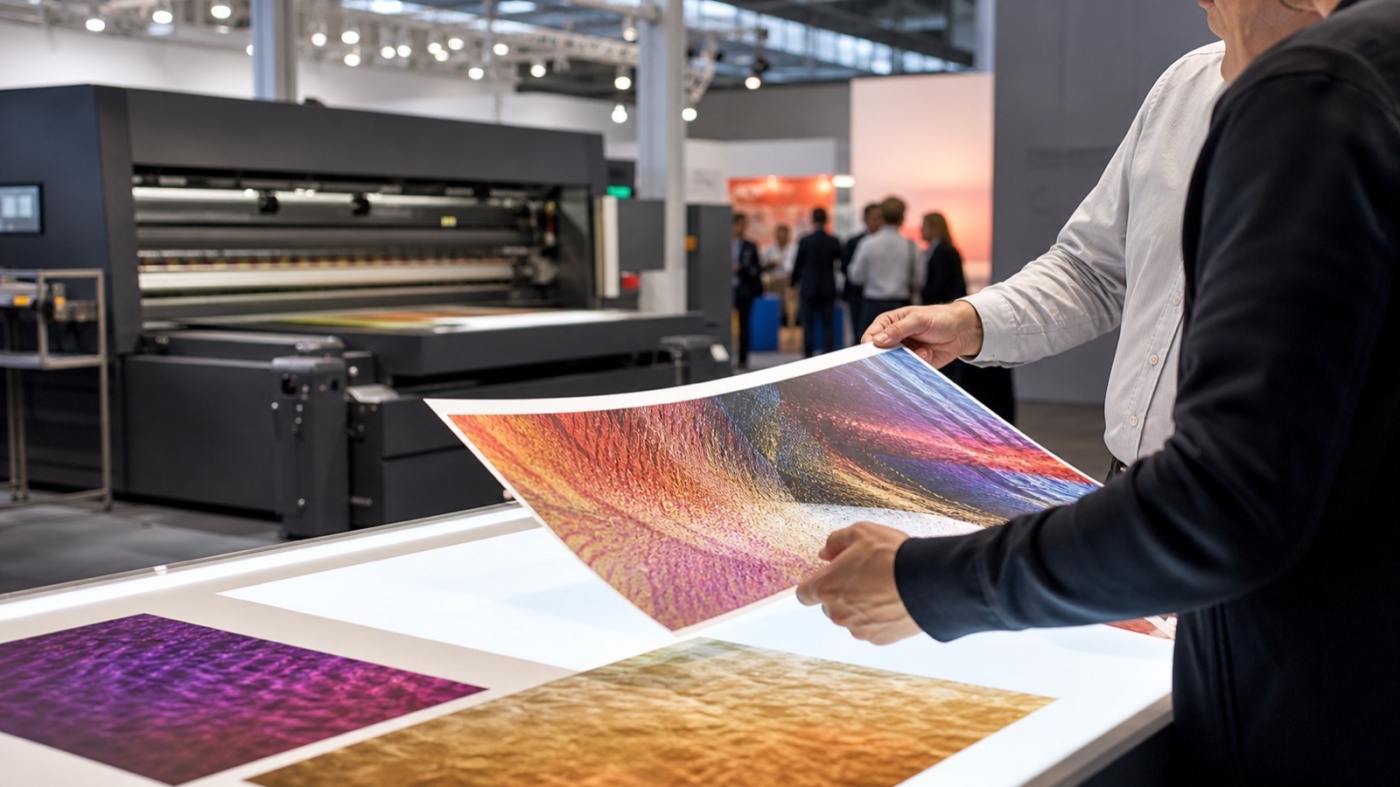
The strongest medium of understanding at this fair, however, fits in the hand: the sample. A printed sheet, a finished carton, a label on the actual substrate explains in seconds what would otherwise take ten minutes of translation. Plan an open sample area right at the aisle and stock it generously.
The running machine provides the second conversation starter. A visitor watching a print run stops walking. Your team greets them there rather than approaching them in the aisle. Fixed demonstration times, pre-booked appointments and a visible daily schedule on the stand give this rhythm its structure.
Zones for the first glance and for the contract
The four groups translate into zoning. At the front sits the open sample area with short routes and standing height. Behind it stands the machine with generous sightlines and safety clearance, plus a small viewing zone where demonstrations are easy to follow.
Semi-open consultation places with a table and four chairs carry the middle level of conversation. For pricing and contract talks a closed room belongs on the plan, acoustically separated, with a screen, storage and refreshments. Where machines run, acoustics deserve attention: absorbing surfaces, carpet under the meeting zones and, where useful, headset solutions for guided demonstrations.
Contact capture runs on consent throughout. Visitors actively agree to their data being recorded, your team adds a short note on the conversation, and the handover to sales happens the same evening.
Nine show days call for shift thinking
A run this long asks for something different than a three day format. Stand personnel work in shifts, with clear handovers and genuine breaks, otherwise conversation quality drops from midweek onwards. Budget travel, accommodation and staffing early, since at drupa they rank among the largest items. Our article on exhibition stand cost offers orientation.
The stand itself works nine days straight as well. Hard-wearing flooring, serviceable lighting, a lockable store for samples and paper plus daily cleaning keep the appearance fresh. Plan consumables day by day and store them within reach so restocking during opening hours runs smoothly.
What nine days leave behind
The value of this fair emerges in the weeks that follow. Reply quickly, send the samples you promised and assign every conversation a clear next step. A four year rhythm rewards disciplined follow-up, while giving you plenty of time between editions to nurture the relationships you built.
The same logic applies to the stand. A modular structure scales down after Dusseldorf, travels to regional industry shows and grows again for the next edition. Our article on sustainable exhibition stands explains how that works in practice. And to set the lead time for your next appearance, take a look at our trade fair calendar.