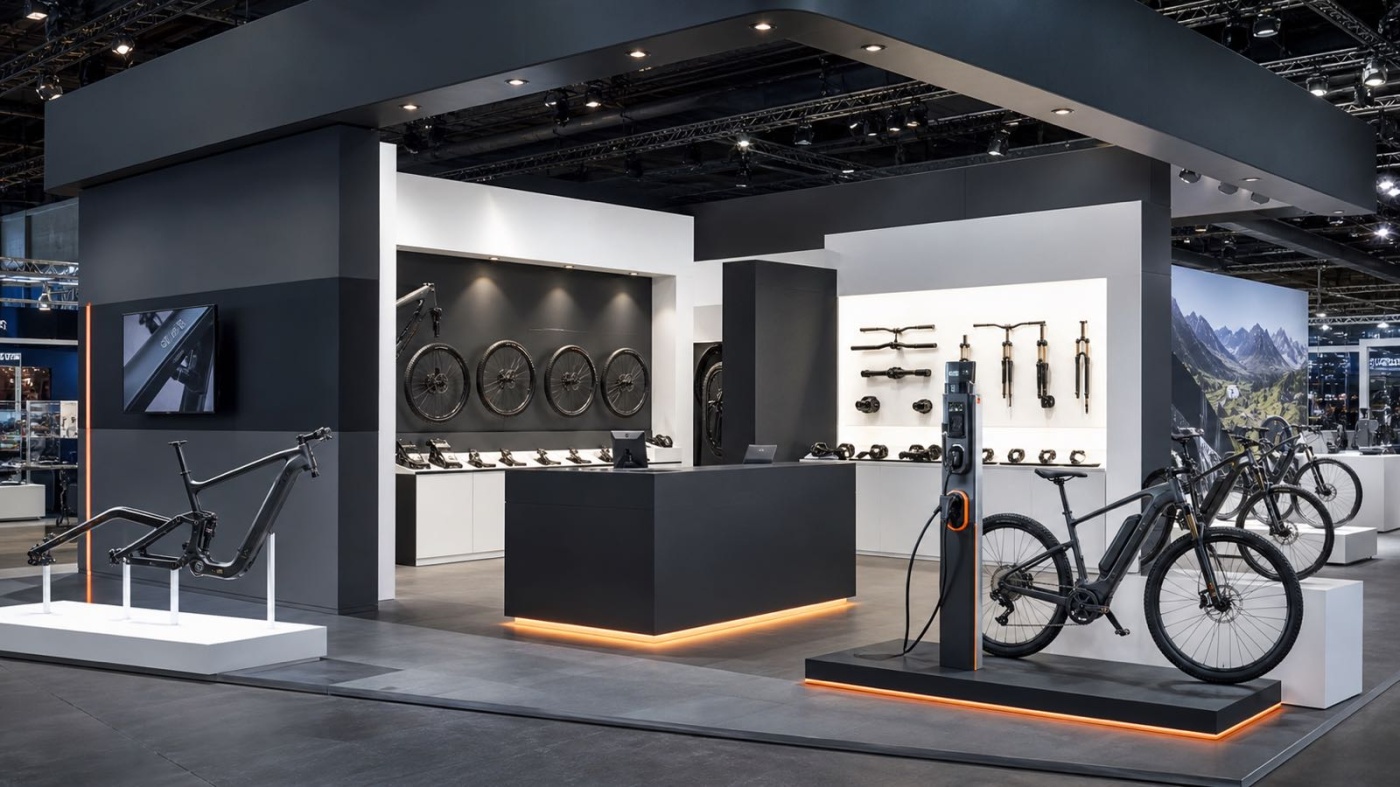
Eurobike is the international meeting point of the cycling industry and has been held in Frankfurt am Main since 2022. If you exhibit here, you present bicycles, e-bikes, components and new mobility solutions to a trade audience that wants to do more than look at products: they want to touch them and try them out. That is what sets a cycling trade fair apart from many other formats. The stand is rarely just a display area. It is a stage, a workshop and an experience space at the same time.
This guide is written for companies planning an exhibition stand for Eurobike. It explains, in plain terms, what characterises the Frankfurt exhibition grounds, what the cycling industry expects from a stand, and which deadlines and rules you should keep in view. If you are preparing a concrete appearance, you will find further information on our page about the exhibition stand for Eurobike.
Eurobike: the leading fair for cycling and mobility
Eurobike sees itself as a global platform for bicycles and ecomobility. The focus is on sport, lifestyle and everyday mobility, alongside topics such as service, workshop, training and new mobility solutions. For 2027 the organiser has repositioned the fair and announced a more compact appearance geared more strongly towards trade visitors, complemented by a public element around the Eurobike Festival.
According to official information, Eurobike 2027 is scheduled for 1 to 3 September 2027 in Frankfurt. The organiser publishes the binding dates and the current cycle on its official channels, where you will also find the registration deadlines. For an exhibition stand at Eurobike it is worth checking these key details early, because the whole planning process depends on them.
The Frankfurt exhibition grounds at a glance
For the 2027 edition, Eurobike moves to the eastern part of the Frankfurt exhibition grounds and occupies halls 3, 4 and 5 around the Agora. This Agora is a central outdoor area between the halls and offers space for test tracks and demo areas. For a cycling fair this is a decisive advantage: visitors can ride bikes outdoors directly, rather than only viewing them at the stand. If you are planning an appearance, you should clarify early on whether an outdoor area or a link to a test course makes sense, because these spaces are in demand and are closely tied to the stand concept during planning.
Visitor flow matters just as much. The Frankfurt exhibition grounds are well connected to public transport: there is a dedicated commuter rail station and tram stops, and Frankfurt central station is within walking distance. Many trade visitors arrive by public transport and enter the grounds through the main entrances. For you as an exhibitor this means that, depending on which direction the flow of visitors reaches your area from, the orientation of the stand and the placement of the reception and test track can decide how much attention you attract.
Three further points belong in every plan. First, the location of the assigned hall and its proximity to the Agora, because short distances between the stand and the open space improve the experience for test rides. Second, delivery: setup and dismantling follow fixed time windows set by the organiser, and access to the eastern halls must be coordinated with the logistics schedule. Third, the adjacent areas such as the Forum and the Festhalle, which are used for partner and networking events and shape the surroundings of your appearance.
Stand requirements for the cycling industry
An exhibition stand for the cycling industry has to achieve one thing above all: it must make products tangible. Bicycles and e-bikes only take effect when visitors pick them up, sit on the saddle and feel the build quality. That places particular demands on the space. Open, walkable stands without unnecessary barriers make sense, so that people with bikes can move freely. Display walls, mounts and platforms should present the bikes at eye level while ensuring both theft protection and stability.
One point that is often underestimated is the floor. On a bicycle stand, things are pushed, rolled and tested, sometimes with heavy equipment or cargo bikes. The surface therefore has to be robust, non-slip and easy to clean, and it must withstand the crowds over three fair days. If you integrate test areas or a small course into the stand, you should consider transitions, ramps and run-out zones from the outset, so that safety and experience fit together. The combination of a stand area inside the hall and a test track outdoors also needs to be joined up in the planning, so that visitors intuitively find the route from the stand to the test ride.
Experience and consultation zones
Beyond the pure product presentation, a good Eurobike stand needs zones for conversation and experience. The cycling industry lives on advice: technical details, frame sizes, drive systems and accessories do not explain themselves. A quiet consultation zone with seating creates room for longer technical conversations, while an open experience area draws in passing visitors. A clear separation of these areas helps to ensure that intensive conversations do not get lost in the bustle.
Experience zones can take many forms, such as a workshop corner where assembly or service is demonstrated, a station for digital configurators, or an area where drives and components are shown in cross-section. What matters is that each zone has a clear task and that the paths between them stay short. This way the stand guides visitors, almost as a matter of course, from the first eye-catcher through the consultation to the test ride. How such a flow can be put into practice is shown in our overview of exhibition construction services.
Technical guidelines and deadlines
Every appearance on the Frankfurt grounds is subject to the technical guidelines of Messe Frankfurt. Among other things, they govern building heights, building restriction zones, escape routes and sight screens to neighbouring stands. The basis is the stand construction permit: dimensioned stand plans with floor plan and elevation are submitted to the organiser several weeks before setup begins, and construction only starts after approval. For special constructions such as tall structures, platforms for test areas or overhead elements, structural proof may be required.
Fire protection is a fixed component. As a rule, the materials used must be at least flame-retardant, that is, they must meet fire protection class B1. The specific deadlines, dimensions and requirements differ from fair to fair and from year to year, which is why the technical guidelines of Messe Frankfurt in force at the time are always the binding source. Above all, it is important to allow enough lead time. If you only tackle the permit, structural proof and connection orders shortly before the fair, you can easily come under pressure. Early planning creates room for coordination and changes.
An exhibition stand builder for Eurobike
An experienced exhibition stand builder accompanies your Eurobike appearance from the first idea to dismantling. This includes concept and design, the 3D visualisation of the stand, production, logistics and assembly, as well as storage after the fair. Especially at a cycling fair with test areas and experience zones, it pays off when all trades come from one team and a fixed contact keeps the overview.
One practical advantage lies in proximity. From Offenbach, the Frankfurt exhibition grounds can be reached in a few minutes, which means short distances for delivery, setup and last-minute adjustments. Modular system construction supports this approach as well: tool-free frames, textile coverings and reusable elements can be combined flexibly, used again later and fit well with a sustainable fair appearance. Details of our range of services can be found on the exhibition construction Frankfurt page.
Choosing the stand size and shape
The stand shape determines how many sides of your stand are open to the aisle and how visitors approach. In essence, there are four basic shapes to choose from: the row stand with one open side, the corner stand with two open sides, the head-end stand with three open sides, and the island stand, which is accessible from all four sides. For a cycling fair with plenty of movement, open shapes are particularly suitable, because they take in visitors from several directions and leave room for test rides and passing traffic.
Just as important as the size is the zoning, that is, the considered division of the space into presentation, consultation, experience and storage. A smaller, clearly structured stand often looks more coherent than a large but unstructured area. Which shape suits your goals, your budget and the assigned hall is best clarified in conversation. Our page on the exhibition stand types offers an overview of the options.
Conclusion
A successful Eurobike appearance combines several levels: an area that makes bicycles tangible, robust floors for the crowds, clear consultation and experience zones, and the connection to the test tracks around the Agora. If you also take the technical guidelines of Messe Frankfurt into account early and allow enough lead time, you create the basis for a smooth process. You will find the official dates and deadlines on the Eurobike website.
If you are planning your exhibition stand for Eurobike, die trendSETZEREI GmbH from Offenbach supports you from the concept to the assembly, with short distances to the Frankfurt grounds. You can reach us by phone on +49 69 201 65 001 and by email at info@dietrendsetzerei.de. All further ways to get in touch can be found on our contact page.