For eight days the Dusseldorf exhibition grounds belong to a single material story. K is the world's leading trade fair for plastics and rubber, and for several editions it has debated exactly what applies to stand building too: how material stays in circulation. Exhibiting here means speaking to an audience that calculates material flows for a living.
Eight show days, eighteen halls, one material at the centre
K takes place every three years in October in Dusseldorf. The coming edition is scheduled for October 2028, with 2031 to follow. Confirmed dates are listed in our trade fair calendar.
For the 2025 edition Messe Dusseldorf reported around 3,200 exhibitors from 66 countries across 18 halls and the open-air site, plus more than 175,000 trade visitors from 160 nations, the large majority of them from outside Germany. K therefore occupies practically the entire site, from raw material producers through machinery and plant builders to processors, mould makers and service providers.
Stand building operates in a distinctive environment here. Many exhibitors bring running machines, extruders and injection moulding systems weigh tonnes, and delivery and build-up stretch across a long window. All the more reason to treat your own stand as a temporary material store from the very first sketch.
When the fair's leading themes apply to your stand as well
Messe Dusseldorf most recently placed K under three leading themes: Shaping the Circular Economy, Embracing Digitalization and Caring about People. The stands hold recyclates, multilayer films designed for sorting, bio-based compounds and machinery that closes material loops.
Against that backdrop the stand itself becomes a statement. A set of bonded composite panels heading for the skip after eight days sits oddly beside an exhibit explaining recyclate quality. Trade visitors notice the difference, and buyers increasingly ask about it.
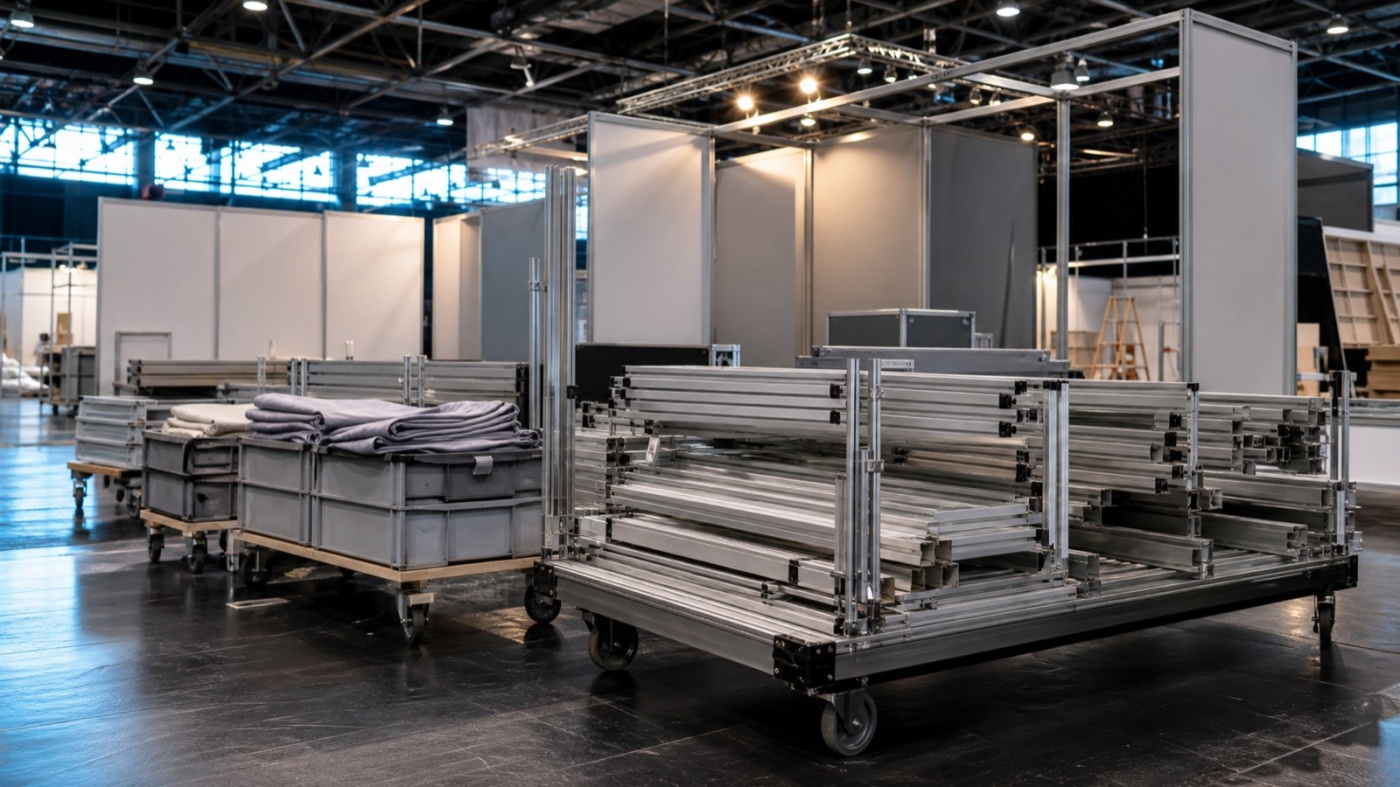
The convincing answer lies in the engineering. An aluminium frame system, connected without tools, with textile skins and LED tiles, returns to storage in full. The frames stay in service for years while the printed skin carries the message of each edition. Our page on sustainable exhibition stands describes how that method works.
Three years to the next edition: the real test of reuse
At an annual fair, reuse is easy to justify. K tests the idea more strictly, because three years pass between editions. A stand created for this one show alone spends the time in between sitting on a shelf.
The benefit therefore appears once the system keeps working in the meantime. Plan your K appearance in the same grid as the rest of your show season, and the same frames, counters and luminaires travel on to specialist fairs, in-house exhibitions and customer days. The large Dusseldorf appearance becomes the maximum configuration, and every smaller appearance is a subset of it.
Three years also shape the design. Colour worlds, claims and product names move on in that time, load-bearing components rarely do. Separate the two cleanly: structure and technology for the long haul, graphics and skins as the changing layer. For exhibitors who need little space between editions, rented system components offer a calm route as well.
Clean separation: dismantling begins at the drawing board
What falls apart into clean fractions during teardown is decided months earlier on screen. Bolted and slotted connections come apart, bonded surfaces rarely do. Laminated composite panels look handsome and usually end their journey in the residual fraction. A raised floor built from system platforms with an exchangeable covering, by contrast, stays usable year after year.
Three decisions carry particular weight. First the wall surface: textile prints can be washed, stored and replaced while the frame system stays. Second the floor: rented coverings and reusable panels replace the classic single-use carpet. Third the graphics: separate artwork from carrier, so an update sends only the printed layer back into the loop.
Machinery stands at K need one more document, a teardown plan that fixes the sequence: services and safety barriers first, then cladding, then platform and machine base. For special constructions and floor loads the technical guidelines of Messe Dusseldorf set the frame, including the deadline for the approval application.
What you can evidence after teardown
In this industry, sustainability convinces through figures rather than adjectives. A carefully planned appearance yields several of them: the share of reused components by weight or value, the number of appearances per component, the transport kilometres driven, the materials used per fraction and the quantity that genuinely goes to disposal.
Those figures come from the stock records and the teardown protocols. A digitised warehouse turns them into an evaluation rather than an estimate. For companies reporting under CSRD they make a welcome building block, because trade fair appearances otherwise vanish into a single line in the marketing cost centre.
trendSETZEREI states a reuse rate of up to 85 percent across the life cycle of its system stands. That figure belongs in your documents as what it is: an experience value from modular building, which we break down per project. Traceability is what matters, because a number without a calculation path rarely convinces procurement and sustainability teams.
The stand that writes your circular story with you
At K, every exhibitor explains how their material travels in a loop. The stand is the first chance to demonstrate that rather than assert it: built modular, separable by material, stored with documentation and ready for the next appearance.
There is time before the coming edition for a construction that carries three years and several appearances. If you would like to set up your Dusseldorf appearance along those lines, we are glad to talk through the grid, the storage logic and the evidence you hold afterwards.