IDS in Cologne runs for five days and takes place every two years. Together, those two facts shift the calculation of a trade fair appearance considerably compared with an annual three day show, and they shift it in both directions. Factoring them in early gives you a budget that holds.
Five show days every two years reshape the maths
The International Dental Show is the leading global trade fair for the dental community. It is run by Koelnmesse together with the Association of German Dental Manufacturers. Exhibitors include makers of treatment units, instruments and consumables, suppliers of laboratory technology and digital manufacturing, hygiene and infection control, practice and laboratory software, imaging systems and the dental trade. The audience brings dentists, dental technicians, practice and laboratory teams, dealers and purchasing groups from around the world.
For your budget, five show days mean one thing above all: running costs occur five times over. Staff, accommodation, catering, cleaning and stand support sit noticeably above what exhibitors know from a three day event. The two year rhythm pulls the other way: a stand that survives two years in storage and goes up again at the next edition spreads its purchase price across a long period.
Calculate in three separate blocks, therefore: what goes directly to the organiser, what the stand build costs and what operating the stand during the show week ties up.
What is fixed before the first design exists
A noticeable share of the budget is settled before anyone talks about design. It covers floor space rental per square metre, graded by stand type, the organiser's compulsory contributions such as media and marketing fees, plus exhibitor passes and entries in the catalogue and the online directory.
Then come the connections, and at IDS this list runs longer than elsewhere: electricity at sufficient capacity, water and waste water for treatment units and washing points, compressed air and suction for demonstrations, plus network capacity for software presentations and streaming. Every connection is ordered from the organiser and invoiced separately. Connection values, prices and ordering deadlines appear in the exhibitor portal for each edition, while the Koelnmesse technical guidelines govern build heights, screening walls and approval requirements.
Put a figure on this block first. It is largely fixed and it determines how much room remains for stand build and staging. Our overview of exhibition stand cost gives orientation on the individual items.
Treatment units and demo areas: the cost driver of this fair
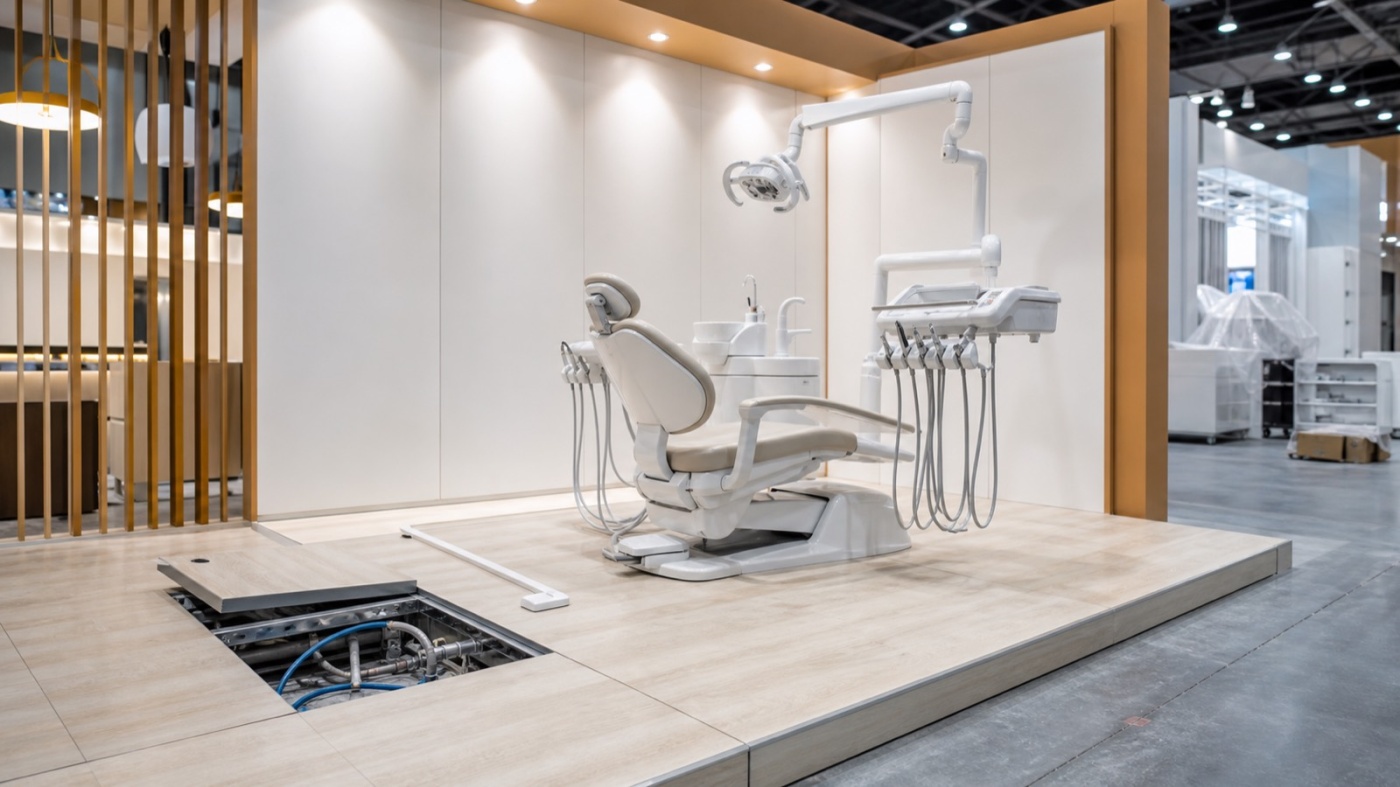
What sets IDS apart from most trade fairs is the nature of the exhibits. A treatment unit, a milling machine or a steriliser is demonstrated in live operation here, with water, air, power and suction. This is where the largest fair-specific cost block comes from.
Four points drive the total. First, media routing: supply and drainage run through floor ducts or across a raised platform floor. Even a few centimetres of build-up height bring ramps, additional floor area and documentation of the construction with them, and they change the character of the whole stand.
Second, connection density: every additional demo unit needs its own media points. Three treatment positions cost considerably more than one, even where the floor area stays the same. It pays to decide early which devices genuinely run live and which convince as an exhibit or on film.
Third, delivery of heavy equipment: treatment units, imaging systems and laboratory machines arrive on the stand early, call for pallet trucks or forklifts and need a build sequence that places each machine before the last wall goes up. Getting that order right saves a full build day.
Fourth, the surroundings: the major players in this industry appear in Cologne with elaborate, sometimes double-decker stands. That raises visual expectations across the halls. For mid-sized exhibitors, a clear, brightly lit stand with a few well staged demo positions performs better than matching that scale.
Build-up, staff and the week in Cologne
The third block covers time on site. Build-up and dismantling days come on top of the show itself, generously calculated for technically demanding stands with platform floors and media routing. Travel, accommodation and working time apply to each of those days.
Staffing is where the length of the fair shows most clearly. Five days at full strength usually means a shift model and often a second travel group at the halfway point. At IDS there is a further factor: demonstrations are led by specialists. Dental technicians, application consultants or dentists on the stand cost more than general stand personnel and convince a professional audience far more effectively.
Hotel rooms belong on the early booking list as well. During IDS, Cologne is heavily booked across the whole week and room rates follow demand. Booking for the next edition right after the current one saves a four figure sum.
Add catering, daily cleaning, overnight stand security, storage for consumables and printed material, plus a buffer of around ten per cent for reordering during the show. That buffer gets used almost every time, usually for connections, furniture or graphics that prove worthwhile once the stand is standing.
How the budget becomes an investment across two editions
The two year rhythm is the strongest lever on cost per appearance. A stand built as a modular system with aluminium frames, interchangeable fabric graphics and LED surfaces keeps its base structure while graphics, message and floor plan adapt for the next edition. Between editions it goes into storage, checked and catalogued, ready in the meantime for smaller trade fairs, congresses and in-house events.
Spread the purchase across two or three editions and the ratio between build and operating costs shifts markedly. Exhibitors with few dates between IDS years do well to compare this with a rental solution. Our pages on renting an exhibition stand and sustainable exhibition stands show how both routes add up.
Whatever you choose, an honest figure comes first. Listing floor space, connections, stand build, staff and operation separately, then adding a buffer, leaves you calm going into the IDS week and keeps your room to manoeuvre exactly where it works hardest: in demonstration, light and conversation.