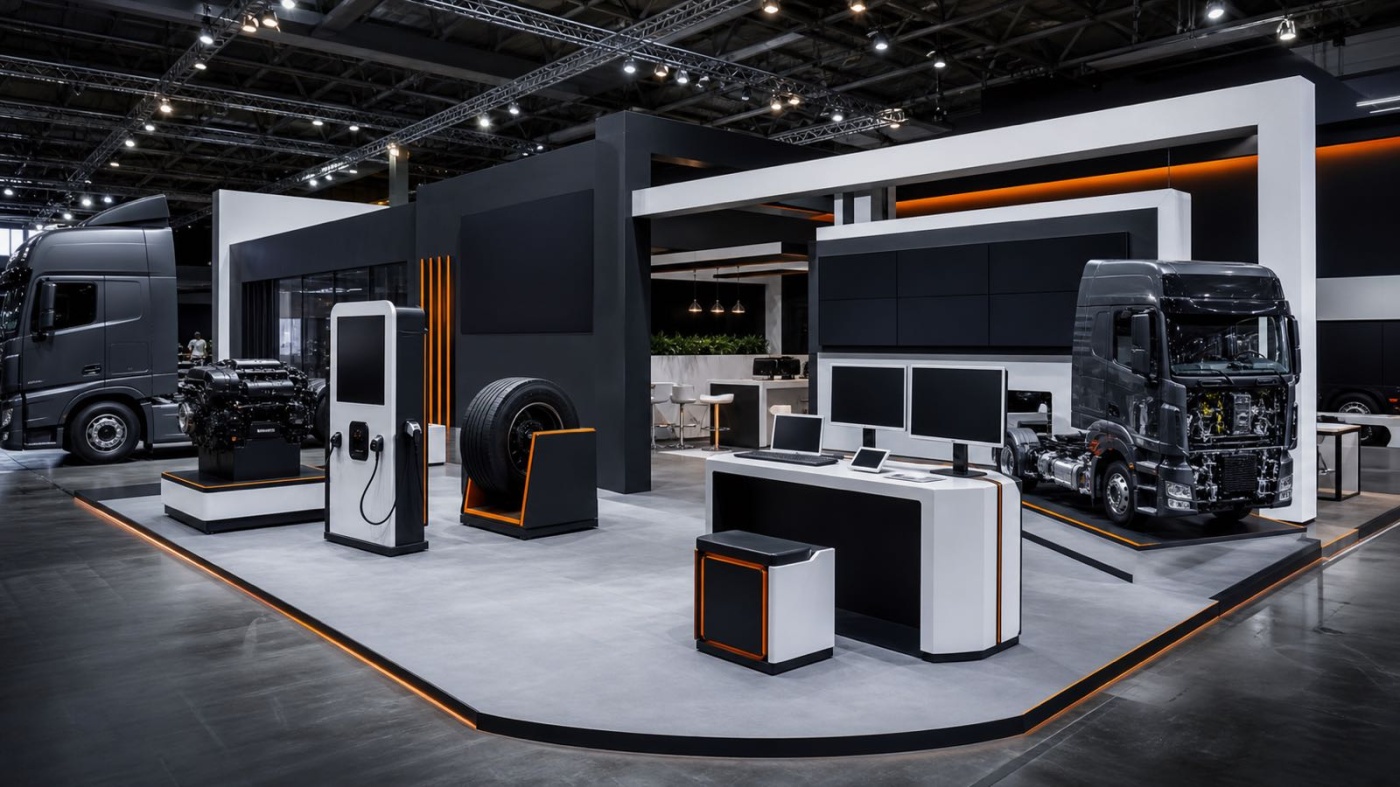
The IAA TRANSPORTATION is the leading global trade fair for commercial vehicles, transport and logistics. It brings together manufacturers of trucks and vans, suppliers, providers of alternative drive systems and logistics and software companies, and it takes place every two years at the exhibition grounds in Hannover. The next edition is scheduled for 15 to 20 September 2026, although exhibitors and visitors should always reconfirm the dates through the official information of Deutsche Messe before finalising any plans, because time frames can change.
Exhibiting here rarely means brochures and screens alone. Real vehicles, drive systems and heavy components usually take centre stage. That is exactly what makes an exhibition stand for the IAA TRANSPORTATION a special building task: it has to carry heavy loads, hold vehicles safely and still work as a convincing brand appearance. This guide sorts the key points, from floor load to stand shape.
What defines the IAA TRANSPORTATION
The IAA TRANSPORTATION has established itself as a global stage for the entire value chain around commercial vehicles. On display are trucks and light commercial vehicles, trailers and bodies, supplier parts, tyres, telematics and increasingly electric and hydrogen based drive systems. The audience is highly professional: fleet managers, buyers, engineers and decision makers from haulage companies and industry arrive at the stand with concrete questions.
For stand construction this means two things. First, the demand for technical credibility is high, an appearance should radiate competence and robustness, not mere decoration. Second, the exhibits are often large and heavy, so the stand is planned around these objects from the very first sketch. The question of which vehicle or which unit takes the leading role determines the floor area, the structural design and the delivery approach.
The Hannover exhibition grounds: heavy exhibits, floor load and delivery
The Hannover exhibition grounds are among the largest in the world and are built for large format, heavy exhibits. For the IAA TRANSPORTATION this is a real advantage, because tractor units, semi trailers and complete vehicle combinations need halls that can absorb such weights. Exhibitors with very heavy vehicle exhibits should nevertheless always check the permitted floor load of the specific hall in writing beforehand, because the values differ from building to building and from one stand area to another.
A central topic is driving the vehicles onto the stand. Large and heavy exhibits reach the floor through defined hall gates, access routes and in some cases over ramps. The delivery of such objects follows fixed time windows and paths so that heavy transports do not block one another. Anyone who wants to place a tractor unit or a complete combination on the stand plans the ramps, the manoeuvring areas and the build up sequence well in advance.
There is also the generous outdoor space in Hannover. It suits particularly large or tall demonstrations, vehicle presentations and exhibits that would be hard to house inside a hall. Outdoor areas come with their own requirements, for example on anchoring, weather resistance and ground bearing capacity. Whether hall or outdoor space, the combination of high floor load, wide access routes and planned delivery is the common thread for every commercial vehicle appearance.
Stand requirements for commercial vehicles: floor load, access and platforms
When a real vehicle stands on the booth, three points move to the foreground. The first is floor load. The weight of a truck rests on only a few contact points, so very high forces can arise in a small area. Whether an additional load distribution is needed and which areas are cleared for it is something the stand builder settles with the technical requirements of the hall before the exhibit rolls in.
The second point is access. Not every vehicle can be manoeuvred freely, and turning circle, clearance height and ground clearance decide the feasible route. That is why the question of the drive on approach belongs at the start of every plan, not at the end. If a raised platform is wanted, it has to carry the drive on load, which is why flat ramps with sufficient bearing capacity are often part of the structure.
The third point is platforms and podiums. They lift vehicles and components into view, create sight lines and separate presentation from conversation. A platform for heavy exhibits is a structural task: bearing load, edge protection and access are calculated, not estimated. Anyone who brings these three points, floor load, access and platform, together cleanly avoids expensive surprises during build up.
Meeting and lounge zones: the second area on the stand
As important as the vehicle is as an eye catcher, business is done in conversation. At the IAA TRANSPORTATION professionals meet for long, technical appointments, so alongside the exhibit area the stand needs a quiet second zone. Meeting rooms, semi open discussion niches and a lounge give customers the space in which interest turns into an order.
This second area should be set apart from the loud exhibit zone acoustically and visually. Closed or half height cabins dampen the hall noise, and a lounge with seating and refreshments keeps guests on the stand for longer. In a multi storey design, meetings and hospitality often move to an upper floor, while the space below stays clear for the heavy exhibits. In this way a floor area becomes a place that both shows technology and deepens relationships.
Follow the technical guidelines of Deutsche Messe
Every appearance in Hannover follows the technical guidelines of Deutsche Messe. Among other things they govern build heights, sight screens to neighbouring stands, escape routes, fire protection and the permitted floor load. For commercial vehicle stands the rules on loads, on raised structures and on delivery are especially decisive, because here the work involves real vehicles and heavy constructions.
It is important not to assume any deadlines or limit values as generally valid. Approval deadlines for stand plans, requirements for structural certificates for platforms and raised structures and the exact registration paths for heavy exhibits appear in the currently valid version of the technical guidelines and can differ from fair to fair. These values must be checked in the official rules of Deutsche Messe for the specific event before any planning starts. An experienced stand builder keeps these documents ready and submits the necessary certificates in good time.
Stand builder for the IAA TRANSPORTATION: nationwide and with an own fleet
The trendSETZEREI GmbH is based in Offenbach in the Rhine Main region and works nationwide, which includes appearances in Hannover. This is an honest statement and not a given: building a stand in Hannover means additional travel, logistics and on site coordination for a company from the Rhine Main area. That is exactly why an own vehicle fleet is valuable here, because it makes the delivery of stand components predictable and less dependent on external service providers.
With commercial vehicle appearances that involve heavy components, the reliability of the logistics counts. When platforms, walls and technology stand at the right hall gate on schedule, the build up runs calmly. The all from one hand principle means that concept, production in the own workshop, transport and assembly come together with one point of contact. You can find more details on the scope of services under exhibition build services. Driving the vehicle itself onto the stand usually remains the exhibitor's task, but the stand is built so that it succeeds smoothly.
Stand size and stand shape for the commercial vehicle appearance
The right stand shape at the IAA TRANSPORTATION depends heavily on the exhibits. A row stand with only one open side suits compact presentations, while large vehicles need more open sides and manoeuvring space. These shapes are worth considering:
- Row stand: one open side, good for clearly bounded, smaller presentations.
- Corner stand: two open sides, better visibility and more entry points.
- End stand: three open sides, good for vehicles that should work from several sides.
- Island stand: open on all sides, ideal for heavy, large exhibits with a free drive on approach.
The stand size follows from the vehicle dimensions, the manoeuvring needs, the second area for meeting and lounge and the safety distances. A real truck needs not only its parking footprint but also room to drive on and distance from the audience. An overview of the construction types and shapes is available on the exhibition stand types page. As a rule of thumb: plan generously and keep the routes clear rather than playing the exhibit and the meeting zone against each other.
Conclusion: plan early, drive on safely, appear convincingly
An exhibition stand for the IAA TRANSPORTATION in Hannover stands or falls with the technology thought through early. Floor load, access and ramps for heavy vehicle exhibits, a quiet second area for meeting and lounge and attention to the technical guidelines of Deutsche Messe form the foundation. Anyone who settles these points in good time and aligns the stand shape with the exhibits will have a robust and effective appearance at the leading global trade fair for commercial vehicles.
If you are planning an appearance at the IAA TRANSPORTATION 2026, talk to us early. You can reach the trendSETZEREI GmbH by phone on 069 201 65 001 and by e mail at info@dietrendsetzerei.de. Feel free to get in touch through our contact page. The official fair information is available on the IAA TRANSPORTATION site.