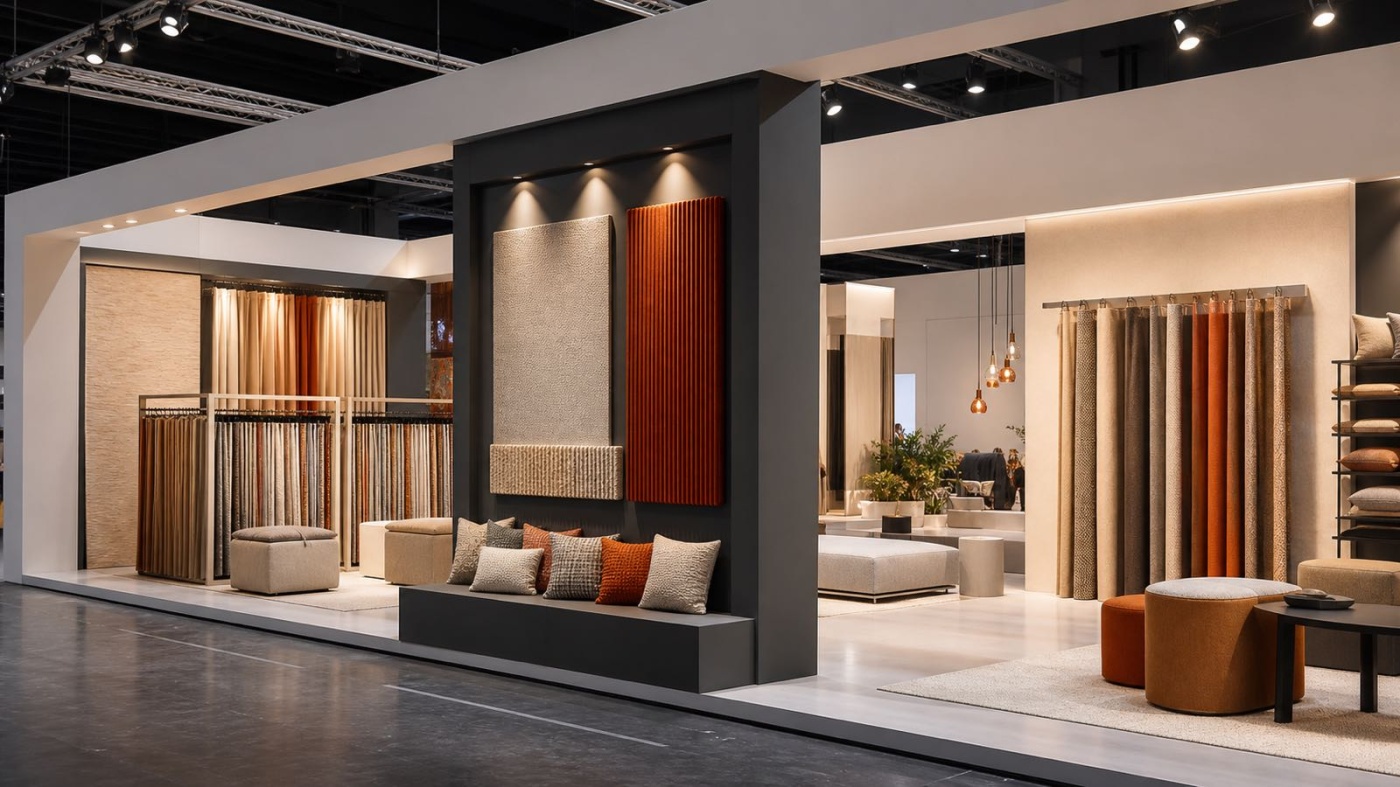
Heimtextil is the international trade fair for home and contract textiles, and it takes place every year in Frankfurt am Main to open the exhibition calendar. It brings together manufacturers, distributors and designers from around the world, from upholstery fabrics and bedding to carpets and textiles for hotels, medical practices and public buildings. For many companies in the sector it is the first major appointment of the year, when the collections, materials and colour themes of the coming season are shown for the first time.
Textiles work through the eye and the hand. On few other trade fairs does it matter so much how a product can be touched and viewed in the right light, which makes the stand part of the presentation itself. A well planned Heimtextil exhibition stand guides visitors towards the goods and lets the texture, drape and colour of the fabrics come into their own. To see how such an appearance is planned, take a look at our landing page on the exhibition stand for Heimtextil. This guide sets out the most important conditions to keep in mind as an exhibitor.
Heimtextil: the trade fair for home and contract textiles
Heimtextil is held annually and, as the opening event of the year, starts the series of leading Frankfurt trade fairs. The organiser is planning the coming edition for 12 to 15 January 2027, and Messe Frankfurt publishes the binding dates through its official channels. A look at the official Heimtextil page from Messe Frankfurt is therefore worthwhile at the start of any planning.
The range on show is broad and, according to the organiser, covers the following areas among others:
- Home and contract textiles, meaning fabrics for private living spaces and for commercial rooms
- Decorative fabrics and upholstery fabrics as well as wall, window and interior decoration
- Bed and bath textiles along with bedding, that is mattresses, blankets and pillows
- Carpets, fibres and yarns as textile raw materials
- Textile design and, new for the 2027 edition, the Flooring and Equipment area with an adjusted hall concept
The fair is aimed above all at trade visitors: retail buyers, interior architects, contract furnishers, representatives of the hotel sector and manufacturers of private labels. For past editions, Messe Frankfurt reports more than 48,000 buyers from 136 countries. For exhibitors this means an international, expert audience that examines material quality and workmanship closely, so the presentation on your stand helps decide whether a collection stays in the memory.
The Frankfurt exhibition grounds at a glance
The Frankfurt exhibition grounds lie in the west of the city, in the Bockenheim and Westend districts, and rank among the largest fairgrounds in the world. They offer around 400,000 square metres of hall space spread across several halls of differing sizes, plus outdoor areas (source: messefrankfurt.com). Heimtextil occupies several of these halls, and the organiser sets the hall allocation and the distribution of floor area among exhibitors for each edition.
Getting there is well solved by car and by public transport. The grounds have a direct motorway connection (A648) and can be reached via the Frankfurt Messe suburban rail station (lines S3 to S6) as well as the Festhalle/Messe underground and tram stop (lines U4, 16 and 17). The airport and the main station are only a few minutes away, an advantage for international exhibitors and visitors at Heimtextil.
For stand construction, logistics matter as much as location. Delivery of stand materials and goods runs through the hall gates and is tied to registration and time slots, and the organiser sets the assembly and dismantling times for each fair. The exact structural values, such as the permitted construction heights, the clear height of the hall and the permissible floor load, differ from hall to hall. What always applies here are the current Technical Guidelines of Messe Frankfurt, the binding set of rules for stand construction that the organiser updates regularly. You should always check these values in their currently valid version before planning and never carry them over from earlier editions.
Stand requirements for a Heimtextil exhibition stand
At a textile fair the goods take centre stage, and the stand has to serve them. The sense of touch is central: visitors want to handle fabrics and judge how they drape. The stand therefore needs surfaces and fixtures where textiles can hang freely, be stretched or stacked, without creasing or straining. Well thought out fabric handling also saves time during the fair.
Light is just as important. The colours and surfaces of textiles change considerably depending on the colour temperature and the direction of the light. Even, glare free general lighting together with targeted accents lets patterns and material structure appear true to life, whereas poorly chosen light distorts colours. Sample areas, where individual designs are presented generously, help trade visitors assess quality and workmanship at a glance.
Consultation zones and sample presentation
Business at Heimtextil comes about in conversation. Alongside the open product display, a stand therefore needs quieter consultation zones where you and your buyers can go through collections in peace, discuss quantities and compare samples. Sensible zoning, meaning a clear division of the stand into areas with different functions, separates the presentation area from the conversation while keeping distances short.
For sample presentation, systems that make many designs accessible on little space are a good choice, for example swivel frames, sample hangers or shelves with easily reachable lengths of fabric. It is important that samples can be found, taken out and put back quickly, because the people on the stand change frequently during the fair. A tidy, logically sorted sample system supports the sales conversation rather than slowing it down.
Technical guidelines and deadlines
Whoever exhibits at Heimtextil operates within the Technical Guidelines of Messe Frankfurt. Stand construction usually requires stand approval. For this, you or your exhibition stand builder submit dimensioned stand plans, meaning scaled floor plans and elevations, to the organiser, and construction may begin only after approval has been granted. For special constructions such as platforms, roofed areas or suspended elements, the fair additionally requires structural proof of stability that, depending on the requirement, is checked by an independent structural engineer.
On top of this come fire safety and consideration for neighbours. Stand construction materials generally have to meet at least fire class B1, meaning they must be flame retardant. Depending on the position, visual screens towards neighbouring stands are prescribed, so that closed rear walls do not affect them. All of this needs lead time: approvals and connections for electricity, water and network have to be applied for before assembly, often several weeks in advance. Messe Frankfurt sets the exact deadlines, dimensions and requirements in its currently valid Technical Guidelines. Check these early, because deadlines missed shortly before the fair can hardly be made up.
Exhibition stand builder for Heimtextil
A full service exhibition stand builder accompanies the appearance from the first idea to dismantling: consultation and concept, design and three dimensional visualisation, production, logistics and assembly, and storage after the fair. For textile exhibitors, close coordination between stand design and product presentation is decisive, so that lighting, sample areas and consultation zones fit together from the start. For an overview of the services, see our page on exhibition stand construction in Frankfurt.
As an exhibition stand builder based in Offenbach, trendSETZEREI is only a few minutes from the Frankfurt exhibition grounds, which helps with assembly, dismantling and short notice changes during the fair. A modular system build, meaning a stand made of reusable aluminium frames with textile coverings, suits Heimtextil well: it can be adapted in size and shape to the floor area, used several times, and combines textile surfaces with a clear, calm stand architecture.
Choosing stand size and stand form
The stand form follows from the allocated floor area and from the number of open sides. A row stand is open only towards the aisle and suits a focused presentation along the rear wall. A corner stand sits at the junction of two aisles and offers two open sides. A head stand at the end of a row opens onto three sides, and an island stand stands freely, accessible from all sides. As the number of open sides rises, so do visibility and design scope, though an open stand needs a careful concept to work from every direction.
For textile exhibitors, zoning matters as much as the form, because presentation areas, consultation areas and storage have to be distributed sensibly across the size. Which form suits your goals and budget depends on the floor area, the position within the hall and the type of goods. You will find an overview among the exhibition stand types.
Conclusion
Heimtextil in Frankfurt is an important start to the year for the textile sector, and the stand helps decide how a collection is perceived. If you consider touch, light and consultation zones from the beginning, match the stand form to the floor area, and check the Technical Guidelines of Messe Frankfurt early, you create the basis for a calm assembly and a convincing appearance. The organiser publishes the binding dates, deadlines and structural requirements through its official channels, so a timely look belongs at the start of any planning.
If you are planning your appearance at the coming Heimtextil, trendSETZEREI supports you from concept to dismantling. You can reach us by phone on +49 69 201 65 001 and by email at info@dietrendsetzerei.de, and further ways to get in touch are shown on the contact page.