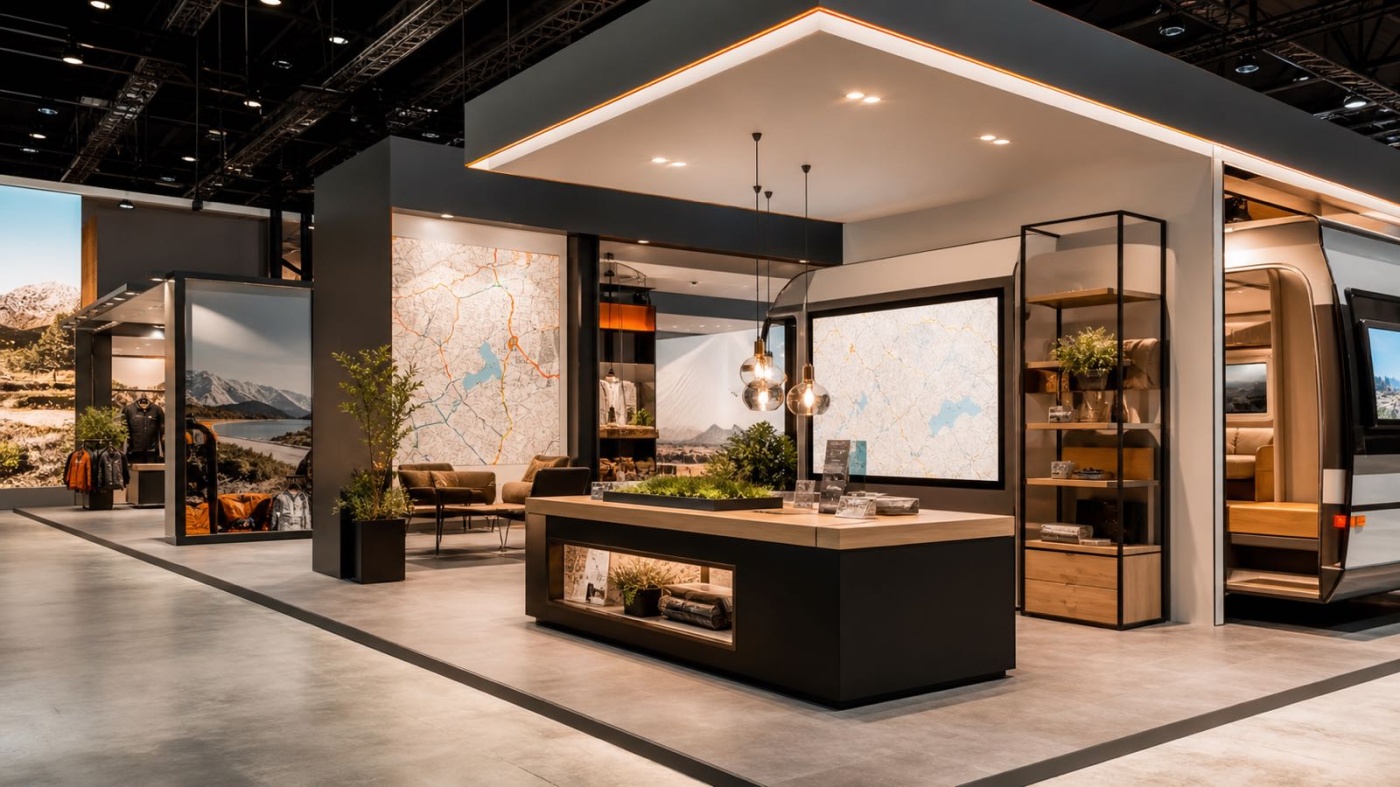
The CMT in Stuttgart is one of the large consumer fairs in the German trade fair calendar and opens the fair year for many providers. If you exhibit here, you do not face a purely professional audience but visitors who are planning their next holiday, their next motorhome or their next piece of outdoor equipment. That shapes every appearance, because a stand here has to invite, inform and safely guide large crowds all at once.
This guide summarises what matters for an exhibition stand at the CMT. It describes the Stuttgart fairground and how guests arrive, explains the particular demands of caravanning and tourism, puts the technical requirements in context and shows which stand forms suit which goals. Please always check specific dates, build heights and deadlines for the respective fair year, as they can change.
The CMT: a holiday fair for caravan, motor and tourism
According to the organiser, the CMT is the world's largest consumer fair for tourism and leisure. It takes place every January on the grounds of Messe Stuttgart and covers a broad range of topics: caravanning and motorhomes, tourism and travel destinations, plus cycling, outdoor and leisure. A recurring element is the partner country, which introduces itself as a travel destination with its own presentation.
The caravanning area is especially visible, where leisure vehicles are shown and can in part be walked through on site. For your appearance, this consumer character means that expectations differ from a purely trade fair. Guests often come with their families, spend a lot of time on the grounds and decide emotionally. An exhibition stand at the CMT should therefore be quick to grasp and offer room for both advice and experience. The organiser publishes the exact dates and the official framework data on the official CMT page of Messe Stuttgart. For 2027, according to available information, Messe Stuttgart plans the CMT for the period from 16 to 24 January, and it announces the binding dates through its official channels.
The Stuttgart fairground at a glance
Messe Stuttgart lies on the Filder plateau south of the city, right next to the airport and with a direct connection to the A8 and A81 motorways. This location is an important factor for a consumer fair such as the CMT, because many guests travel in and out on a single day. The grounds are compactly organised, and the halls group around a central axis, so even first-time visitors can orient themselves easily.
The CMT occupies a large part of the grounds and spreads across several connected halls with different focuses. For stand planning it is decisive which hall your space is in and where it sits, because visitor flows, ceiling heights and access routes differ from hall to hall. Clarify early whether your area is on a main aisle, at an entrance or within a thematic cluster, because that determines how much passing traffic you reach and how you orient the stand.
Public transport plays a central role in how visitors move. From Stuttgart's main station, the S-Bahn lines S2 and S3 reach the fair in about half an hour, and the station is close to the entrance. In addition, the U6 light-rail line runs to the fair and on to the airport. The airport itself is within walking distance of the grounds, which makes international arrivals easier. Because many people arrive at the same time on strong visitor days, you should plan for the routes to fill up in the morning and in the early evening. A stand that opens its accessible side toward the main flow and sets clear focal points benefits from this dynamic.
Stand requirements for caravanning and tourism
Anyone showing motorhomes, caravans or large leisure vehicles plans differently from an exhibitor with brochures and screens. Such exhibits have to be driven into the hall, manoeuvred and positioned precisely. Clarify the access routes early, along with the available manoeuvring areas and the sequence during the build, so that heavy vehicles reach their spot before the rest of the stand construction. The floor load of the hall also matters, because vehicles and structures place high point loads on the hall floor.
A stand in the caravanning and tourism environment is usually open and walkable. Guests should be able to enter vehicles, touch materials and have travel destinations explained to them. That calls for wide, low-barrier entrances and a routing that works even under heavy traffic. Expect dense visitor movement on weekend days and keep enough free space so that crowds do not build up in front of bottlenecks. Non-slip flooring, clearly recognisable entrances and a calm zone for lingering increase the time visitors spend without making the stand feel cluttered.
Advice and experience zones
At a consumer fair, the experience often decides whether a guest stops. It is therefore worth dividing the stand into zones. An open experience area on the aisle draws attention and invites people in, for example through a walkable vehicle, a scenic backdrop or a short demonstration. Behind or beside it comes the advice zone, where your team can respond to questions in peace. This separation ensures that passing visitors and serious prospects do not get in each other's way.
Visitor guidance should follow this structure. Lead guests from the eye-catching focal point at the edge, across the experience area and inward to advice and quieter seating. Sufficiently wide paths, clear signage and well-considered lighting help you steer the flow. It is precisely under heavy traffic that generous route planning pays off, because it eases queues and makes the visit more pleasant. That leaves time for the conversations that matter later in sales.
Technical rules and deadlines
Every fair sets its own technical rules, and for the CMT the technical guidelines of Messe Stuttgart apply. Among other things, they govern what may be built without approval and what requires a separate proof. Plan for enough lead time, because approvals and proofs take time and must be in place before the build begins. The following points belong on the list in almost every plan:
- Stand construction approval: submit dimensioned stand plans with floor plan and elevation on time, and build only after release.
- Structural proof: for special constructions, superstructures or platforms, a verifiable proof may be required.
- Fire protection: the materials used must as a rule be at least flame-retardant, meaning they meet class B1.
- Screening and consideration: closed stand sides facing neighbours usually have to be finished as a neutral screen.
- Lead time: coordinate technical connections, approvals and special applications early with the organiser.
Take the specific deadlines, build heights and limit values from the technical guidelines of Messe Stuttgart for the respective fair year. Do not rely on blanket figures found online, but work with the current version. An experienced stand construction partner usually handles this comparison for you and submits the documents on time.
A stand builder for your CMT exhibition stand
A full-service stand builder accompanies your appearance from the first idea to dismantling. This includes concept and design, the 3D visualisation of the stand, production, logistics to the fair, on-site assembly and storage for the next use. The advantage is that all steps are coordinated and you have one fixed point of contact, rather than having to coordinate several service providers.
die trendSETZEREI GmbH is based in Offenbach am Main and works nationwide, so also for appearances in Stuttgart. With our own vehicle fleet, we organise delivery and build-up ourselves, which increases scheduling and execution reliability. You will find an overview of the range of services on the page about our exhibition stand services. For the CMT this means that arrival, build-up logistics and coordination with the technical guidelines come from one team.
Choosing stand size and stand form for your CMT exhibition stand
The stand form follows from your area and from the number of open sides. A row stand is open only toward the aisle and suits compact appearances with a clear front design. The corner stand sits at an aisle intersection and opens to two sides, which brings more footfall. A head stand at the end of a row of stands is open on three sides and feels more spacious. The island stand stands free and is accessible from all sides, which gives it the greatest visibility and makes it especially suitable for large exhibits such as vehicles.
As the stand form opens up, the design scope grows, but so does the need for well-considered zoning. The more open the stand, the more important clear focal points, guided paths and a calm advice area on the inside become. Which form suits your goals and your budget is best decided with a concrete area in mind. You will find a detailed comparison in our guide to the stand types and stand forms.
Conclusion
A successful exhibition stand at the CMT combines two things: it attracts the passing audience of a large consumer fair and at the same time provides room for calm advice. This works when hall location, visitor flows, delivery and technical rules are thought through together early on. If you know the lead times and take the official requirements of Messe Stuttgart into account in their current form, you avoid time pressure and unpleasant surprises during the build.
If you are planning an appearance at the CMT in Stuttgart, we support you from the concept to on-site assembly. Get in touch through our contact form, or reach us by phone at +49 69 201 65 001 and by email at info@dietrendsetzerei.de.