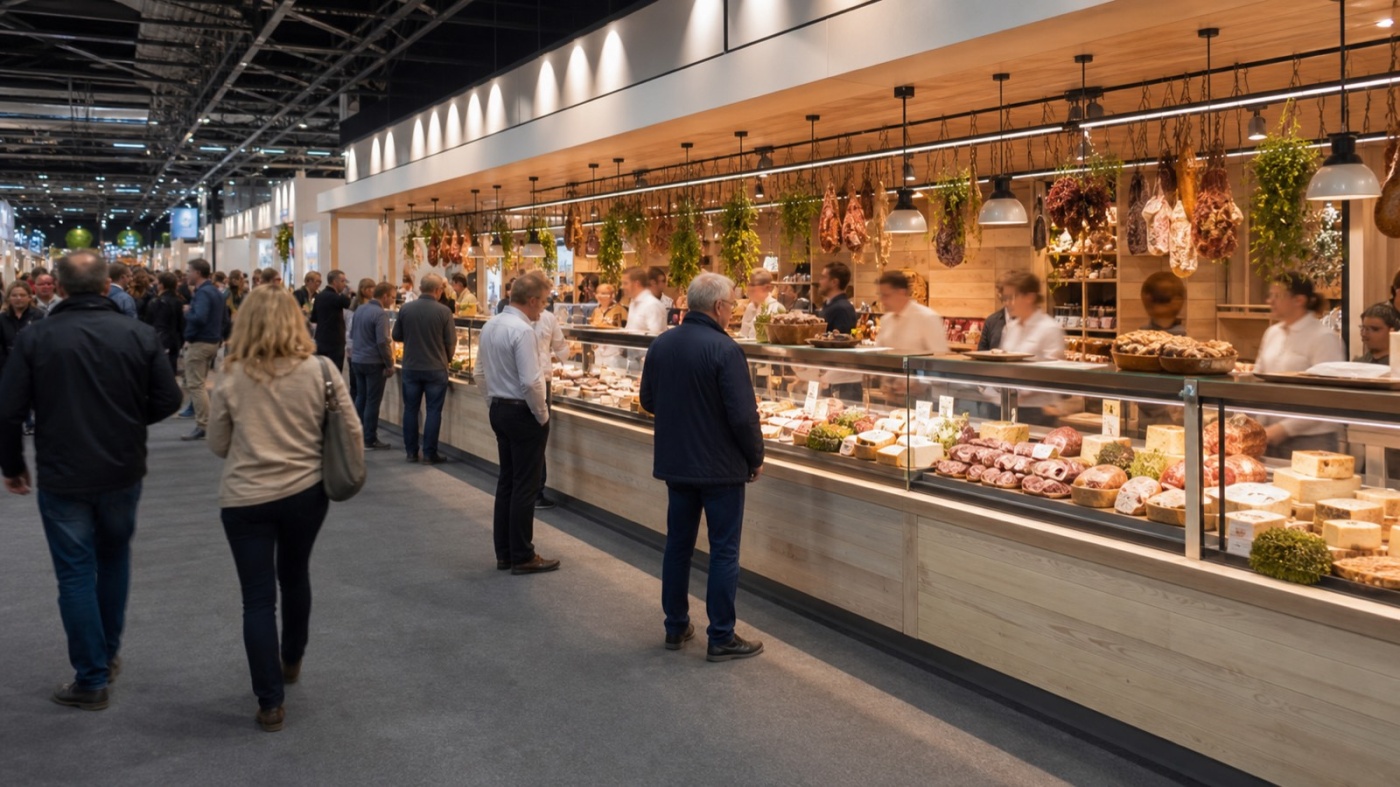
Few German trade fairs draw a crowd like the Internationale Grüne Woche in Berlin. For ten days the grounds below the radio tower become a walk through food, agriculture and horticulture, with well over 400,000 visitors and around 2,000 exhibiting companies from roughly 100 countries. Exhibitors make their most important decision long before construction starts: which hall they stand in.
Ten days with the public: what defines this venue
Grüne Woche joins two worlds. For the general public it is an experience and a shopping destination: people taste, compare and buy straight from the stand. For the sector it is a professional platform with congresses, agricultural policy forums and a dedicated trade visitor programme. Both run at the same time, and most stands serve both sides.
The rhythm differs sharply from a three-day trade show. Ten opening days including two weekends mean high footfall, very different daily patterns and a level of wear on the stand that deserves planning. Staffing, restocking and cleaning belong in the concept just as much as design does.
Themed worlds: how the grounds are organised
For Grüne Woche the Berlin exhibition grounds are structured into themed worlds, and visitors navigate by exactly those. A flower hall, the halls of the German regions with their federal states, an international world tour through the country halls, a market hall, agriculture with the experience farm, animals, garden with house and yard, an area for the young generation and a field devoted to sustainable living together form the tour.
For your choice of location the logic is clear: your themed world decides who walks past you. A regional producer standing in the hall of their federal state meets the right expectation, because visitors go there looking for specialities from that region. A manufacturer of garden equipment reaches an audience that is already in buying mode.
Check early which themed world matches your offer most precisely and talk to the organiser about available space in that area. Our trade fair calendar gives an overview of the upcoming editions.
Keep in mind that the Berlin halls vary widely in shape. Some run across two levels, others are long and narrow or built around an inner loop. Ceiling height, the course of the main aisles and the position of stairs and lifts all influence how high you may build and from which direction your stand gets seen first. A look at last year's hall plan already gives useful clues before you book.
Entrances, axes and visitor flows
The site below the radio tower is a ring of halls around the Sommergarten, linked by long connecting corridors. The south entrance on Messedamm opens up the front halls, the north entrance sits at hall 19, and further access points spread visitors across the grounds. Most people arrive in the morning at one of these points and work their way in one direction.
Two qualities of location follow from that. Halls near an entrance deliver high frequency with many brief contacts, while halls further in reach visitors who already have a plan and bring more time. Both have value, depending on whether you are after reach or unhurried conversations.
Inside the hall, look for the magnets: a stage, a special show, a catering area or a well-known crowd favourite concentrate the flow. Space within sight of such an attraction often does more than a few extra square metres at a quiet end of an aisle. The organiser's official site plan shows this structure for each edition.
Choosing your space: frequency, neighbours and back-of-house
At a public fair with direct sales, the split of the area shifts. What counts is the length of your serving front towards the aisle rather than the depth of the stand. Two separate contact points, for example tasting and till, keep the crowd moving and shorten the wait at a single counter.
Back-of-house matters just as much. Stock for ten days, refrigeration, a sink, waste separation, the till system, a cloakroom and a seat for the team all need room. On a selling area, reserve a noticeably larger share for this zone than you would at a classic trade fair. A corner or head stand helps twice over, because queue and consultation can be spread across two sides.
Your immediate neighbours deserve a thought too. Related offers all around you work in everyone's favour, because visitors arrive ready to compare. A loud stage or a strongly scented neighbour calls for a design answer instead, perhaps a closed side wall or a consultation area turned inwards. Ask the organiser which exhibitors have already booked around your position before you sign.
Plan the connections early: power, water, drainage and cooling are ordered from the organiser and come with their own deadlines. Food hygiene requirements shape the choice of materials and surfaces directly. Our overview of exhibition stand services shows which trades we take on.
Ten days of continuous operation: what the build should deliver
A stand at Grüne Woche sees more contact in ten days than many trade fair stands see in three years. Robust wipe-clean surfaces, protected edges, a hard-wearing floor build-up and replaceable graphics keep the appearance fresh to the final day. Bright, even lighting carries the stand into the evening as daylight in the halls fades.
Plan the restocking as well. Deliveries during the run follow fixed time slots set by the organiser, and an easily reached store on the stand saves time every morning. Modular system construction pays off twice here: it goes up quickly, adjusts in detail and returns the following year in a new configuration.
Three questions to settle before booking space
At Grüne Woche the hall decides your audience, the position decides your footfall, and the back-of-house decides how relaxed your team stays. Clarify those three points before you book the space, and the stand that follows will carry you through ten days. To plan your next edition, use our stand enquiry.