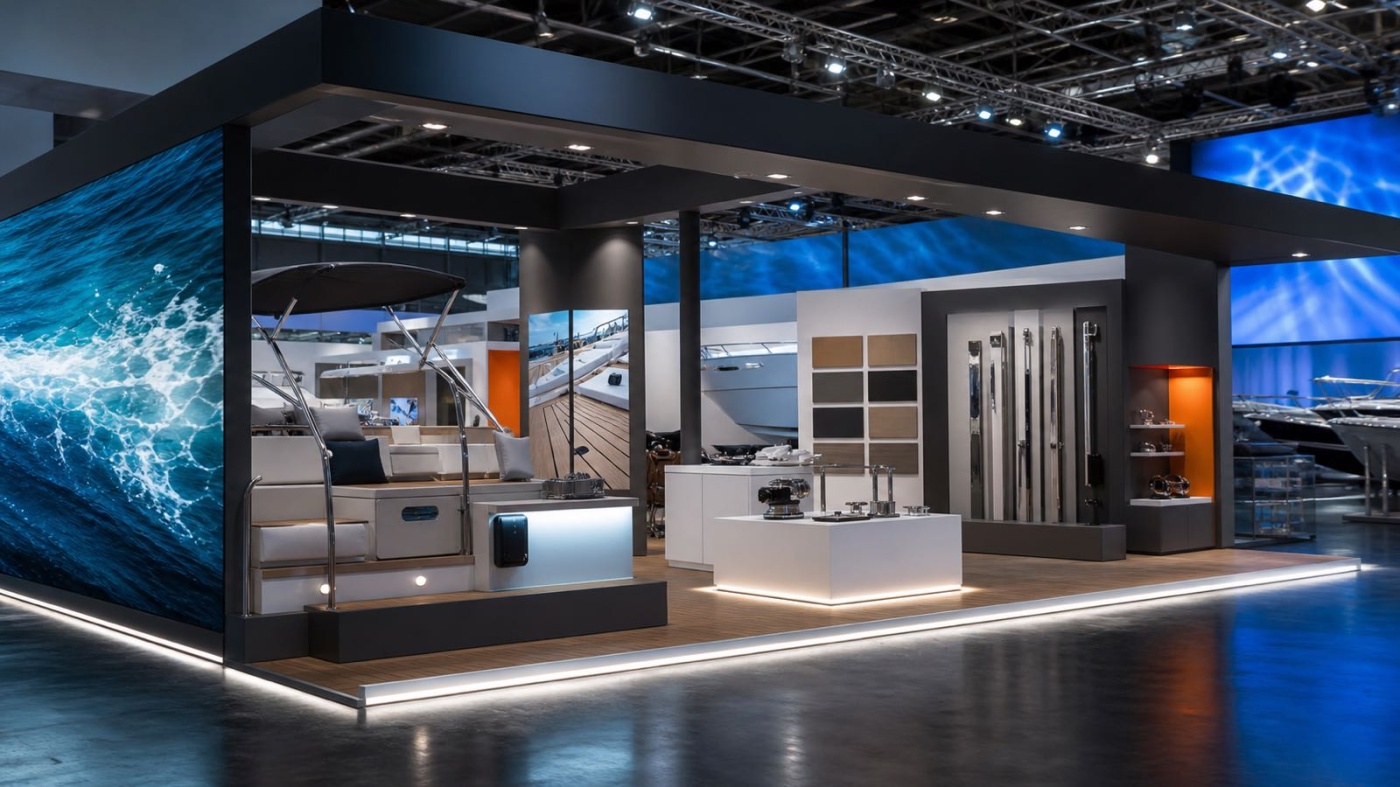
boot Düsseldorf is the central meeting point for the watersports industry and draws a large audience that comes specifically to look at boats, yachts, equipment and accessories. For exhibitors this is a stage with unusual demands, because hardly any other trade fair calls for so much attention to heavy and bulky exhibits. If you want a convincing presence here, you should get to know the conditions of the exhibition grounds early and factor them into your stand planning.
This guide explains, in plain terms, what matters for an exhibition stand at boot: from the structural realities of the halls, through moving large exhibits into place, to the technical guidelines and the choice of a suitable stand shape. The aim is to help you approach the planning in a structured way and avoid the typical pitfalls.
boot: A Public Trade Fair Built Around Watersports
boot Düsseldorf takes place once a year in January and runs for nine days. It covers the full breadth of watersports, including sailing, motorboats, yachts and superyachts, diving, angling, paddling and surfing, along with equipment, accessories and travel destinations. That makes boot above all a consumer show: a large share of visitors come out of a personal interest in watersports, and many of them arrive with a concrete intention to buy.
For your presence, this means the stand has to withstand heavy visitor traffic while still offering room for advice. Unlike purely trade-focused fairs, the first, emotional impression of the product often counts for a lot here. The exact date of boot 2028 is expected to fall in January, but at this point it is not yet confirmed in every case. Please check the specific date on the official trade fair website before you start planning.
An Overview of the Düsseldorf Exhibition Grounds
boot occupies the Düsseldorf exhibition grounds across a large number of halls. The official exhibitor information lists around seventeen halls, which are divided up for the various themed worlds. For exhibitors, the sheer number of halls matters less than the question of which hall suits your own exhibit, because the halls differ in height, gate width and floor load capacity.
This is precisely a central topic at boot. Hardly any other fair displays so many heavy and bulky exhibits, from sailing and motorboats through large yachts to trailers. Objects like these cannot simply be carried in; they have to be brought through the hall gates and positioned with a crane or forklift. So check early whether your exhibit will pass through the intended gates and whether the permissible floor load of the hall is sufficient for the weight.
Closely linked to this is delivery. Large exhibits need coordinated time slots, suitable access routes and often heavy lifting equipment. The sequence of delivery and build-up needs careful planning, so that a boat stands in the hall before the stand is built around it. For the binding figures on floor load, gates, hall heights and traffic routes, the technical guidelines of Messe Düsseldorf apply, and you should consult them before detailed planning.
Stand Requirements for the Watersports Sector
An exhibition stand at boot has to be designed for the particular nature of large exhibits. That starts with the load capacity of the floor: a boat on a stand or in a display basin distributes its weight onto a few points, which the hall has to carry. Just as important is getting the exhibit inside, because anything that does not fit through the gate or cannot be lifted safely also cannot be shown. These questions are best clarified before the stand is designed, not afterwards.
An open, walk-in presentation is standard at boot. Visitors want to step aboard, touch materials and get a feel for the proportions. The stand should therefore offer clear routes, absorb the crowds and still leave quieter spots for conversations. If you are planning a water basin or a demonstration area, you have to account for additional requirements around sealing, water and power connections and safety, and coordinate these with the trade fair early on.
Experience and Consultation Zones
Because boot thrives on hands-on experience, a deliberate zoning of the stand is worthwhile. An experience zone puts the main exhibit at the centre, well lit and accessible from several sides, so that visitors can walk around it and take it in. A stage like this attracts an audience and creates the images that stay in people's memories after a trade fair appearance.
Alongside it, you need quieter consultation zones. Prospective buyers of a boat or a yacht do not hold brief conversations; they need seating, some shielding from the bustle and space for documents or screens. If you separate these two functions spatially, your team can excite the crowd and look after serious prospects in peace at the same time. Storage for brochures, a cloakroom and technical equipment should also be planned in, so that the stand stays tidy over the nine days of the fair.
Technical Guidelines and Deadlines
The technical guidelines of Messe Düsseldorf apply to every stand. Among other things, they govern building heights, height-restriction zones, escape routes and the visual screens to neighbouring stands. As a rule you will need a stand construction permit, for which dimensioned stand plans with floor plan and elevation have to be submitted. For special constructions, such as platforms for heavy exhibits, roofed-over areas or multi-storey builds, the trade fair usually requires structural proof.
When it comes to fire protection, the materials used normally have to be at least flame-retardant, meaning class B1. Because the specific deadlines, building heights and conditions can differ from one fair and year to the next, you should take the currently valid technical guidelines of Messe Düsseldorf as your binding basis. Allow plenty of lead time, because the permit, the structural check and ordering connections all take time. These are the points to tick off early:
- Submit dimensioned stand plans on time for the stand construction permit
- Prepare structural proof for special constructions and heavy exhibits
- Observe fire protection requirements (at least B1) when choosing materials
- Coordinate floor load, moving exhibits through the gates and connections with the trade fair
An Exhibition Stand Builder for boot
An exhibition stand for boot combines design ambition with hard practical logistics. As a full-service stand builder, trendSETZEREI takes on the steps from consultation through design and 3D visualisation to production, build-up and dismantling. That keeps responsibility in one place, which makes coordination with the trade fair and compliance with the technical guidelines easier.
To be honest, our office is not in Düsseldorf but in Offenbach am Main. We work throughout Germany, however, and run our own vehicle fleet, with which we also bring material and the stand to Düsseldorf. For a logistically demanding fair like boot in particular, that is an advantage, because transport, delivery and build-up can be closely coordinated. You can find an overview of how we work on the exhibition stand services page.
Choosing the Stand Size and Shape for Your boot Stand
The right stand shape depends on the exhibit, the budget and the floor space you have booked. A row stand is open only towards the aisle and suits compact presences. A corner stand sits at the junction of two aisles and offers two open sides, which brings more footfall. An end stand opens up on three sides and creates room for larger exhibits. An island stand is accessible from all four sides and is therefore ideal for letting visitors walk freely around a boat or a yacht.
At boot, the zoning within your chosen shape plays a major role. Plan the main exhibit, the visitor routes and the consultation areas together, so that the crowds do not build up. Which shape makes sense for your plans is closely tied to the stand size. You will find a detailed comparison in the article on exhibition stand types.
Conclusion
boot Düsseldorf places particular demands on an exhibition stand, because heavy and bulky exhibits, high visitor traffic and an experience-driven audience all come together. If you think about the choice of hall, moving exhibits into place, delivery and the technical guidelines together and early, you give yourself a calm process and a stand that shows the product to its best advantage. Check the exact date of boot 2028 in good time, so that you have enough lead time for planning and the permit.
If you would like to prepare your presence at boot, get in touch. You can reach trendSETZEREI by phone on +49 69 201 65 001 and by email at info@dietrendsetzerei.de. Through our contact page you can describe your project, and we will come back to you with the next steps. You will find the official information about the fair on the boot Düsseldorf website.