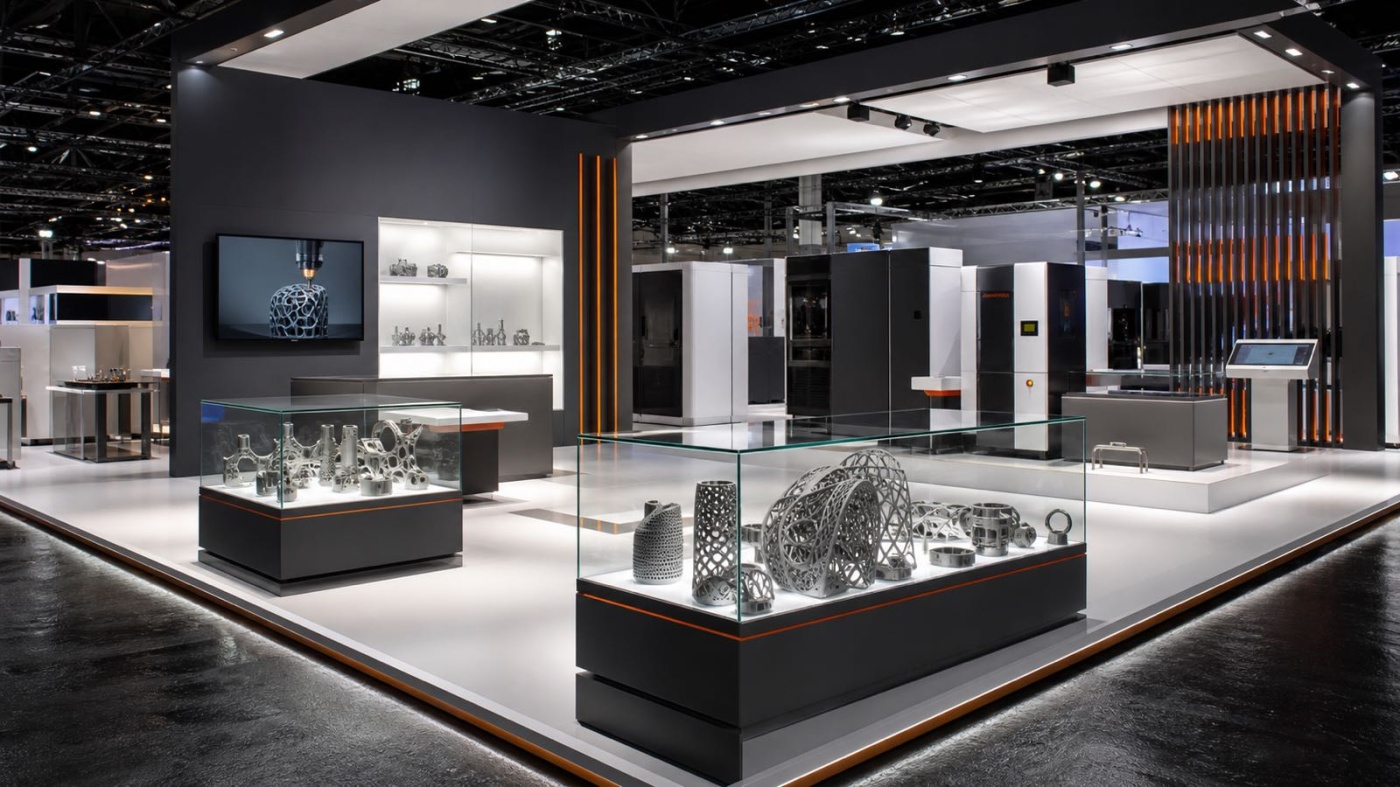
Formnext has become a fixed date for everyone who works with additive manufacturing and industrial 3D printing. Companies that exhibit here rarely show flat, brochure-style booths. They show running machines, real printed parts and complete process chains. That is exactly what makes the planning more demanding than at many other trade fairs, because production systems carry weight, need power and media, and have to be presented safely.
This guide brings together what matters most for an exhibition stand at Formnext. It describes the character of the fair, the particulars of the Frankfurt grounds with a focus on hall logistics and delivery, the technical requirements for machine exhibits, and the guidelines and deadlines you should keep in view. The aim is a factual overview that makes your preparation easier.
Formnext: the trade fair for additive manufacturing
Formnext is an international trade fair centred on additive manufacturing technologies. It takes place in Frankfurt am Main and is organised by Mesago Messe Frankfurt GmbH. According to the organiser, the coming edition is planned for 17 to 20 November 2026. The binding dates and all detailed information are published by Mesago on the official Formnext channels.
In terms of content, the fair maps the entire process chain of additive manufacturing. On display are industrial 3D printing systems for metals, plastics and ceramics, along with materials, software for design and production planning, automation solutions, and technologies for post-processing and quality assurance. The audience comes from mechanical engineering, aerospace, medical technology, automotive and tool making. For exhibitors this means an expert audience that wants to see systems in operation and to discuss technical questions in detail. A stand at Formnext is therefore rarely about looks alone. Most of the time it is a small working workshop or demonstration area.
The Frankfurt exhibition grounds at a glance
The Frankfurt grounds are large and divided into several halls. Formnext usually occupies halls in the area around the Portalhaus, often halls 11 and 12. Which halls are used in a given year is decided by the organiser. For stand planning, the hall is more than an address, because its structural parameters determine what is possible. The permitted floor load, the ceiling height and the points available for suspensions are set out in the Technical Guidelines of Messe Frankfurt for the relevant hall.
At a fair with heavy, technical exhibits in particular, logistics take centre stage. A 3D printing system is not a box you carry in. Delivery, the routes inside the hall and the final position all have to fit together. Messe Frankfurt manages traffic during build-up and dismantling through a central traffic management system, and exhibitors, stand builders and forwarding agents register their deliveries online in advance. This registration keeps access orderly and helps you avoid waiting times at the gates.
The schedule is tightly timed as well. For the coming edition, the organiser has set the build-up days for several days before the fair opens, in part around the clock, and dismantling starts right after the last day. If you need particularly long build-up time, you can apply for chargeable early build-up when your stand reaches a certain size or when you plan a double-decker. For heavy systems it pays to arrange equipment such as a forklift or crane early on with your stand builder and forwarding agent.
Media connections are another point to consider. Power, compressed air, water and data lines are fed in through the hall floor and have to be ordered from the organiser in advance. Their exact position feeds into the layout, so the machines end up where the supply is available.
Exhibition stand at Formnext: requirements for an additive manufacturing booth
The biggest difference from many other fairs lies in the weight and the operation of the exhibits. A production system quickly reaches several hundred kilograms on a small footprint. This brings floor load to the foreground. The stand floor and the hall floor beneath it have to carry the point load, and the permitted values are stated in the Technical Guidelines of Messe Frankfurt. For very heavy machines, distributing the load across the stand structure can help.
Supply is the next factor. Demonstration systems often need more power than a purely presentation-focused stand, sometimes three-phase power, plus compressed air or extraction. These needs should be settled early, because they determine both the connection order with the organiser and the cable routing within the stand. When a system runs in demonstration mode, you also have to allow for safety distances, shielding and a calm zone for operation.
Presenting the exhibits is a topic in its own right. Printed parts live off their detail, so they want to be well lit and within reach, often in display cases or on illuminated plinths. Many exhibitors add screens that show the printing process or the design data, for which the stand needs a stable data connection planned in advance.
Consultation and demo zones
Because Formnext is a working fair, the way you zone the stand strongly shapes its success. A clear division into three areas that interlock works well.
- An open demo zone where the system or the process is shown live and visitors can stop to watch.
- A quieter consultation and meeting area where detailed conversations are possible without machine noise, half-separated if needed or as a closed meeting room.
- A display area for printed sample parts that forms the transition from watching to talking.
Visitor flow follows from this arrangement. The live demo draws attention from the aisles, the sample parts invite people to come closer, and the meeting area catches concrete interest. When demonstrations are running, it helps to announce fixed times, so that the audience gathers and your stand staff can work to a plan.
Technical guidelines and deadlines
As at every Messe Frankfurt event, the Technical Guidelines are the binding basis at Formnext as well. Among other things they govern construction heights, restricted building zones, escape routes and screening walls towards neighbouring stands. For stand construction you will normally need a stand construction approval, for which you submit dimensioned stand plans with a floor plan and elevations. These plans have to reach the organiser in good time before build-up begins, and construction starts only after the approval note has been issued.
For special structures, such as double-decker stands or larger builds, Messe Frankfurt additionally requires a structural analysis that is checked by an independent body. The stand construction materials generally have to meet at least fire class B1, that is flame retardant. You should take the exact values, classes and submission deadlines from the Technical Guidelines of Messe Frankfurt in the version valid for your fair year, since details can change. The key point is lead time: approvals, the structural check and connection orders all take time, so your plans should be finalised several weeks before build-up.
An exhibition stand builder for Formnext
A stand builder who knows the procedures at Messe Frankfurt takes a large part of this organisation off your hands. From the concept through design, construction and production to logistics and assembly, the whole sequence can be steered from one team. That is an advantage precisely for technical stands with heavy systems, because stand statics, media planning and delivery all have to be coordinated with one another.
As an exhibition stand builder based in Offenbach, die trendSETZEREI GmbH is only a few minutes from the Frankfurt grounds. The short journey makes build-up, dismantling and quick adjustments during the fair easier. For the stand structure, a modular system build lends itself well, because its aluminium frames can be combined flexibly and reused for later fairs. You will find an overview of the range of services on the page about exhibition stand construction in Frankfurt.
Choosing the stand size and stand type
Beyond size, the stand type decides how your presence comes across. A row stand is open only to the aisle side and suits a focused, budget-friendly appearance. A corner stand sits on two open sides and offers more visibility. The end stand opens on three sides and already feels noticeably more present. The island stand is accessible from all four sides and gives a running system plenty of room, but it also brings higher demands on planning and budget.
At Formnext in particular, the right type is closely tied to the exhibit. A machine that should be seen working from several sides comes into its own on an end or island stand, while a row stand calls for a clear line of sight to the demonstration area. Always plan the zones for demo, consultation and sample parts together with the stand type, so that routes and sightlines are coherent. You can compare which type fits your goals using the exhibition stand types overview.
Conclusion
A successful appearance at Formnext begins long before the build-up day. When you think through hall logistics, floor load, media supply and the Technical Guidelines early, you avoid costly surprises and can concentrate at the fair on what counts: the system in operation and the conversation with expert visitors. The binding dates and requirements always come from the organiser, and everything else can be well prepared with careful planning.
If you are planning your appearance at Formnext and are looking for a partner for concept, construction and logistics, die trendSETZEREI GmbH supports you from Offenbach with a short journey to the Frankfurt grounds. You can reach us by phone on +49 69 201 65 001 and by email at info@dietrendsetzerei.de. For an initial assessment, feel free to use the contact form.