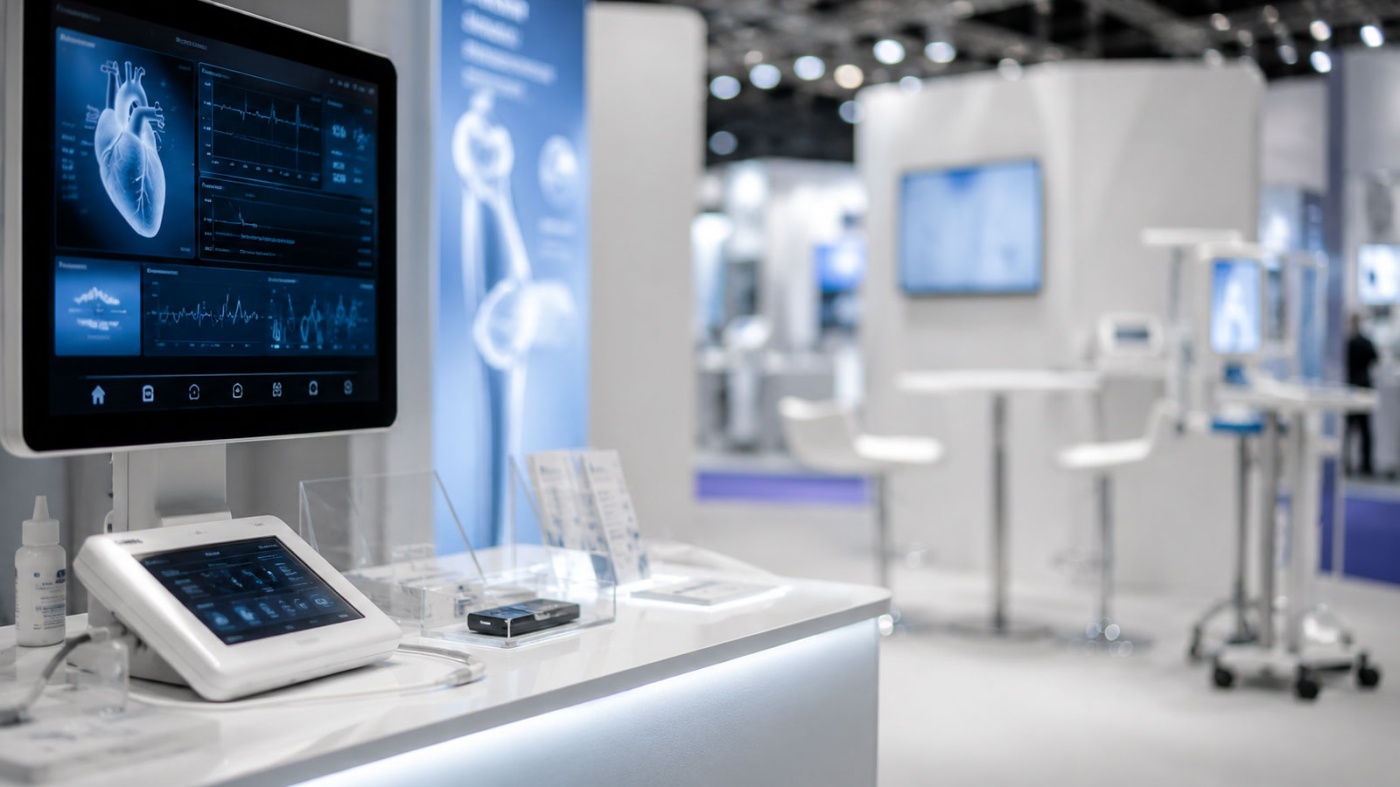
MEDICA in Düsseldorf ranks among the most important meeting points for the medical sector. For manufacturers of medical technology and for providers of diagnostics, practice supplies and digital health solutions, taking part is often the central date of the year. Whoever exhibits here meets trade visitors from hospitals, specialist retail, industry and research, over several days and from many countries.
A well thought out exhibition stand at MEDICA helps to decide whether those contacts turn into real conversations. Between dense visitor traffic, products that need explaining and a high expectation of professionalism, the stand has to do many things at once. This guide sets out, in plain terms, what medical technology exhibitors should keep in mind during planning and construction, from the exhibition grounds through the stand requirements to the technical guidelines.
MEDICA in brief (including COMPAMED)
MEDICA is an international trade fair for the medical sector and is often described as the world forum for medicine. It is organised by Messe Düsseldorf. The fair takes place every year in November and is aimed at a professional audience: doctors, hospital staff, purchasing departments, specialist retail and representatives from industry and science. The range of topics spans imaging diagnostics and laboratory technology, practice and hospital supplies, health IT and wearable devices.
Running alongside MEDICA is COMPAMED. It is the accompanying international trade fair for the supplier side of medical technology manufacturing. Here, companies present components, materials, parts and production services from which medical technology products are made. For exhibitors, the closeness of the two fairs matters, because the target groups overlap and the entire value chain of medical technology is represented in one place. If you are planning to attend, clarify early which of the two fairs fits your own positioning.
The Düsseldorf exhibition grounds
The Düsseldorf exhibition grounds sit in the north of the city on the Rhine and are divided into several halls grouped around central entrances and connecting routes. For a large international trade fair like MEDICA, many of these halls are occupied and sorted by product area. This arrangement affects where your target group moves around. For that reason, check the hall layout of the relevant edition early, so that your stand ends up where the visitors who matter to you come together.
Visitor flows spread unevenly across the show days and the individual halls. Aisles on main thoroughfares and near heavily frequented topic areas bring plenty of passing traffic, but they also call for a clear message so that your stand stays recognisable to people on the move. Quieter locations towards the edges offer more room for focused conversations in return. Both situations can be accounted for at the planning stage once the stand position is fixed early.
Getting there is another advantage of the location. The grounds are directly accessible by public transport, among other things via tram and light rail lines that connect the fair with the city centre and the main station. Düsseldorf Airport is very close by, which keeps journeys short, especially for international trade visitors and for your stand team. For the delivery of stand construction material and exhibits, separate access routes and time windows apply, which are set by the organiser. You should factor these logistics requirements into the build up and dismantling schedule so that material reaches the stand in good time.
Requirements for an exhibition stand at MEDICA in medical technology
Exhibition stands in medical technology have particular requirements that differ from many other sectors. The products often need explaining, the conversations are technical and the purchasing decisions are long term. This shapes the design of the stand from the very beginning.
The following points matter above all:
- Clear consultation and meeting zones: technical conversations need space and a degree of shielding from the aisle, so that confidential topics can be discussed without disruption.
- A serious, high quality look: materials, lighting and finish should convey trust, because visitors judge product quality by the quality of the stand.
- Space for product demonstrations: devices and applications must be shown and tried out, with suitable display areas and power and, where needed, data connections.
- Guidance under heavy footfall: the stand should take in many visitors without routes being blocked or conversations getting lost in the crush.
- A tidy, clean appearance in the spirit of hygiene: smooth surfaces, clean lines and an orderly presentation underline the sector's standards and come across as credible.
These requirements cannot be added on afterwards. They belong in the concept before the first draft exists.
Consultation and meeting zones
Because MEDICA is about professional advice, quiet zones are often the most important part of the stand. A graded layout works well: an open area for making contact at the aisle, half open meeting spots behind it and, depending on the stand size, separated meeting rooms for longer or confidential conversations. That way your team can lead interested parties to the right place according to the depth of the conversation.
When planning these zones, the balance between open approachability and quiet counts. Too much shielding comes across as closed off, too little lets focused conversations get lost in the noise. Acoustically effective elements, well considered lighting and clear circulation help to balance the two. Also plan for enough seating and a small surface for documents, so that conversations do not fail for want of somewhere to sit.
Technical guidelines and deadlines
Every stand on the Düsseldorf exhibition grounds is subject to the technical guidelines of Messe Düsseldorf. Among other things, these govern construction heights, restricted construction zones, fire protection requirements for materials, screening towards neighbouring stands and the connections for power, water and data. For structures, suspensions or two storey constructions, additional evidence may be required, such as structural calculations. Always take the specific values and conditions from the technical guidelines of the relevant edition, as they can differ from fair to fair and from year to year.
The deadlines are just as important. Dimensioned stand plans have to be submitted to the organiser for approval, and construction may only begin once that approval is granted. Connections and additional services are usually ordered up to a cut off date before the fair, and later orders can be more expensive or no longer possible. Binding dates and deadlines are published by Messe Düsseldorf through its official channels. Allow a generous lead time so that approval, orders and production mesh together without time pressure.
Exhibition stand builder for MEDICA
A stand at MEDICA does not have to be built by a local firm. trendSETZEREI GmbH is based in Offenbach am Main in the Rhine-Main region and works nationwide, so in Düsseldorf too. With our own vehicle fleet, we bring stand construction, structures and exhibits directly to the exhibition grounds, which keeps the logistics with one team and reduces interfaces.
What matters for a smooth appearance is less the distance than the organisation. Whoever knows the technical guidelines of Messe Düsseldorf, keeps an eye on the deadlines and plans the sequence of delivery, build up and dismantling cleanly can reliably deliver an appearance in Düsseldorf from Offenbach too. It makes sense to bundle the support from the first concept idea through to dismantling with one fixed point of contact. You will find details of the scope of services on the page Exhibition Stand Services.
Choosing stand size and stand form
Stand size and stand form determine how much room is left for consultation, demonstration and reception. At MEDICA, where technical conversations take centre stage, the area should be calculated fairly generously for meeting zones, rather than filling every square metre with exhibits. As a rough guide: the more your products need explaining and the longer the conversations, the more quiet zones you need.
The stand form also depends on the position in the hall. A row stand is open only towards the aisle, a corner stand towards two sides, a peninsula stand towards three sides and an island stand is accessible from all sides. More open sides mean more visibility and more visitor access, but they also call for well considered guidance so that consultation zones do not lie too exposed. Which form suits your goal is best decided on the basis of the specific stand position. An overview of the options is offered on the page Stand Types.
Conclusion
A successful appearance at MEDICA in Düsseldorf grows out of the interplay of many factors: the right position in the hall, clear consultation and meeting zones, a serious and hygienic looking design, and clean compliance with the technical guidelines and deadlines. The organiser is planning the coming edition for November 2027; the binding date is published by Messe Düsseldorf on its official channels, so please confirm it there. Whoever starts planning early has the necessary room to manoeuvre with approval, production and logistics.
If you are planning an exhibition stand for MEDICA, trendSETZEREI GmbH supports you nationwide from Offenbach, from the concept through to dismantling. Get in touch by phone on +49 69 201 65 001 or by email at info@dietrendsetzerei.de. You will find further ways to make contact on the page Contact. The official information about the fair itself is provided by the organiser on the MEDICA website.