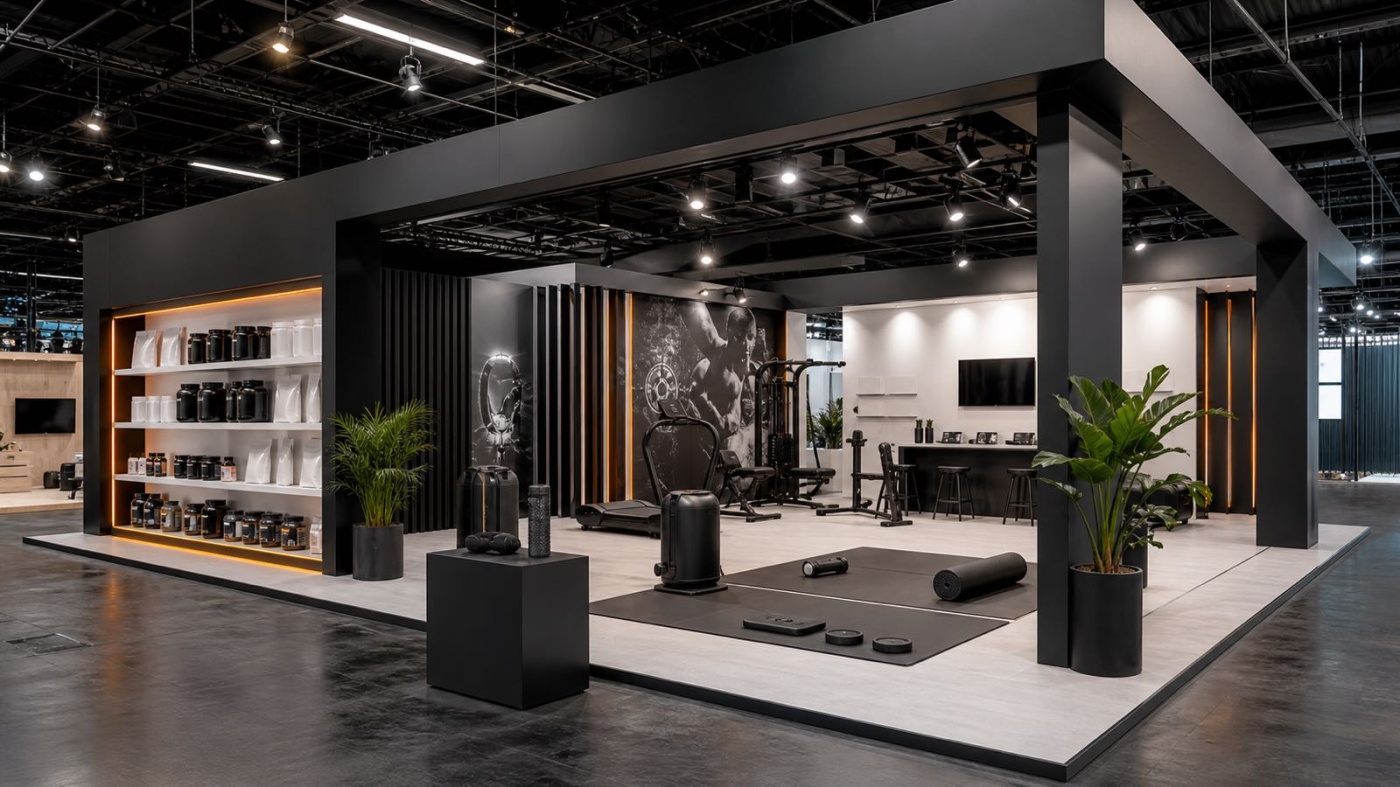
FIBO in Cologne is the world's largest trade fair for fitness, wellness and health. It brings together manufacturers of training equipment, providers from the fields of nutrition, gear and health, along with studios and brands from across the fitness sector, all in one place. If you exhibit here, you meet an active professional audience during the trade days and, on the public days, a large number of interested visitors. In this setting, the design of your stand plays a real part in deciding whether your brand stays visible in the crowd.
A well planned exhibition stand at FIBO therefore has to do more than serve as a display surface. It carries heavy equipment, offers room for demonstrations and withstands the pressure of a lively audience. This guide sorts the key points for exhibitors: the Cologne fairground, the particular stand requirements of the fitness sector, activity and experience zones, the technical guidelines with their deadlines, and the choice of stand size and stand form.
FIBO: the setting for your exhibition stand
FIBO is regarded as the leading international trade fair for the fitness and health sector and takes place every year in spring at the Cologne fairground. On show is the full spectrum of the industry, from strength and cardio machines through functional training, nutrition and supplements to studio equipment, wellness and health services. Bodybuilding, stage programmes and an extensive range of talks and hands-on activities have long been part of FIBO as well.
The fair usually distinguishes between trade days at the start and public days over the weekend, when private visitors also come onto the grounds. According to current planning, FIBO is scheduled for 8 to 11 April 2027. Because dates and opening hours can change, you should check the exact period once more on the official FIBO website before you begin planning. For your stand planning, the difference between trade and public days matters, because it shapes the expected number of visitors and therefore how robust the surface needs to be.
The Cologne fairground at a glance
The Cologne fairground lies in the Deutz district on the right bank of the Rhine and spreads across several large halls. FIBO regularly occupies a considerable share of this space, arranged by theme into areas such as equipment, nutrition, studio fit-out and the stage programme. For you as an exhibitor this means that the position inside the hall and the proximity to activity areas or main aisles have a direct effect on how many visitors reach your own stand.
One feature of FIBO is the heavy exhibits. Weight stations, free-weight areas, cardio machines and complete studio set-ups place a significant load on the stand floor. The floor load of the hall and the distribution of weight across the stand are governed by the specifications of Koelnmesse, which should be clarified before planning. If you are planning a walkable training area or a stage, build the load assumptions into the construction from the very start.
Delivery also calls for preparation. Large machines and stand material reach the halls through defined access routes and gates, and deliveries run within a tight window shared with many other exhibitors. Bulky and heavy elements often need pallet trucks, forklifts or extra helpers, whose use should be arranged in advance with the organiser. A realistic schedule for build-up and dismantling keeps delays from carrying through into the final hours before opening.
Not least, the visitor rush shapes FIBO. On the weekend days in particular, the halls fill with a very active audience that tries out equipment, joins demonstrations and moves through the aisles. A stand has to hold up to this pressure without edges, floor coverings or demonstration areas turning into a bottleneck or a safety risk.
Stand requirements for the fitness sector
A stand at FIBO is put under more strain than at many other fairs, because the goods are not only shown but actively used. These points deserve particular attention during planning:
- Floor load and structural stability: heavy training equipment and free-weight areas call for a load-bearing, level stand surface and, depending on the set-up, a tested substructure.
- Demonstration areas and activity stages: live demonstrations need clear, well defined surfaces that stay safe and stable even under intense use.
- Open, walkable stands: low thresholds and inviting access lower the barrier to trying out equipment and steer the flow of visitors across the stand.
- Visitor rush: robust materials, hard-wearing floor coverings and sufficiently wide routes cope with the high footfall on public days.
- Sound and technology: music, microphones and screens belong to demonstrations, yet should be measured and coordinated so that they support your appearance and comply with the hall rules.
If you address these requirements early, you avoid later replanning. The combination of weight, movement and crowds sets the FIBO exhibition stand clearly apart from a classic presentation stand.
Activity and experience zones
FIBO thrives on participation. Visitors want to test equipment, join a workout or try a product straight away. Activity and experience zones are therefore a central design tool for drawing attention and starting conversations. An open training area, a small stage for guided exercises or a sampling station for nutrition products turn the stand into an experience rather than a mere display.
Zones like these need careful planning. Sensible zoning separates active areas from the quieter consultation and reception space, so that demonstration and conversation can work side by side. Activity surfaces need additional room for watching visitors, non-slip floors and technology that holds up over several fair days. The routes for waiting and watching people belong in the plan too, so that the crowd at the stage does not block neighbouring stands.
Technical guidelines and deadlines
The technical guidelines of Koelnmesse apply to every stand on the Cologne fairground. Among other things, they govern construction heights, sight screens to neighbouring stands, escape routes and the requirements for materials. These specifications are binding and should be read before detailed planning begins, because they help determine the design options for the stand.
A central step is the stand construction approval. As a rule, exhibitors or their stand builder submit dimensioned stand plans with a floor plan and elevation, and construction may only begin once approval has been granted. For special constructions such as raised structures, platforms, stages or suspended elements, the organiser usually requires proof of structural stability. For fire safety, stand construction materials generally have to meet at least class B1, meaning flame retardant. Sight screens to neighbouring stands and rules on escape routes are added to this. The specific values and deadlines differ from fair to fair and from year to year, which is why the technical guidelines of Koelnmesse in force at the time are decisive and no single figure should be adopted as a blanket rule. Allow enough lead time so that approval, structural proof and connections are clarified well before build-up.
Stand builders for FIBO
An experienced stand builder accompanies your appearance from the first idea to dismantling. This includes consultation and concept work, design with 3D visualisation, production of the stand, logistics and assembly, as well as follow-up and storage. At FIBO in particular, it helps when a single point of contact considers the heavy exhibits, the demonstration areas and the technical guidelines together, rather than coordinating individual trades separately. You will find an overview of the full range of services on the exhibition stand services page.
To be clear: die trendSETZEREI GmbH is based in Offenbach am Main and works throughout Germany, which includes appearances at the Cologne fairground. An in-house fleet makes it easier to deliver heavy equipment and stand elements and to coordinate tight build-up and dismantling windows. The distance to Cologne is not an obstacle when logistics and schedule are planned in from the beginning.
Choosing stand size and stand form
The right stand form depends on your budget, your goals and the space assigned to you. A row stand is open only to the aisle side and suits a compact, focused appearance. A corner stand sits on two open sides and gains visibility and footfall as a result. A peninsula stand opens onto three sides and is well suited to demonstrations with an audience. An island stand is freely accessible from every side and offers the most room for large equipment and walkable activity areas, but it calls for a considered concept so that it works from every direction.
More than the number of square metres, zoning often makes the difference. Reception, consultation, demonstration and storage should be arranged so that visitors are guided intuitively and operations run smoothly. Which form suits your appearance is best compared against concrete examples. An overview of the common variants is provided on the stand types page.
Conclusion
A successful appearance at FIBO combines expertise with clean planning. The Cologne fairground with its large, heavily occupied halls, the heavy exhibits of the fitness sector and the lively visitor rush place particular demands on floor load, demonstration areas and robustness. If you take the technical guidelines of Koelnmesse into account early, meet the deadlines for stand construction approval and structural proof, and choose stand size and stand form deliberately, you lay the foundation for a safe and effective appearance.
If you are planning an exhibition stand for FIBO in Cologne, die trendSETZEREI GmbH supports you from concept to dismantling. Get in touch to go through the space, your goals and the schedule together. You can reach us by phone on +49 69 201 65 001 and by email at info@dietrendsetzerei.de, and you will find the contact form on the contact page.