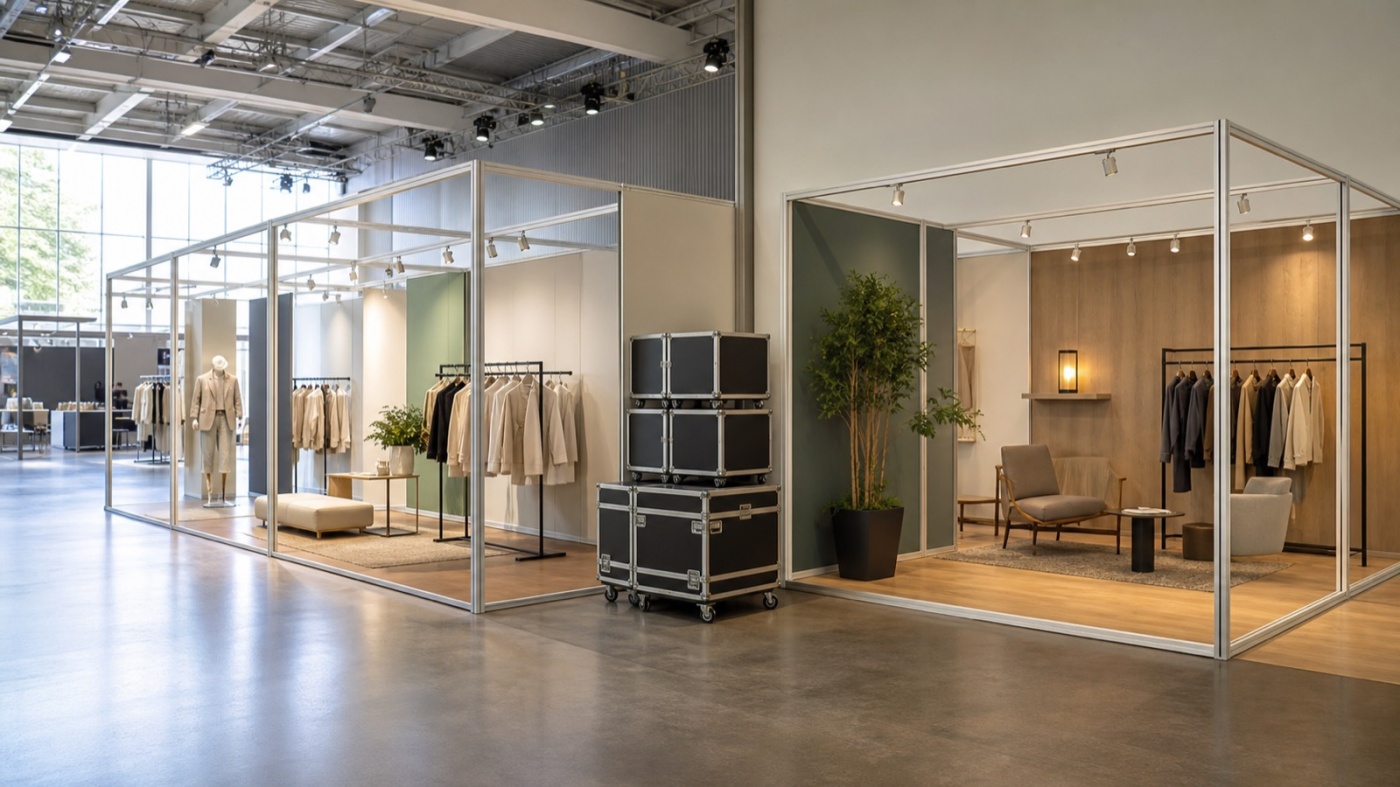
An exhibition stand works for as long as the show runs. Four days, sometimes five. Then it goes back into storage and waits for the next date in the calendar. Yet a well planned stand concept holds far more than that: enough substance for a spring roadshow, your own showroom, an in-house exhibition and a customer event at the plant. The difference lies in the planning.
A kit of parts rather than a stage set
Most appearances are planned event by event: a separate budget for every show, a fresh design for every occasion, then storage or disposal. There is another way. You define one presentation system and draw from it whatever the occasion calls for.
The gain is twofold. Your brand reads as one piece across every touchpoint, because visitors in the exhibition hall, in the showroom and in the factory see the same visual language. And the cost per use falls with every additional date, since structure, graphics and lighting are spread across several occasions. Modular system construction is what makes that calculation work over the lifetime of the stand: aluminium frames are engineered for repeated assembly, and printed textiles can be swapped without touching the structure.
Sequence matters here. Multiple use belongs in the very first concept meeting, because it shapes material choices, connection details and transport dimensions. A one-off custom build can be turned into a travelling system afterwards only with considerable effort.
The building blocks that travel well
A robust kit consists of a small number of dependable elements.
Frames and wall surfaces. Tool-free aluminium frames form walls, portals, alcoves and free-standing totems. The same profiles produce a six-metre back wall in the hall and a room divider in the showroom.
Printed textiles. Fabric graphics weigh very little, travel in a case and can be cleaned. Motifs change with the occasion, the frames stay put.
Counters, display cases, furniture. Rolling units with their own flight case stand safely on any floor.
Light. LED strips integrated into the frames travel with the stand and keep the appearance independent of a ceiling rig, which is rarely available outside an exhibition hall anyway.
Media technology. Screens on system brackets, cabling inside the profile, one central connection point.
The common thread: light, flat-packable, tool-free to assemble, repairable. Elements with those four qualities perform in a fair hall just as well as in a client's lobby.
Where the formats part company
An honest look at the limits saves time later.
Height and structure. Exhibition halls offer generous height, showrooms and foyers usually far less. Design the build-ups in stages, so the tall version stands in the hall while a lower version fits through doors, into lifts and below sprinkler systems.
Rules and regulations. Inside the hall, the technical regulations of the respective exhibition organiser apply. A customer event in a rented venue follows the building and assembly-venue rules of the federal state concerned, and your own plant adds occupational safety requirements. Demands on fire behaviour, escape routes and anchoring vary by location and by operator. Clarify them with the venue in advance rather than carrying assumptions over from the fair.
Transport. A roadshow with eight stops in ten days lives on packing dimensions that fit a van and on a build that two people complete within a few hours. That noticeably limits component sizes and weights.
Daily operation. A showroom runs all year. There, surfaces that tolerate regular cleaning matter, as do graphics that still look fresh in month twelve.
Graphics and content change, the structure stays
The occasion sets the message. At a trade fair you mostly speak to people encountering your company for the first time: large surfaces, one clear statement, one strong product image. In the showroom you welcome existing customers who bring time and appetite for detail, which allows more text, more samples, more technology. At an in-house exhibition you show breadth instead of a single highlight.
To make those switches quick, work with a graphic grid. Fix the textile formats as standing sizes and design new motifs to exactly those dimensions. A language change or a product change then becomes a print file and a parcel instead of a new build. The overview of our exhibition stand services shows which trades come together along the way, from concept to installation.
What a travelling kit asks of your warehouse
A system that goes on the road several times a year deserves care. Keep an inventory list with quantities, dimensions and condition. Hold a configuration plan for each scenario, meaning the assembly drawing for "fair, 40 square metres", "showroom" and "roadshow". After every use come a visual check, cleaning of the textiles and replacement of damaged parts.
A modest stock of spare profiles, connectors and lamps keeps the next date secure. For peaks in the calendar, top up your own inventory with rental parts: when two dates coincide or a floor space turns out larger than planned, a rented system stand closes the gap while your capital stays free.
A concept that keeps working beyond the show
The value of a stand concept becomes visible from the second use onwards. Treating frames, graphics and light as one system buys recognition, shortens build times and spreads the investment across many dates. The limits sit wherever venue, height and regulation call for their own answers, and those are exactly the points that belong on the table early.
When you plan the coming year, look at the whole calendar at once: fairs, roadshow stops, showroom and customer days together. That list is what turns into a kit of parts that fits every time. Talk the formats through before the first sketch, and the concept will carry from the very first date.