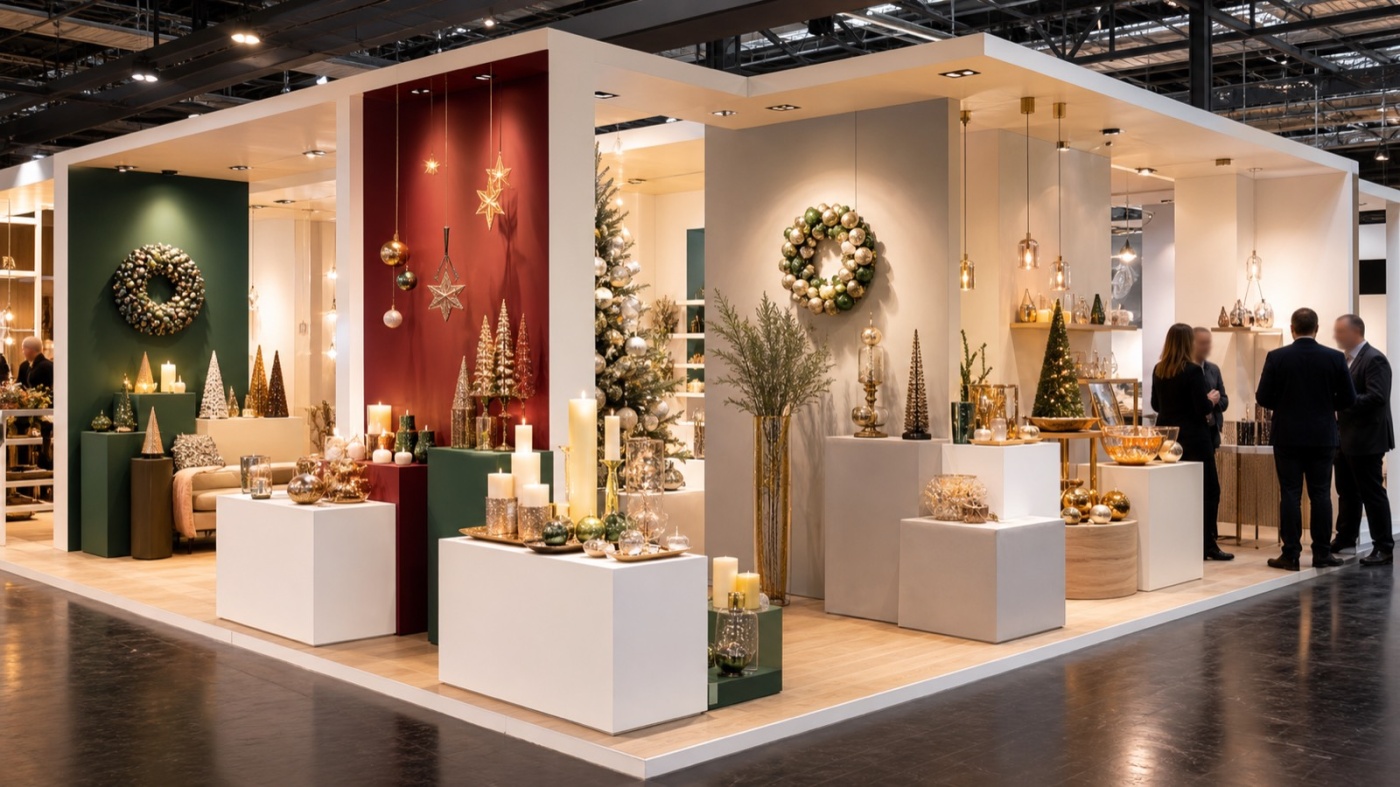
Christmas ranges are ordered a year ahead, and the appointment for that sits in Frankfurt in winter. At Christmasworld, buyers from retail, floristry and visual merchandising work their way through the entire festive year, from tree ornaments and candles to Easter decoration. At a fair that lives on the first glance, the shape of your stand carries much of the effect.
An order fair that lives on the first glance
Christmasworld runs on the Frankfurt exhibition grounds alongside Ambiente and Creativeworld and covers the full field of seasonal decoration: tree ornaments and festive decoration, candles, ribbons and packaging, party articles, florist supplies and garden decoration as well as visual merchandising and light installations. The audience arrives with a clear brief: buyers from specialist and chain retail, florists, garden centres, decoration service providers and visual merchandisers of large retail groups.
These visitors walk the halls systematically and compare at high frequency. The decision to step onto a stand happens in the aisle and takes seconds. Decoration works differently from a machine or a component: it lives on light, colour surfaces, texture and on the buyer already picturing her own shelf. How much of that reaches the aisle depends on the shape of the stand.
Four shapes are common: inline, corner, head-end and island. They differ in the number of open sides, and every open side changes the wall area left for merchandising units and back walls. Exactly this trade-off shapes the presentation at Christmasworld.
Inline and corner stands: the workhorses of the decoration halls
The inline stand opens to one aisle, has neighbours left and right and a continuous back wall behind. For decoration ranges that back wall is the valuable part, because it offers the largest continuous display surface of any stand shape. Shelf axes, themed walls and colour gradients come into their own here.
Three things pay off on an inline stand: structuring the range into a few clear colour or theme worlds instead of an evenly filled surface, one eye-catcher at eye level that carries across fifteen metres, and a consultation area at the side rather than in the middle, so the front stays open for visitors. A small storage room behind the back wall costs floor area and returns it through easy restocking of sample boxes and lasting order on the stand.
The corner stand opens to two aisles. Footfall rises, and the range splits across two axes, for example Christmas along one and all-season or spring decoration along the other. In exchange, two wall surfaces remain for display, which calls for a stricter selection. Towards the neighbouring stands the technical regulations define how dividing walls are treated, and a designed surface works far better than a plain white one.
Head-end and island stands: when a brand needs a stage
The head-end stand sits at the end of a block and opens to three sides. It carries over distance, which benefits light series, decorated trees, large objects and everything that draws attention from far away. With a single wall side remaining, free-standing display units, plinths and illuminated frames take over the task of structuring the space. A head-end stand rewards a calm material language: few colours, clear height levels, focused light on selected highlights.
The island stand is accessible from all four sides and becomes a walk-in themed world. Brands with a wide range stage complete collections here, define dedicated zones for order talks and give the appearance a centre, such as a light object, a tower or a raised platform. Planning effort rises accordingly: height zones, rigging, structural calculations and escape routes belong on the table early, and approval documents call for more lead time than an inline stand.
For exhibitors who attend Christmasworld regularly while varying the floor area, a rental system is often the most relaxed route, because frames, technology and display units recombine for each edition. Our page on how to rent an exhibition stand explains the process.
What the floor plan reveals before you book
Before committing to a shape, study the actual plot: the ratio of frontage to depth, columns in the grid, ceiling height and rigging options, floor ducts for power and water, plus the position relative to hall entrances and exits. A narrow, deep inline stand calls for a different layout than a wide, shallow one.
Then there is the Messe Frankfurt framework. The technical regulations govern construction heights, restricted building zones, escape routes and dividing walls, and dimensioned stand plans go in for approval several weeks before build-up starts. Deadlines and values change from edition to edition, so the current version stays the reference.
One topic deserves particular attention at this fair: fire safety. Textiles, branches, artificial snow, paper and ribbons here belong to the product range and to the stand design at the same time. Everything counted as stand construction is usually required to be flame retardant to class B1, and the matching certificates belong in the folder together with the materials. Our page on the exhibition stand builder in Frankfurt covers the local framework in detail.
The shape follows the range
In the end the route leads from the product to the shape and rarely the other way round. A deep range with many variants benefits from wall area, which points to inline or corner. A brand showing mood, light and scale gains from a head-end or island position. Both carry, as soon as the plot fits the story.
Dates of upcoming editions are listed in our trade fair calendar. For a first draft, your preferred hall, the square metres and a few images of your range are enough, and we clarify the rest in conversation.