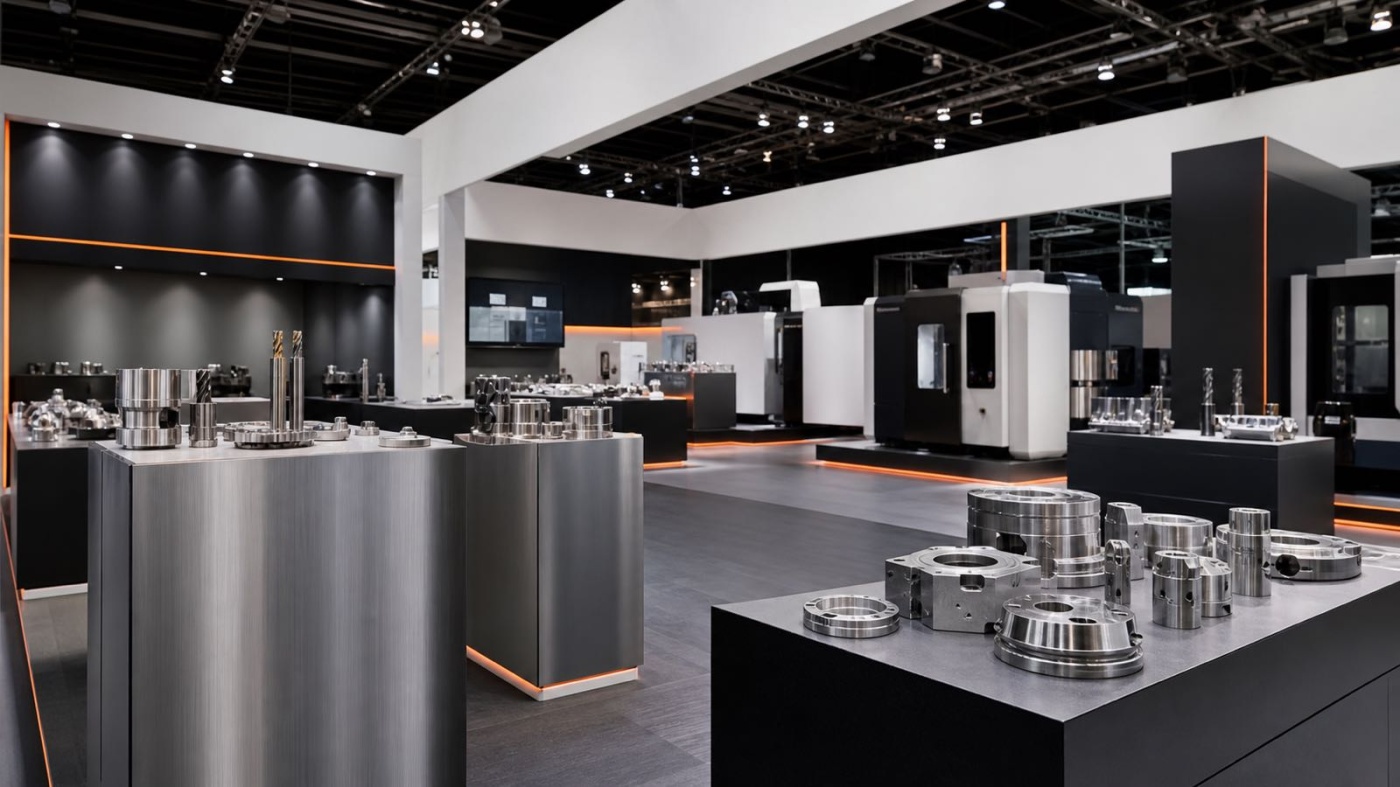
The AMB in Stuttgart is one of the leading trade fairs for metal-cutting technology. Companies that exhibit there rarely show lightweight brochure racks. They present heavy machine tools, precision tooling and complete manufacturing solutions. This places very specific demands on stand construction, from floor loads and moving the exhibits into the hall to running live demonstrations throughout the show.
This guide sets out, in factual terms, what you should keep in mind when planning an exhibition stand for the AMB. It describes the Stuttgart fairground, the technical conditions for machinery and toolmaking, the key deadlines and the question of which stand form suits your goals. Specific figures and dates change from one edition to the next, so the official sources are named at the decisive points.
The AMB: leading trade fair for metal-cutting technology
The AMB is an international exhibition for metalworking and takes place at the Stuttgart fairground on a two-year cycle. The focus is the entire metal-cutting process chain. On display are machine tools for turning and milling, precision and clamping tools, measuring and testing technology, and solutions for automation, robotics and digital manufacturing. The organiser distributes the topic areas across ten halls that are clearly structured, so that related exhibitors are located close to one another.
The AMB is a trade-only fair. Its audience consists of decision-makers, design engineers, production and maintenance specialists and technical buyers. For exhibitors this means a highly knowledgeable public that wants to see machines running and to compare technical details. The organiser plans the AMB 2026 for the middle of September, according to information from trade sources for 15 to 19 September 2026. The binding date is published by Messe Stuttgart on its official channels, where you will also find the current hall layout.
The Stuttgart fairground at a glance
The Stuttgart fairground offers around 120,000 square metres of exhibition space. Halls 3 to 9 are of identical construction and each provide about 10,500 square metres on a floor plan of roughly 150 by 70 metres, with further halls of differing dimensions in addition. For a machine stand, the delivery arrangements matter as much as the floor area itself. On the Stuttgart site, the trucks drive beneath the halls from north to south and supply the levels during the build-up, which makes moving heavy exhibits into place easier.
A few key points about the location:
- Position: directly beside Stuttgart Airport, with direct access to the A8 and A81 motorways.
- Arrival: visitors reach the grounds from Stuttgart main station in about 30 minutes by S-Bahn or light rail.
- Halls: identically built halls of around 10,500 square metres each, supplemented by larger special halls.
- Delivery: underground truck access, allowing the halls to be supplied at ground level.
The exact clear heights, floor loads, gate openings and connection points differ from hall to hall. The technical guidelines of Landesmesse Stuttgart are authoritative here. Before you design a heavy stand, you should check these values for the specific hall you have been assigned. The organiser also sets the build-up and dismantling times for each event, and these are listed in the exhibitor schedule for the AMB.
Stand requirements for machinery and toolmaking
Heavy exhibits are the central theme at the AMB. A machine tool can weigh several tonnes, and that load is distributed over a comparatively small footprint. For this reason the permitted floor load of the hall is a figure you should clarify early. The technical guidelines of Messe Stuttgart state the permitted values for each hall, and in individual halls area loads in the region of around 33 kilonewtons per square metre are documented. Whether this value applies to your hall and your point load has to be checked case by case against the current guidelines and, where necessary, agreed with the organiser.
Beyond structural questions, moving the exhibits into place matters. Very heavy machines are brought to their positions using heavy-duty rollers, a crane or a forklift, which affects access routes, gate widths and time slots during the build-up. There is also the supply of services. Machines running in demonstration mode often need high-voltage power, compressed air, sometimes water and cooling, and extraction. These connections are ordered in advance from the organiser and marked on the stand plan. Finally, safety plays a role: moving axes, hot chips and cooling lubricant must be enclosed so that neither stand personnel nor visitors are put at risk.
Demonstration and presentation areas
A stand at the AMB thrives on live operation. Many exhibitors show live machining so that trade visitors can judge machining quality, cycle time and handling first hand. Such a demonstration area needs more space than the machine itself occupies. A zone for onlookers forms around the machine, and here you should plan visitor flow so that people can watch without stepping into the working area.
Clear barriers and safety distances from moving axes are important, as is protection from chips, sparks and coolant mist, for example through screens or enclosures. Noise also deserves thought, because several machines in one hall add up. A quiet consultation zone, set slightly apart from the demonstration area, helps to hold sales conversations at a reasonable volume. For the technical preparation of the demonstration you should also allow time during the build-up, so that the machine is set up and tested before the first day of the fair.
Technical guidelines and deadlines
Every stand requires stand construction approval. As a rule, exhibitors or their stand builder submit dimensioned stand plans with a floor plan and elevations to the organiser, and construction begins only after clearance. For special constructions, tall structures or a double-decker stand, the fair additionally requires structural verification. For the materials used, fire protection class B1, meaning flame-retardant, usually applies as a minimum. Sight screens towards neighbouring stands and compliance with escape routes are also governed by the guidelines.
Lead time is decisive. Approvals, structural checks and the ordering of connections take time, and the deadlines often fall several weeks before the start of the build-up. The specific deadlines, construction heights and requirements differ from one fair and one edition to the next. Only the technical guidelines of Landesmesse Stuttgart in their currently valid version are binding. You should read these documents early and plan the dates backwards from the build-up, so that no approval becomes a bottleneck.
A stand builder for your AMB exhibition stand
A suitable partner covers the entire chain, from the concept through design and 3D visualisation to production, logistics, assembly and dismantling after the fair. With a machine stand in particular, coordinating stand construction, structural work and service supply is demanding, which is why a single point of contact and a clear area of responsibility are helpful. You can find an overview of the scope of services, from consultation to follow-up, at exhibition stand services.
Honesty belongs here. The trendSETZEREI GmbH is based in Offenbach am Main in the Rhine-Main region and works throughout Germany, including in Stuttgart. We do not claim to be based on site. Our own fleet and logistics as a fixed part of the service ensure that stand components and heavy exhibits reach Stuttgart and return in a predictable way. The journey to Stuttgart is possible directly by motorway, and the underground delivery of the fairground makes moving exhibits in easier. For the AMB this means the distance is a matter of good logistics planning, not an obstacle.
Choosing stand size and stand form
Stand size and stand form determine how your presence works in the hall and how many sides are open. A row stand is open only towards the aisle and suits compact appearances. A corner stand sits on a corner and is open on two sides, which brings more footfall. A head-end stand at the end of a row opens onto three sides. An island stand stands free and is accessible from all sides, which offers advantages precisely for large machines with live demonstrations, because visitors find room all around.
When zoning the stand, you divide it into areas: an open space for the machine and the demonstration, a consultation zone for conversations and, as required, a small storage or technical area. The stand form should suit the number and size of the exhibits, not the other way round. You can find an overview of the options and their typical uses at exhibition stand types. For the AMB it is worth fixing the stand form early, because it influences the structural work, moving in the exhibits and visitor flow.
Conclusion
A successful appearance at the AMB does not arise from an attractive design alone. It comes from coordinating floor load, moving in the exhibits, service supply and safety with the technical guidelines of Messe Stuttgart, and from a realistic timetable for approvals and build-up. If you clarify these points early and use the official specifications for the AMB and the fairground, you plan far more calmly. A good starting point is the official AMB page of Messe Stuttgart.
If you are planning your exhibition stand for the AMB in Stuttgart and are looking for a partner for concept, construction and logistics from one team, get in touch with us. You can reach the trendSETZEREI GmbH by phone on +49 69 201 65 001 and by email at info@dietrendsetzerei.de. Further ways to work together and an enquiry form can be found on the contact page.