Cabins get negotiated where aircraft are built: every spring, Aircraft Interiors Expo brings airlines, cabin integrators and suppliers to Hamburg. For most suppliers, though, that date is one of several across the year. And this is exactly where the way a stand is built decides the budget for the next twelve months.
An audience that looks underneath the seat shell
Aircraft Interiors Expo takes place annually in April at the Hamburg Messe grounds, organised by RX. AIX occupies halls B1 to B7, while the World Travel Catering & Onboard Services Expo runs alongside in halls A1, A2 and A4; one badge covers both. The Passenger Experience Conference opens the week the day before, and the Crystal Cabin Awards are presented during the show. The most recent edition brought together around 460 exhibitors and more than 12,000 participants.
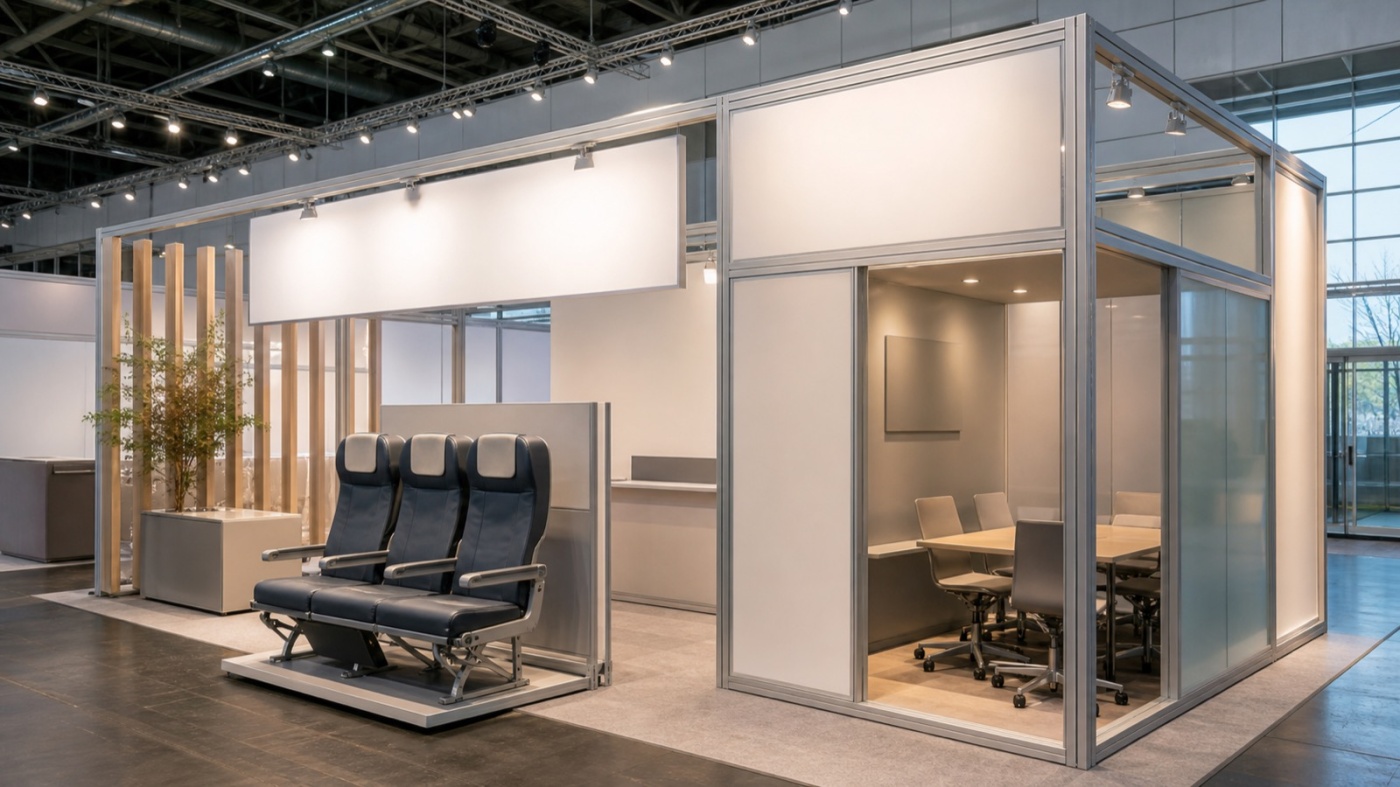
The audience is compact and exceptionally qualified: cabin managers from airlines, design teams, procurement, OEM and MRO representatives, lessors. These visitors sit down in the seat, check the stitching, fold out the table and look underneath the shell. They ask about weight, fire behaviour, the certification route and lead times. The resulting stand profile differs from most industrial fairs: generous exhibit space for mock-ups and seat rows, material samples to touch, and a striking number of closed meeting rooms, because cabin projects are negotiated in confidence. Second storeys are correspondingly common.
Hamburg adds a characteristic of its own: the exhibition grounds sit in the middle of the city. Manoeuvring and parking space is limited and deliveries follow tight time windows. A construction method that arrives in calculable load units and assembles quickly pays off twice over here.
Why a cabin supplier's show year rarely ends in Hamburg
Companies supplying seat components, textiles, lightweight parts, lighting or cabin electronics usually appear several times a year: at AIX in Hamburg as the industry meeting point, plus airshows, MRO and interiors events, regional conferences and customer days hosted by their own clients. Stand sizes vary considerably. Hamburg calls for a presence with a mock-up and a meeting room; three months later a mid-sized corner stand does the job; in autumn a compact in-line stand at a conference exhibition follows.
Three separate builds for three dates tie up budget, storage space and energy. A kit of parts that assembles into all three appearances turns that arithmetic around.
One kit, three appearances
Modular stand construction means the stand grows out of a defined stock of components rather than a one-off structure. The basis is a grid dimension, usually an aluminium frame system that accepts fabric graphics, solid panels, LED tiles, doors and shelving without tools. trendSETZEREI works with Aluvision as a system partner.
In practice:
- Same components, different shape. The same frames form an island stand in Hamburg, a peninsula stand in summer and an in-line stand in autumn. The walls change their arrangement while their dimensions stay.
- Graphics as the wearing part. Fabric skins carry the message and change per show or campaign. They are the most affordable element of the stand and the most visible one.
- Digital surfaces instead of new builds. LED tiles from stock display different content each time, from a cabin animation to the current certification status.
- Height on demand. A system stand extends to a second level where the floor space allows it and stays single-storey where hall rules point the other way.
- Rent what you use once. Anything needed for a single show, a special display case or additional furniture, comes in as a rental. How that works out commercially is covered in our guide to renting an exhibition stand.
What carries a system stand through the year
A kit of parts creates value through the organisation behind it. Five points decide.
A component register. Every element is recorded with dimensions, condition and location. That makes it possible to check on screen whether the next floor plan works from stock.
Orderly storage. Between shows, components sit dry, sorted and documented. trendSETZEREI uses a digitalised warehouse in which every part stays traceable.
Inspection after every dismantling. Frames are checked for distortion, fabrics cleaned, electrics tested. The stand returns to storage repaired and starts the next show as good as on day one.
Artwork templates per format. Each recurring stand size has its own data set with bleed and safety margins. New visuals therefore go into production quickly.
An annual plan instead of single projects. Looking at the show year as a whole allows graphics production, transport and staffing to be scheduled sensibly and spares you duplicated effort.
Commercially, this shifts the cost curve. The first investment exceeds that of a simple single-use build; from the second and third appearance onwards, cost per show drops clearly, because transport, assembly and graphics carry most of it. How the individual items add up is explained under exhibition stand cost.
The side effect suits aviation requirements neatly: reuse can be documented. Components running for several years generate less waste per appearance, and that ratio increasingly appears in sustainability reporting. According to its own figures, trendSETZEREI returns up to 85 percent of the materials it uses to the cycle.
From a single date to a considered show year
Aircraft Interiors Expo deserves a carefully planned appearance, because the Hamburg audience looks closely and because decisions taken there run for years. The bigger lever, though, sits one level above: in deciding whether the stand stays a three-day project or becomes the platform for an entire show year.
Upcoming editions are listed in our trade fair calendar. If you are planning several appearances a year and want to know how much of that can come from one kit, we are glad to go through your date list with you.