Once the last visitor has left, the longest phase in the life of an exhibition stand begins: its time in storage. What happens there decides how good the stand looks at the next show and how much of it you carry forward. A look at the months between two appearances.
Dismantling sets up the next build
Dismantling happens under pressure. The teardown window is tight, the hall gets loud, and everybody wants to head home. This is exactly where the damage appears that shows up six months later.
A clean teardown follows the same logic as the build, in reverse. Graphics come off first, while there is still room to handle them. Textiles are released and folded loosely rather than stuffed. Electrics, power supplies and lighting go into their own padded cases. Only then does the structure come down.
Two habits pay off more than any others. First, every part returns to the exact case it came from, and the packing list gets ticked off. Second, anyone who spots damage during teardown labels the part immediately and takes a photograph. Those thirty seconds save half an hour of searching later and keep a bent profile from surfacing on the next build day.
Packaging deserves its own line in the plan. Sturdy flight cases, edge protection and labelled lids cost money once and last for many shows. Improvised cardboard costs substance on every journey.
Inbound inspection: condition is established in the warehouse
At the warehouse the stand gets unpacked rather than merely parked. It sounds like effort, and it removes precisely the surprises that turn expensive on build day.
Inbound inspection runs in four steps. Parts are cleaned, aluminium wiped down, timber edges and lacquered faces reviewed, textiles washed or sent out for cleaning. A visual check of every position against the packing list follows: complete, functional, ready to look good. Step three covers electrics, since portable electrical equipment is subject to recurring testing under German accident prevention rules, with intervals set by the operator on the basis of a risk assessment. Further requirements for stand technology sit in the technical regulations of each show.
Step four is documentation. Every finding lands in the inspection record with a photograph and a decision attached: clean, repair, replace. That builds a history which brings clarity to the next budget conversation.
Storing it well: climate, packaging, inventory
An exhibition stand handles storage well as long as three conditions hold: dry, temperature-stable and low in dust. Moisture is the quiet opponent, warping timber panels, leaving marks on textiles and attacking contacts. A hall with a steady indoor climate preserves condition for years.
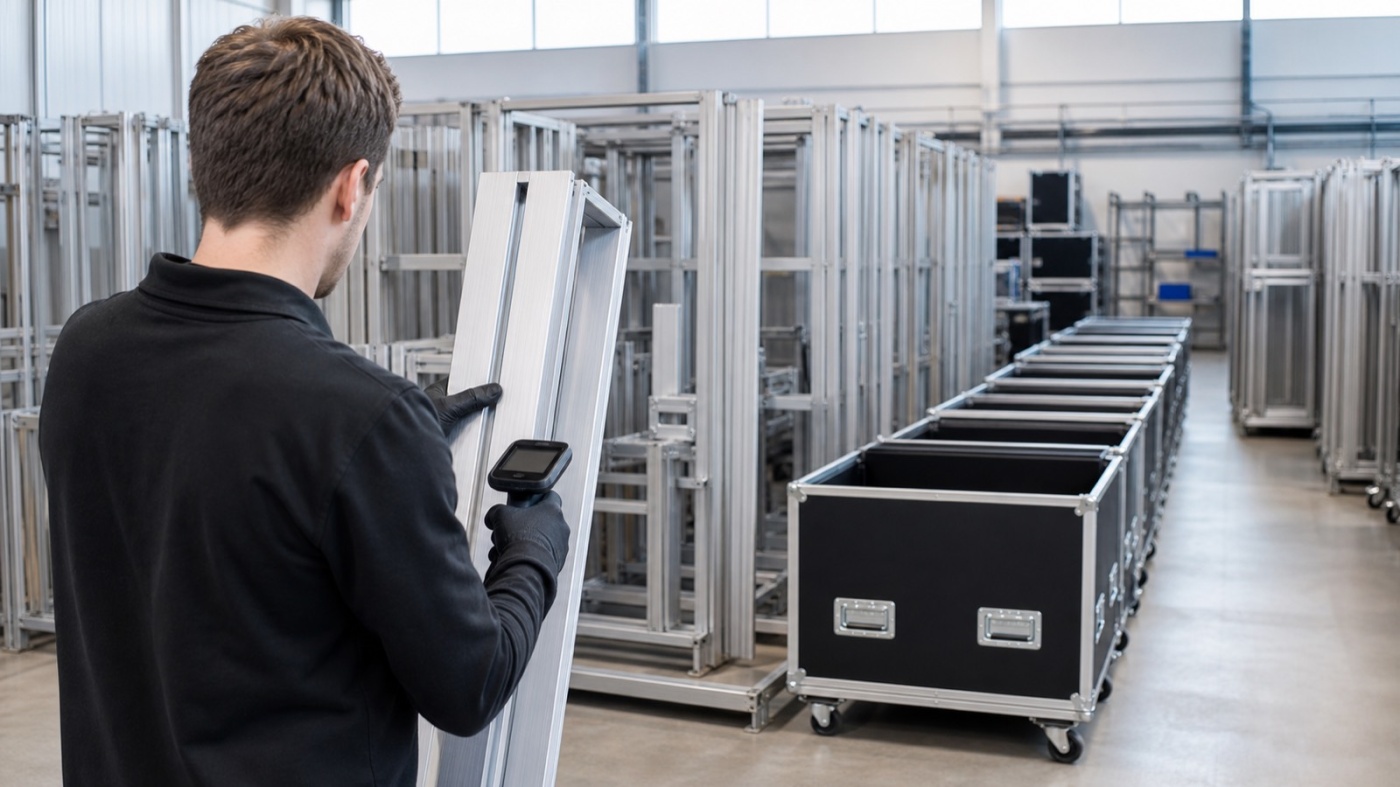
Individual materials come with clear habits. Aluminium frames stand in racks rather than stacked, so nothing bows. Directly printed panels lie flat with interleaving, textile graphics travel washed and folded or rolled on a core. LED tiles and monitors stay in their original cases, while batteries are stored separately and charged.
The inventory makes the biggest difference of all. A digitised warehouse records every component with a photograph, dimensions, condition, storage location and customer allocation. That lets the next show be planned on screen: what exists, what fits the new footprint, what gets added. This is how our own warehouse runs, and the effect shows most clearly in how quickly a quotation comes together.
Costs are usually based on occupied volume or on pallet spaces and run as a monthly rate. Compare that against the alternative of building the stand fresh for every show, because at two appearances a year the arithmetic tends to be clear.
Keeping spare parts and wear under control
Wear hits the same small components every time: clamps and tension levers, silicone welt, hinges, castors, power supplies, lamps and cables. They cost little, and on build day they decide between two calm hours and two hectic ones.
Keep a basic stock ready. A case with the twenty most common small parts travels along on every build and gets refilled after every show. System stands add a second advantage, since profiles, frames and accessories can be reordered from the manufacturer at any time in identical finish and colour.
Custom-made parts take the workshop route instead. A scratched lacquer face is sanded and resprayed, a knocked edge filled, a veneer patch replaced. The rule of thumb: repair for as long as the surface afterwards still looks worthy of the brand. Once several repairs remain visible, a new component is the better investment.
From the old footprint to the new one
Hardly any exhibitor receives exactly the same footprint twice. Forty square metres in a row become sixty on a corner, the hall changes, and the main approach suddenly comes from the other side. Modular construction exists for precisely this.
When replanning, the skeleton stays and gets recombined. Wall modules form a different outline, plinths move, the counter turns towards the new open side. Three things usually get added: individual modules for the larger area, graphics cut to the new geometry and occasionally one new piece of furniture.
The best moment for that round comes early, right after the stand confirmation arrives. Put the hall plan next to the warehouse inventory and start with what already exists. The list of items to produce follows from there, and the workshop gains breathing room. Our trade fair calendar shows which dates come into question, and the steps from storage through to reuse are set out in our services.
A stand that is stored with care is still a good stand after five shows. If you would like to move your existing stand onto its next footprint, get in touch. A look at the inventory list and the hall plan is usually enough for a first assessment.